
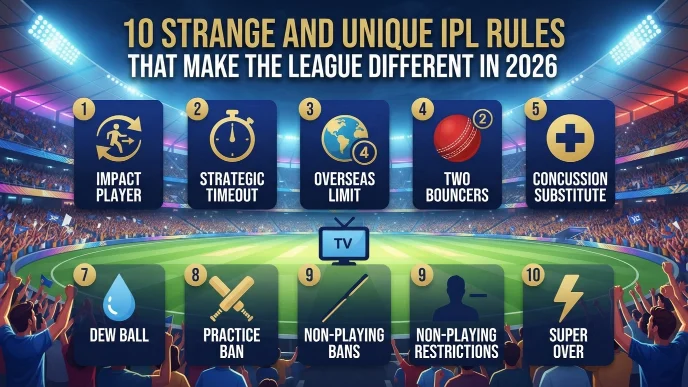

The Indian Premier League (IPL) has several strange and unique rules that make it different from other cricket leagues. These 10 unique IPL rules for 2026 include the Impact Player substitution, strategic timeouts, a maximum of four overseas players, two bouncers per over, concussion substitutes, DRS for wides and no-balls, a dew-based ball change rule, match-day practice bans, strict non-playing player restrictions, and the Super Over tie-breaker.
Cricket is a sport built on tradition, but the Indian Premier League has never been afraid to rewrite the rulebook. Since its inception in 2008, the IPL has introduced regulations that you simply won’t find anywhere else in the cricketing world. Some are designed to enhance entertainment, others to protect player welfare, and a few might leave you scratching your heart.
The 2026 season brings even more layers to this complex rulebook. From the much-debated Impact Player to the newly tightened restrictions on non-playing squad members, these 10 strange and unique IPL rules that make the league different in 2026 showcase why this tournament remains cricket’s most innovative and occasionally controversial competition.
The Impact Player Rule Cricket’s 12th Man
- What It Is: Teams can substitute one player from their starting XI at any point during the match, effectively playing with 12 players.
- How It Works: Captains name five substitutes before the toss. The Impact Player can be introduced at natural breaks between overs, at wickets, or during strategic timeouts.
- Why It’s Strange: No other major cricket league allows in-match substitutions for tactical reasons. Traditionalists argue it diminishes the all-rounder’s role.
- 2026 Update: The rule remains in place until at least 2027, despite widespread criticism from captains and former players.
Strategic Timeout The Commercial Break
- What It Is: Two mandatory 150-second breaks per innings one for the batting side (overs 7-9) and one for the fielding side (overs 13-16).
- Why It’s Strange: No other cricket league has scheduled commercial breaks mid-innings. Critics argue it disrupts momentum and lengthens matches unnecessarily.
- The Controversy: In 2026, Sunil Gavaskar criticized teams for exploiting these breaks, with timeouts often stretching beyond the allotted 2.5 minutes.
The Overseas Player Limit – Only Four Allowed
- What It Is: No team can field more than four overseas players in their starting XI.
- Why It’s Strange: Most T20 leagues allow more overseas players. The IPL restricts foreign talent to protect Indian players’ development.
- 2026 Auction Twist: Overseas players now have a salary cap of ₹18 crore any bid above this goes to the BCCI’s player welfare fund.
Two Bouncers Per Over
- What It Is: Bowlers are allowed a maximum of two short-pitched deliveries (above shoulder height) per over.
- Why It’s Strange: International cricket generally allows one bouncer per over. The IPL gives bowlers an extra weapon or an extra risk of being hit for six.
- 2026 Clarification: The rule was a major discussion point at the captains’ meeting, with umpires strictly enforcing the limit.
Concussion Substitute The Medical Wildcard
- What It Is: If a player suffers a head or neck injury, they can be replaced by a “like-for-like” substitute.
- Why It’s Strange: The “like-for-like” clause is subjective and has sparked controversy. In 2026, Mumbai Indians replaced Mitchell Santner (a spinner) with Shardul Thakur (a fast bowler) a decision that divided opinion.
- Key Rule: The replacement must be approved by the Match Referee based on medical diagnosis.
DRS for Wides and No-Balls
- What It Is: Teams can now use DRS to review wide and no-ball calls.
- Why It’s Strange: Traditional cricket limits DRS to dismissals. The IPL expanded it to include umpiring decisions on illegal deliveries.
- 2026 Update: Batters have only 15 seconds to request a review for a wide.
The Dew Ball Change Rule
- What It Is: In evening matches, the fielding captain can request a ball change after the 10th over of the second innings if dew makes gripping difficult.
- Why It’s Strange: The rule applies only to night games and only in the second innings a concession to the unique challenges of Indian conditions.
- 2026 Change: The ball change is now mandatory if requested after the 10th over.
Match-Day Practice Ban
- What It Is: Teams are prohibited from conducting any formal practice sessions on match days.
- Why It’s Strange: Most leagues allow light training. The IPL bans it entirely to preserve pitch quality.
- Additional Restrictions: Each team gets only two practice nets that cannot be shared. Practice sessions are capped at 3.5 hours.
Non-Playing Player Restrictions
- What It Is: Only the 16 players named in the match-day squad (11 playing + 5 substitutes) can remain near the boundary. Other squad members must stay in the dugout.
- Why It’s Strange: Non-playing players can no longer carry drinks or messages onto the field a duty traditionally performed by squad members.
- 2026 Update: A maximum of five players in bibs can be active around the boundary rope at any time.
The Super Over – Infinite Cricket
- What It Is: If scores are tied, a Super Over decides the winner. If that’s tied, another Super Over is played and another, until a winner emerges.
- Why It’s Strange: Most leagues limit Super Overs to one. The IPL allows multiple, potentially creating cricket’s version of a penalty shootout that never ends.
- Play off Exception: All play off matches, including the final, must be decided by Super Over if tied or rained out.
IPL 2026 Unique Rules at a Glance
| Rule | Year Introduced | Purpose | Uniqueness Factor |
| Impact Player | 2023 | Tactical flexibility | Only major league with in-match tactical subs |
| Strategic Timeout | 2009 | Commercial breaks | Only cricket with scheduled mid-innings breaks |
| Overseas Limit (4) | 2008 | Protect Indian talent | Stricter than most T20 leagues |
| Two Bouncers | 2018 | More attacking cricket | Double the international limit |
| Concussion Substitute | 2019 | Player safety | Subjective “like-for-like” clause |
| DRS for Wides | 2024 | Umpiring accuracy | Expanded beyond traditional DRS |
| Dew Ball Change | 2025 | Night match fairness | Condition-specific rule |
| Match-Day Practice Ban | 2026 | Pitch preservation | Unique to IPL |
| Non-Playing Restrictions | 2026 | Match-day discipline | Newest operational rule |
| Multiple Super Overs | 2008 | Decisive results | Can continue indefinitely |
FAQs
1. What is the Impact Player rule in IPL 2026?
The Impact Player rule allows teams to substitute one player from their starting XI at any point during the match. Teams nominate five substitutes before the toss and can introduce one at a natural break. The rule remains in place until at least 2027, despite criticism that it reduces the value of all-rounders.
2. Why does IPL have strategic timeouts?
Strategic timeouts are 150-second breaks one per innings for each side designed for commercial broadcasting. The batting side calls theirs between overs 7-9, and the fielding side between overs 13-16. No other major cricket league has scheduled mid-innings commercial breaks.
3. How many overseas players can play in an IPL match?
A maximum of four overseas players can be in the starting XI, and no more than four can be on the field at any time. Teams can have up to eight overseas players in their overall squad but cannot field more than four in a match.
4. How many bouncers are allowed per over in IPL?
Bowlers are allowed a maximum of two bouncers (deliveries above shoulder height) per over in the IPL. This is double the international limit of one bouncer per over. Bowling a third bouncer results in a no-ball.
5. What is the concussion substitute rule in IPL?
If a player sustains a head or neck injury, they can be replaced by a “like-for-like” substitute approved by the Match Referee. The rule aims to protect player welfare but has sparked controversy over what constitutes “like-for-like.”
6. Can teams review wides and no-balls using DRS?
Yes, IPL teams can use DRS to review wide and no-ball calls. Batters have 15 seconds to request a review for a wide. This expansion of DRS beyond traditional dismissals is unique to the IPL.
7. What is the dew ball change rule in IPL 2026?
In evening matches, the fielding captain can request a ball change after the 10th over of the second innings if dew makes gripping difficult. The umpires must change the ball upon request. This rule applies only to night games and only in the second innings.
8. Can players practice on match days in IPL?
No. IPL teams are prohibited from conducting any formal practice sessions on the day of a match. This rule was introduced to preserve pitch quality. Teams are also limited to a maximum of two warm-up matches before the season.
9. What are the new non-playing player restrictions in IPL 2026?
Only the 16 players named in the match-day squad can remain near the boundary. Non-playing squad members cannot carry drinks or messages onto the field. A maximum of five players in bibs can be active around the boundary rope at any time.
10. What happens if an IPL match is tied?
If scores are tied, a Super Over is played. If the Super Over is also tied, additional Super Overs are played until a winner is determined. Playoff matches, including the final, must also be decided by Super Over if tied or affected by rain.
CONCLUSION
The Indian Premier League has never been just another cricket tournament. It’s a spectacle, a business, and an ongoing experiment in what the sport can become. The 10 strange and unique IPL rules that make the league different in 2026 are evidence of this relentless innovation.
Some rules like the Impact Player and strategic timeouts prioritize entertainment and commercial appeal. Others like the concussion substitute and match-day practice bans focus on player welfare and pitch preservation. A few, like the overseas player limit and the dew ball change, are pragmatic responses to the unique challenges of Indian cricket.
What makes these rules truly fascinating is how they shape the game itself. The Impact Player has changed team composition, making all-rounders less valuable and specialists more sought-after. The two-bouncer rule has given fast bowlers more attacking options. The dew rule has altered captaincy strategies in night matches.
Love them or hate them, these rules make the IPL unpredictable, exciting, and unmistakably unique. As the tournament continues to evolve, one thing is certain: the rulebook will keep growing, and cricket fans will keep debating. That’s the beauty of the IPL it’s never afraid to ask, “What if ?