
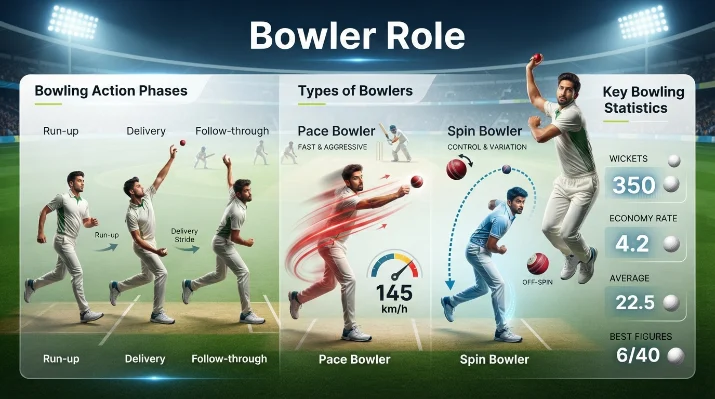

A bowler in cricket is a player who delivers the ball toward the batsman’s stumps with the primary goal of taking wickets or restricting runs. Bowlers are broadly classified into pace bowlers, who rely on speed and movement, and spin bowlers, who use rotation to deceive batsmen. Each delivery is part of a six-ball over, and bowlers must use a straight-arm action any elbow extension beyond 15 degrees is illegal.
The bowler’s role is central to the fielding side’s strategy, supported by fielders positioned according to the bowling style and match situation. Great bowlers combine technical skill, tactical awareness, and adaptability to conditions.
Cricket is a game of glorious uncertainties, and at the heart of every contest stands the bowler the player who holds the power to change a match in a single delivery. Whether it’s the raw pace of a 150 km/h thunderbolt or the subtle deception of a spinning delivery that turns sharply off the pitch, the bowler role is arguably the most influential position in the game.
Bowling is not merely about hurling the ball toward the stumps; it is an art form that demands precision, strategy, and an intimate understanding of the game’s nuances. A bowler must read the pitch, assess the batsman’s weaknesses, adapt to weather conditions, and execute deliveries with pinpoint accuracy all while managing the physical demands of their action.
Understanding the bowler role is essential for anyone who wants to truly appreciate cricket. From the thunderous pace of a fast bowler to the guile of a wily spinner, each bowler brings a unique skill set that shapes the ebb and flow of the game. This guide explores everything you need to know about the bowler role in cricket from the different types of bowlers to the techniques, rules, and strategies that define this fascinating position.
What Is a Bowler in Cricket?
A bowler is a player in a cricket team who specialises in delivering the ball toward the batsman’s stumps. Unlike a baseball pitcher, a cricket bowler must deliver the ball with a straight arm the elbow cannot straighten by more than 15 degrees during the bowling action. This rule ensures that the ball is “bowled” rather than “thrown.”
The bowler is supported by 10 fielders, and together they form the bowling side’s defensive unit. The primary objectives of a bowler are twofold:
- Take wickets dismiss batsmen by hitting the stumps, inducing edges, or trapping them LBW
- Restrict runs bowl economically to prevent the batting side from scoring freely
A bowler who can also bat competently is known as an all-rounder. Bowling requires a specific biomechanical action that can be broken down into seven phases: grip, approach, bound, delivery stride, back foot contact, front foot contact, point of release, and follow through.
Types of Bowlers in Cricket
Bowlers are broadly divided into two main categories: pace bowlers and spin bowlers
Pace Bowlers (Fast Bowlers)
Pace bowlers rely primarily on speed to defeat batsmen. They take a long run-up to build momentum and can deliver the ball at speeds exceeding 145 km/h. The fastest recorded delivery in cricket history is 161.3 km/h (100.23 mph), bowled by Shoaib Akhtar of Pakistan.
Pace bowlers are further classified by their average bowling speed:
| Category | Speed Range |
| Fast | Over 142 km/h |
| Fast-medium | 130–141 km/h |
| Medium-fast | 120–129 km/h |
| Medium pace | 96–119 km/h |
| Slow pace | Below 96 km/h |
Variations Used by Pace Bowlers:
- Swing bowling making the ball curve in the air by using the seam and polishing one side of the ball
- Seam bowling landing the ball on its seam to create unpredictable bounce
- Bouncer a short-pitched delivery aimed at the batsman’s chest or head
- Slower ball a deliberately slower delivery to deceive the batsman
- Reverse swing swing achieved with an older, roughened ball
Spin Bowlers
Spin bowlers bowl at a slower pace but rely on rotating the ball to make it deviate off the pitch. The spin causes the ball to bounce at an angle, forcing batsmen to play carefully.
Spin bowling is divided into two main types based on how the spin is generated
| Type | Method | Common Names |
| Wrist spin | Using the wrist to impart spin | Leg spinner (right-arm), Chinaman (left-arm) |
| Finger spin | Using the fingers to impart spin | Off-spinner (right-arm), Left-arm orthodox |
Spin Bowling Variations:
- Off-spin the ball turns from left to right for a right-arm bowler
- Leg-spin the ball turns from right to left for a right-arm bowler
- Googly a leg-spinner’s delivery that spins in the opposite direction
- Doosra an off-spinner’s delivery that spins the opposite way
- Flipper a back-spin delivery that keeps low after bouncing
- Top spinner a delivery that dips and kicks forward after bouncing
- Arm ball a delivery that goes straight on with the arm
The Bowling Action Step by Step
A proper bowling action is essential for accuracy, pace, and injury prevention. The bowling action consists of several distinct phases:
- Grip how the bowler holds the ball, which varies based on the type of delivery
- Approach (Run-up) the motion before delivering the ball; fast bowlers use longer run-ups to build momentum, while spinners often have shorter run-ups
- Bound the pre-delivery stride that sets up the delivery
- Delivery stride the final strides before release
- Back foot contact when the back foot lands on the crease
- Front foot contact when the front foot lands; the bowler must have part of the front foot behind the popping crease to avoid a no-ball
- Point of release the moment the ball is let go
- Follow through the continuation of movement after release to maintain balance
Key principles apply to all bowling actions: balance, consistency, and keeping the head still and upright. Medium pace and quick bowlers typically use a straight approach aligned toward the target, while spin bowlers tend to have more varied approaches.
Bowling Rules and Regulations
Several rules govern bowling in cricket:
| Rule | Description |
| Legal delivery | The ball must be bowled, not thrown or jerked |
| Arm straightness | Elbow extension cannot exceed 15 degrees |
| Front foot | Part of the front foot must be behind the popping crease at delivery |
| Over | A set of six legal deliveries |
| No consecutive overs | A bowler cannot bowl two overs in a row |
| Over limits | In limited-overs cricket, a bowler is limited to 20% of total overs |
| No-ball | Called for illegal deliveries; batting side gets one extra run |
| Wide | Called if the ball is out of the batsman’s reach |
Bowling Strategies and Field Placements
The bowler’s effectiveness depends heavily on the field placements chosen by the captain. Field positions are arranged based on:
- The type of bowler (pace or spin)
- The batsman’s strengths and weaknesses
- The condition of the pitch
- The match situation
Common attacking fields for pace bowlers include slips and a gully to catch edges. Containment fields spread fielders to cut off scoring shots. For spin bowlers, close-in fielders like short leg and leg slip are common to catch defensive shots.
The captain and bowler work together to set fields that complement the bowling style and create wicket-taking opportunities.
Bowling Statistics Measuring Performance
Bowlers are evaluated using several key statistics
| Statistic | Definition |
| Bowling average | Runs conceded per wicket taken |
| Economy rate | Runs conceded per over bowled |
| Strike rate | Balls bowled per wicket taken |
| Wickets | Total number of batsmen dismissed |
| Five-wicket haul | Taking five or more wickets in an innings |
| Maiden over | An over in which no runs are scored |
Greatest Bowlers in Cricket History
Cricket history features many legendary bowlers who have redefined the art of bowling:
| Bowler | Country | Type | Notable Achievement |
| Muttiah Muralitharan | Sri Lanka | Off-spin | 1,347 international wickets the most in history |
| Shane Warne | Australia | Leg-spin | 1,001 international wickets; revolutionized leg-spin |
| James Anderson | England | Fast-medium | 975+ international wickets; most by a fast bowler |
| Anil Kumble | India | Leg-spin | 956 international wickets |
| Wasim Akram | Pakistan | Left-arm fast | Master of swing bowling; ranked best ODI bowler |
| Shoaib Akhtar | Pakistan | Fast | Bowled the fastest delivery ever at 161.3 km/h |
Common Mistakes Made by Bowlers
Even experienced bowlers can fall into bad habits:
- Overstepping the crease bowling a no-ball by crossing the popping crease
- Inconsistent line and length giving batsmen easy scoring opportunities
- Telegraphing variations revealing the type of delivery through changes in action
- Losing rhythm breaking the natural flow of the run-up
- Failing to adapt continuing the same plan when conditions or batsmen change
How to Improve as a Bowler
For aspiring bowlers, here are key areas to focus on:
- Master the basics perfect your grip, run-up, and release point
- Develop a stock delivery have one reliable delivery you can bowl consistently
- Add variations learn 2–3 variations to keep batsmen guessing
- Study batsmen understand their weaknesses and preferred scoring areas
- Work on fitness bowling requires stamina, especially in longer formats
- Practice accuracy use target bowling drills to improve line and length
- Watch the greats study footage of legendary bowlers to learn technique and strategy
FAQs
1. What is the main role of a bowler in cricket?
The bowler’s primary role is to deliver the ball toward the batsman’s stumps with the aim of taking wickets (dismissing batsmen) or restricting run-scoring opportunities. Bowlers work with fielders to create pressure and force mistakes from the batting side.2. How many types of bowlers are there in cricket?
There are two broad categories: pace bowlers and spin bowlers. Pace bowlers rely on speed and are further classified as fast, fast-medium, medium-fast, or medium pace. Spin bowlers rely on rotation and are divided into wrist spinners and finger spinners.3. What is the difference between a fast bowler and a spin bowler?
Fast bowlers rely on speed (often over 142 km/h) and use a long run-up to generate momentum. Spin bowlers bowl much slower but impart rotation on the ball, causing it to deviate off the pitch. Each type has different strengths and is effective in different conditions.4. Can a bowler bowl consecutive overs in cricket?
No, a bowler cannot bowl two overs in a row. After completing an over of six deliveries, another bowler must bowl from the opposite end of the pitch. This rule applies in all formats of the game.5. What is a no-ball in cricket?
A no-ball is an illegal delivery called by the umpire. Common reasons include the bowler’s front foot crossing the popping crease, the ball being bowled above waist height, or the bowling arm being bent beyond 15 degrees. The batting side receives one extra run.6. What is swing bowling?
Swing bowling is a technique used by pace bowlers to make the ball curve in the air. It’s achieved by polishing one side of the ball while allowing the other to become roughened, creating differing airflow that causes the ball to swing toward the roughened side.7. Who is the fastest bowler in cricket history?
Shoaib Akhtar of Pakistan holds the record for the fastest delivery in cricket history at 161.3 km/h (100.23 mph), bowled against England in the 2003 Cricket World Cup. Other famously fast bowlers include Brett Lee and Mitchell Starc.8. What is a maiden over in cricket?
A maiden over is an over in which no runs are scored off the bowler’s deliveries. It is considered a significant achievement as it builds pressure on the batting side and can lead to wickets in subsequent overs.9. What is the difference between off-spin and leg-spin?
Off-spin is bowled by right-arm finger spinners and turns the ball from left to right. Leg-spin is bowled by right-arm wrist spinners and turns the ball from right to left. Both have different variations and are effective against different types of batsmen.10. How many overs can a bowler bowl in a limited-overs match?
In limited-overs cricket, a bowler is restricted to bowling a maximum of 20% of the total overs in the innings. For example, in a 50-over match, a bowler can bowl a maximum of 10 overs; in a T20 match, the maximum is 4 overs.
CONCLUSION
The bowler role in cricket is one of the most demanding and influential positions in any sport. It requires a rare combination of physical athleticism, technical precision, tactical intelligence, and mental fortitude. Whether generating raw pace, mastering the art of swing, or deceiving batsmen with flight and turn, bowlers are the primary architects of victory on the cricket field.
Understanding the bowler role enriches one’s appreciation of the game. Every delivery tells a story a battle of wits between bowler and batsman, shaped by conditions, field placements, and split-second decisions. From the thunderous pace of Shoaib Akhtar to the magical spin of Shane Warne, bowlers have provided some of cricket’s most unforgettable moments.
For aspiring cricketers, mastering the bowler role is a journey of continuous learning and improvement. The fundamentals grip, run-up, release, follow-throughare just the beginning. The true art lies in reading the game, adapting to conditions, and outthinking the opposition.
As cricket continues to evolve with new formats and innovations, the bowler role remains as vital as ever. Whether you’re a player looking to improve your bowling or a fan seeking deeper understanding, the bowler’s craft offers endless fascination. After all, in cricket, as in life, it’s often the bowler who holds the key to changing the game.