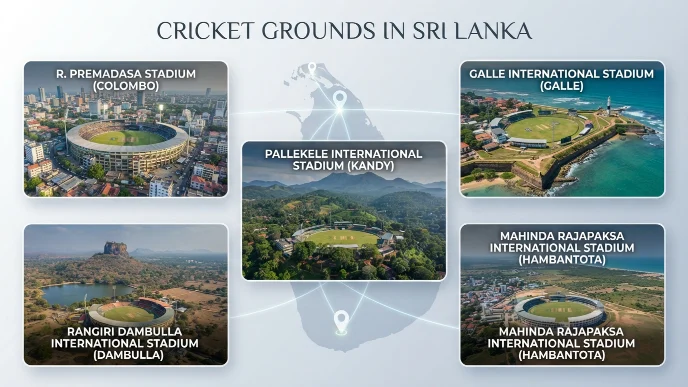

Sri Lanka has ten international cricket grounds, with seven having hosted Test matches. The R. Premadasa Stadium in Colombo is the largest with a capacity of 38,000, while the Galle International Stadium is renowned as one of the world’s most picturesque venues, situated near the historic Galle Fort with the Indian Ocean visible on two sides. The country’s cricket grounds in Sri Lanka include modern facilities like Pallekele International Stadium (2009) and Mahinda Rajapaksa Stadium (2009), alongside historic venues such as the Sinhalese Sports Club Ground (1952) and Asgiriya Stadium (1915).
Cricket is more than just a sport in Sri Lanka it’s a national obsession that unites the island’s diverse communities. The cricket grounds in Sri Lanka tell the story of this passion, from the colonial-era venues that witnessed the birth of the game to the state-of-the-art stadiums built for global tournaments.
The island nation boasts an impressive array of cricket stadiums, each with its own unique character and history. Some sit by the ocean with breathtaking views, others are nestled in the hills of Kandy, and a few stand in the heart of the bustling capital, Colombo.
Whether you’re a cricket fan planning a pilgrimage to watch a match, a traveller exploring the country’s sporting heritage, or simply curious about these iconic venues, this guide covers everything you need to know about Sri Lanka’s cricket grounds.
Overview of Cricket in Sri Lanka
Sri Lanka has ten grounds that have been used to host international cricket matches, and seven of them have hosted Test matches. The country’s love affair with cricket dates back to the British colonial era, and today, Sri Lanka is a respected cricketing nation with a passionate fan base and world-class venues.
The island’s cricket grounds are remarkably diverse from the ocean-side Galle International Stadium to the hill-country Asgiriya Stadium and the modern arenas built for the 2011 Cricket World Cup. Each venue offers a distinct experience for players and spectators alike.
Complete List of International Cricket Grounds in Sri Lanka
| Stadium | Location | Established | Capacity | Test Status |
| R. Premadasa Stadium | Colombo | 1986 | 38,000 | Yes |
| Galle International Stadium | Galle | 1876 | 35,000 | Yes |
| Pallekele International Stadium | Kandy | 2009 | 35,000 | Yes |
| Mahinda Rajapaksa International Stadium | Hambantota | 2009 | 35,000 | No (ODI/T20I) |
| Rangiri Dambulla International Stadium | Dambulla | 2000 | 16,800 | No (ODI/T20I) |
| Sinhalese Sports Club Ground | Colombo | 1952 | 10,000 | Yes |
| Asgiriya Stadium | Kandy | 1915 | 10,300 | Yes (no longer used) |
| P. Sara Oval (Saravanamuttu Stadium) | Colombo | 1982 | 15,000 | Yes |
| Colombo Cricket Club Ground | Colombo | 1984 | 6,000 | Yes (no longer used) |
| Welagedara Stadium | Kurunegala | 1953 | 10,000 | No |
| Tyronne Fernando Stadium | Moratuwa | 1952 | 15,000 | No (no longer used) |
R. Premadasa Stadium — Colombo
The R. Premadasa Stadium, formerly known as the Khettarama Stadium until June 1994, is the largest stadium in Sri Lanka with a capacity of 38,000 spectators. Located on Khettarama Road in the Maligawatta suburb of Colombo, it is considered the “home of Sri Lankan cricket”.
Key Features:
- Established: 1986
- End Names: Khettarama End, Maligawatte End
- Owner: Sri Lanka Cricket
Historic Matches:
The stadium has hosted numerous iconic matches, including the 2012 ICC World Twenty20 final between Sri Lanka and West Indies, the 2002 ICC Champions Trophy final, and the first semi-final of the 2011 ICC Cricket World Cup.
Perhaps the most remarkable moment in the stadium’s history came in 1997 when Sri Lanka scored 952 runs for 6 wickets against India the highest Test score ever recorded.
Galle International Stadium — Galle
The Galle International Stadium is widely regarded as one of the most picturesque cricket grounds in the world. Situated near the historic Galle Fort, the stadium is fringed on two sides by the Indian Ocean, offering breathtaking views.
Key Features:
- Established: 1876 (originally as The Esplanade)
- Capacity: 35,000
- End Names: City End, Fort End
- Area: 4.216 hectares
Tsunami and Rebuilding:
The stadium was completely destroyed by the 2004 Indian Ocean tsunami but was rebuilt and hosted international matches again in 2007. The view from the press box is among the most breathtaking in Sri Lanka, with the 17th-century Dutch Fort providing a stunning backdrop.
Pallekele International Cricket Stadium — Kandy
The Pallekele International Cricket Stadium, also known as the Muttiah Muralitharan International Cricket Stadium, is one of Sri Lanka’s newest venues. Located near the historic city of Kandy, it was specially built to replace the Asgiriya Stadium, which hosted Test matches from 1983 to 2007.
Key Features:
- Established: 2009
- Capacity: 35,000
- End Names: Hunnasgiriya End, Rikillagaskada End
- Playing Area: 80 m long, 75 m wide
- Flood Lights: Yes (installed in 2010)
The stadium was constructed for the 2011 Cricket World Cup, which Sri Lanka jointly hosted with India and Bangladesh.
Rangiri Dambulla International Stadium — Dambulla
The Rangiri Dambulla International Stadium is situated in the North Central Province, close to Dambulla an agricultural trading town famous for its ancient UNESCO-protected Buddhist Cave Temples dating back to 85 B.C.
Key Features:
- Established: 2000
- Capacity: 16,800 (approx)
- End Names: Press Box End, Scoreboard End
- Flood Lights: Yes
Construction History:
The 30,000-seater stadium was constructed in just 167 days, with the inaugural ODI match played between Sri Lanka and England in March 2000. However, the venue was later starved of international cricket due to complications with the lease the 60-acre site was leased from the Rangiri Dambulla Temple. International cricket finally returned in May 2003.
Pitch Conditions:
The pitch is bowler-friendly for seamers in the morning due to the high water table and heavy sweating, and for spinners in the afternoon when the pitch can crumble.
Mahinda Rajapaksa International Cricket Stadium — Hambantota
Located in Sooriyawewa, Hambantota, this stadium was also built for the 2011 Cricket World Cup.
Key Features:
- Established: 2009
- Capacity: 35,000
- Playing Area: 100 m long, 100 m wide
- End Names: Thanamalwila End, Sooriyawewa End
- Flood Lights: Yes (installed in 2010)
- Curator: Ravi Dissanayake
Sinhalese Sports Club Ground — Colombo
The Sinhalese Sports Club Ground, also known as Maitland Place, is the headquarters of Sri Lankan cricket.
Key Features:
- Established: 1952
- Capacity: 10,000
- End Names: Tennis Courts End, South End
- Flood Lights: Yes
The ground hosted Sri Lanka’s second Test match and has been the venue for numerous historic encounters, including the match where Sri Lanka scored 756-5d against South Africa in 2006.
Asgiriya Stadium — Kandy
The Asgiriya Stadium is unique in world cricket it is the only Test ground owned by a secondary-level school, Trinity College.
Key Features:
- Established: 1915
- Capacity: 10,300
- End Names: Hunnasgiriya End, Hanthana End
- Flood Lights: No
Asgiriya hosted Test matches from 1983 to 2007 before being replaced by Pallekele International Stadium. It is no longer used for international matches but remains active for domestic and school cricket.
P. Sara Oval (Paikiasothy Saravanamuttu Stadium) — Colombo
The P. Sara Oval holds a special place in Sri Lankan cricket history it hosted Sri Lanka’s first-ever Test match against England in 1982.
Key Features:
- Established: 1982
- Capacity: 15,000
- Also Known As: Colombo Oval, P. Saravanamuttu Stadium
The ground is also historical as the venue where Sri Lanka registered their first Test victory. It is smaller in size than other Test grounds in Sri Lanka.
Colombo Cricket Club Ground — Colombo
The Colombo Cricket Club Ground is one of the smaller cricket grounds in Sri Lanka.
Key Features:
- Established: 1984
- Capacity: 6,000
- End Names: Press Box End, Pavilion End
The ground is the third clustered around Maitland Place, alongside the SSC and Nondescripts. It held three Tests in the 1980s and still hosts touring sides in warm-up matches.
Welagedara Stadium — Kurunegala
Located at the foot of Ethagala (Elephant Rock) in Kurunegala, the Welagedara Stadium is a multi-use venue.
Key Features:
- Established: 1953
- Capacity: 10,000
- End Names: City End, Swimming Pool End
- Home Team: Kurunegala Youth Cricket Club
The stadium can accommodate at least 10,000 spectators, who can find shade beneath the thick foliage that surrounds the ground.
Tyronne Fernando Stadium — Moratuwa
The Tyronne Fernando Stadium, also known as De Soysa International Cricket Stadium, is located in Moratuwa, southwestern Sri Lanka.
Key Features:
- Established: 1952
- Capacity: 15,000
- End Names: Press Box End, Katubadda End
- Also Known As: Moratuwa Stadium, De Zoysa Stadium
Stadium Comparison Table
| Feature | R. Premadasa | Galle | Pallekele | Dambulla | Hambantota |
| Location | Colombo | Galle | Kandy | Dambulla | Hambantota |
| Capacity | 38,000 | 35,000 | 35,000 | 16,800 | 35,000 |
| Test Status | Yes | Yes | Yes | No | No |
| Established | 1986 | 1876 | 2009 | 2000 | 2009 |
| Flood Lights | Yes | No | Yes | Yes | Yes |
| Unique Feature | Highest Test score (952) | Ocean views | Replaced Asgiriya | Built in 167 days | Built for 2011 WC |
FAQs
1. How many cricket grounds are there in Sri Lanka?
Sri Lanka has ten grounds that have been used to host international cricket matches. Seven of these have hosted Test matches. However, the Colombo Cricket Club Ground, Asgiriya Stadium, and Tyronne Fernando Stadium are no longer used for international matches, though they still host domestic and warm-up games.
2. What is the biggest cricket stadium in Sri Lanka?
The R. Premadasa Stadium in Colombo is the largest cricket stadium in Sri Lanka, with a capacity of 38,000 spectators. It is known as the “home of Sri Lankan cricket” and has hosted numerous major international tournaments, including the 2012 ICC World Twenty20 final.
3. Which is the most beautiful cricket ground in Sri Lanka?
The Galle International Stadium is widely regarded as one of the most picturesque cricket grounds in the world. Situated near the historic Galle Fort, the stadium is fringed on two sides by the Indian Ocean, offering breathtaking views.
4. When was Galle International Stadium rebuilt?
The Galle International Stadium was completely destroyed by the 2004 Indian Ocean tsunami. It was rebuilt and hosted international matches again in 2007. The reconstruction preserved the stadium’s stunning location near the Galle Fort.
5. What is the oldest cricket ground in Sri Lanka?
The Galle International Stadium, originally known as The Esplanade, was established in 1876, making it the oldest cricket ground in Sri Lanka. The Asgiriya Stadium in Kandy, established in 1915, is another historic venue.
6. How many stadiums were built for the 2011 Cricket World Cup in Sri Lanka?
Two new cricket grounds were constructed in Sri Lanka for the 2011 Cricket World Cup: the Pallekele International Cricket Stadium in Kandy and the Mahinda Rajapaksa International Cricket Stadium in Hambantota. Sri Lanka co-hosted the tournament with India and Bangladesh.
7. What is the capacity of Rangiri Dambulla International Stadium?
The Rangiri Dambulla International Stadium has a capacity of approximately 16,800 spectators. It was constructed in just 167 days and hosted its inaugural ODI match between Sri Lanka and England in March 2000.
8. Which stadium holds the record for the highest Test score?
The R. Premadasa Stadium in Colombo is where Sri Lanka scored 952 runs for 6 wickets against India in 1997 the highest Test score in cricket history.
9. Is Asgiriya Stadium still used for international cricket?
No, Asgiriya Stadium is no longer used for international matches. It was replaced by the Pallekele International Cricket Stadium in 2009. However, it remains active for domestic and school cricket matches.
10. Which ground hosted Sri Lanka’s first-ever Test match?
The P. Sara Oval (Paikiasothy Saravanamuttu Stadium) in Colombo hosted Sri Lanka’s first-ever Test match against England in 1982. It was also the venue where Sri Lanka registered their first Test victory.
CONCLUSION
Sri Lanka’s cricket grounds are more than just sporting venues they are living monuments to the nation’s cricketing heritage and cultural identity. From the ocean-side beauty of Galle International Stadium to the electric atmosphere of Colombo’s R. Premadasa Stadium, each ground tells a unique story of triumphs, heartbreaks, and unforgettable moments.
The island’s stadiums have witnessed cricketing history from Sri Lanka’s first Test match at P. Sara Oval in 1982 to the record-breaking 952 runs at R. Premadasa Stadium in 1997. They have hosted World Cup matches, welcomed the world’s greatest players, and provided the backdrop for Sri Lanka’s rise as a cricketing powerhouse.
Modern venues like Pallekele and Hambantota represent the country’s ambitions, while historic grounds like Asgiriya and Galle preserve the soul of the game. Whether you’re planning to visit these stadiums or simply appreciate their significance, understanding Sri Lanka’s cricket grounds offers a window into the heart of a cricket-obsessed nation.