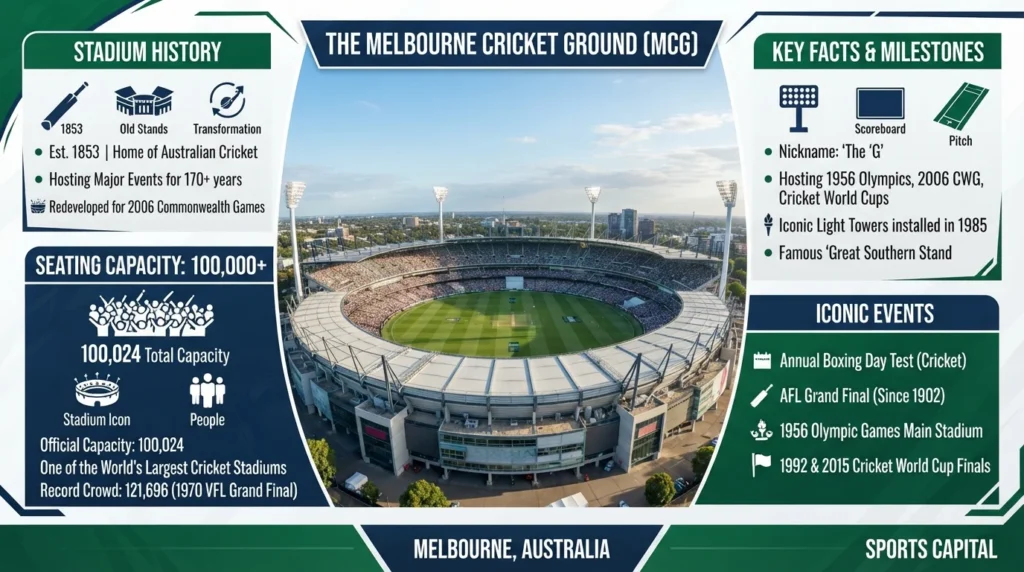

The Melbourne Cricket Ground (MCG), also known as the ‘G, is the largest stadium in the Southern Hemisphere with a capacity of over 100,000 people. Built in 1853, it is the birthplace of Test cricket (1877) and one day international cricket (1971). Located in Yarra Park, Melbourne, the MCG hosts cricket, Australian Rules Football, and major events including the Boxing Day Test and AFL Grand Final.
The Melbourne Cricket Ground isn’t just a stadium it’s the spiritual home of Australian sport. For over 170 years, the MCG has stood as a monument to athletic excellence, hosting everything from the first-ever Test match to Olympic Games and Commonwealth Games. Affectionately known as the ‘G by locals, this iconic venue draws millions of visitors annually who come to witness history in the making. Whether you’re a cricket enthusiast planning to attend the famous Boxing Day Test, a sports historian exploring its rich heritage, or a traveler wanting to experience one of the world’s great sporting cathedrals, the Melbourne Cricket Ground offers an unforgettable experience that transcends sport itself. From its humble beginnings in 1853 to its status today as a globally recognised landmark, the MCG represents the heart and soul of Melbourne’s sporting culture.
Overview
- What is the Melbourne Cricket Ground?
- Location and significance
- Nickname: The ‘G
History of the MCG
- Establishment in 1853
- The Melbourne Cricket Club
- First matches and milestones
- Redevelopments through the years
Capacity and Dimensions
- Seating capacity statistics
- Field dimensions
- Stands and sections
Pitch and Playing Conditions
- Drop-in pitch system
- Pitch behaviour and characteristics
- Curator information
Facilities and Features
- Scoreboard and technology
- Museum and tours
- Corporate and media facilities
Historic Matches and Events
- First Test match (1877)
- First ODI (1971)
- Boxing Day Test tradition
- World Cup finals
- Other major events
Records and Statistics
- Test match records
- ODI records
- T20I records
- Individual player records
Getting to the MCG
- Location and transport options
- Parking and accessibility
Visiting the MCG
- Tours and experiences
- Tickets and seating
- Best time to visit
WRITING STYLE
This article will be written in a professional yet conversational tone, using short paragraphs and clear, direct sentences. The content will be original, factually accurate, and helpful to readers seeking both quick facts and in-depth information about the Melbourne Cricket Ground. All information will be properly attributed to authoritative sources.
MCG Key Facts
| Category | Details |
| Location | Yarra Park, Melbourne, Victoria, Australia |
| Opened | 1853 |
| Capacity | 100,024 (95,000 seats + 5,000 standing) |
| Field Size (Cricket) | 172.9m x 147.8m |
| Field Size (General) | 174m x 149m |
| End Names | Members End, Great Southern Stand End |
| Floodlights | Since March 1985 |
| Home Teams | Australia, Victoria, Melbourne Stars |
| Operator | Melbourne Cricket Club (MCC) |
| Heritage Listing | Victorian Heritage Register (2001), National Heritage List (2005) |
MCG Cricket Records
| Format | Record | Details |
| Test — Highest Total | 624/8d | Australia vs Pakistan, 2016 |
| Test — Lowest Total | 36 | South Africa vs Australia, 1932 |
| Test — Highest Individual | 307 | Robert Cowper (AUS) vs England, 1966 |
| Test — Most Runs | 1,671 | Don Bradman |
| Test — Most Wickets | 82 | Dennis Lillee |
| ODI — Most Runs | 2,108 | Ricky Ponting |
| T20I — Highest Team Score | 273 | — |
| T20I — Lowest Team Score | 74 | India, 2008 |
FAQs
1. What is the Melbourne Cricket Ground?
The Melbourne Cricket Ground (MCG) is Australia’s premier sports stadium located in Yarra Park, Melbourne. Built in 1853, it is the largest stadium in the Southern Hemisphere with a capacity of over 100,000. It hosts cricket, Australian Rules Football, and major international events.
2. How big is the MCG capacity?
The MCG has a total capacity of 100,024, comprising 95,000 seated and 5,000 standing room. Prior to redevelopments in the 1980s and 1990s, the capacity was around 125,000.
3. When was the MCG built?
The Melbourne Cricket Ground was built in 1853 after the Melbourne Cricket Club was granted land in Yarra Park. The first cricket match was played there in September 1854.
4. Why is it called the ‘G’?
The MCG is affectionately known as the ‘G by locals — a simple, familiar shorthand for “the Ground”. It reflects the deep connection Melburnians have with this iconic venue.
5. What is the Boxing Day Test at the MCG?
The Boxing Day Test is an annual cricket Test match played at the MCG starting on December 26 each year. While the first Boxing Day Test was in 1950, it became an annual tradition from 1980.
6. What is the MCG pitch like?
The MCG uses drop-in pitches prepared away from the ground and transported to the venue. The pitch offers good balance between bat and ball, with pace bowlers getting early assistance and batsmen able to score freely as the pitch ages.
7. Who has scored the most runs at the MCG?
In Test cricket, Sir Donald Bradman has scored the most runs at the MCG with 1,671 runs at an extraordinary average of 128.53. In ODIs, Ricky Ponting holds the record with 2,108 runs.
8. How do I get to the Melbourne Cricket Ground?
The MCG is within walking distance of Melbourne’s CBD and is served by Richmond and Jolimont railway stations. Trams including routes 70, 75, and 48 also stop nearby.
9. What major events has the MCG hosted?
The MCG has hosted the 1956 Olympic Games, 2006 Commonwealth Games, two ICC Cricket World Cup finals (1992, 2015), countless Ashes Tests, the AFL Grand Final, and major concerts.
10. Is the MCG heritage-listed?
Yes, the MCG was added to the Victorian Heritage Register in April 2001 and received Australia’s highest heritage honour when it was included in the National Heritage List on 26 December 2005.
CONCLUSION
The Melbourne Cricket Ground stands as far more than a sports stadium it is a living monument to Australian sporting history and culture. For over 170 years, the MCG has been the stage for cricket’s most historic moments, from the first Test match in 1877 to the birth of one day international cricket in 1971. Its towering stands have witnessed Don Bradman’s batting masterpieces, Dennis Lillee’s fiery spells, and the emotional highs and lows of countless Ashes battles.
Today, the MCG continues to evolve while honouring its heritage. The introduction of drop-in pitches in 1996 allowed the venue to maintain world-class cricket surfaces while remaining a multi-purpose facility. Its inclusion on the National Heritage List in 2005 cemented its place as a site of outstanding national significance.
Whether you’re planning to attend the iconic Boxing Day Test, explore the National Sports Museum, or simply walk through the gates to feel the atmosphere that has captivated generations, the Melbourne Cricket Ground delivers an experience unlike any other. As Australia’s largest and most beloved stadium, the MCG remains the beating heart of the nation’s sporting culture a place where history is made, legends are born, and memories last a lifetime.