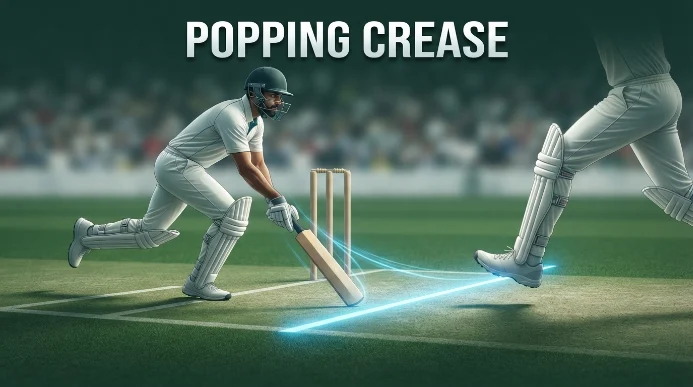

The popping crease is a critical line on a cricket pitch, positioned 4 feet (1.22 meters) in front of each set of stumps. It serves as the primary reference point for determining no-ball deliveries, run-outs, and stumpings.
For bowlers, part of their front foot must land behind this line to deliver a legal ball. For batters, being within or beyond this crease determines whether they are safe or in danger of being dismissed. The popping crease is essential for fair play and accurate umpiring decisions.
Cricket is a game of fine margins, and few elements illustrate this better than the humble popping crease. This simple painted line, often overlooked by casual viewers, is at the heart of some of the most critical decisions in the sport. Whether it’s a bowler being called for a no-ball by the barest millimeter or a batter scrambling to make their ground for a crucial run, the popping crease is where fortunes are made and lost.
For aspiring cricketers and passionate fans alike, understanding the popping crease is non-negotiable. It’s not just a line on the pitch; it’s the law. The popping crease dictates the legality of deliveries, the safety of batters, and the effectiveness of wicket-keeping. A clear grasp of its rules, dimensions, and significance is essential to appreciating the game’s nuances. In this comprehensive guide, we will explore every facet of the popping crease, demystifying its role and revealing why this four-foot line is one of cricket’s most important features.
What Is the Popping Crease Definition
The popping crease is a painted line on the cricket pitch, positioned 4 feet (1.22 meters) in front of the stumps at each end. It runs parallel to the bowling crease and extends to the return creases on either side. The name “popping” historically refers to the popping sound made when a batter’s bat or foot was placed over the line.
In modern cricket, the popping crease serves three main purposes:
- For the Bowler: It determines the legality of the delivery. A bowler must have part of their front foot behind the popping crease when the ball is released.
- For the Batsman: It acts as the boundary line for safety. A batter must have some part of their bat or body grounded behind the popping crease to avoid being run out or stumped.
- For the Wicket-keeper: It helps position the keeper legally; they must not take the ball in front of the stumps except in specific circumstances.
The Official Rules Governing the Popping Crease
The Laws of Cricket, administered by the Marylebone Cricket Club (MCC), provide the official specifications and rules for the popping crease:
The Creases
- Dimensions: The popping crease is 4 feet (1.22 meters) in front of the stumps. It is considered to be behind the stumps.
- Marking: The line is 2.64 meters (8.66 feet) in length, bounded by the return creases on either side.
- Position: It is measured from the center of the stumps to the edge of the crease line.
- NO BALL
- A delivery is a no-ball if the bowler’s front foot lands on or completely in front of the popping crease. At least part of the foot must be behind the line.
- This rule applies regardless of whether the foot is grounded or not.
- The back foot is irrelevant for this specific no-ball law; only the front foot matters.
Run Out
- A batsman is run out if they are out of their ground (not behind the popping crease) when the wicket is put down by the fielding side.
- The line of the popping crease is the safe zone for the batter.
Stumped
- A batsman is stumped if they are out of their ground (not behind the popping crease) when the wicket-keeper puts down the wicket without a fielder’s intervention.
- The same popping crease marks the safe area for the batter.
Why the Popping Crease Exists
The popping crease is not an arbitrary line; it serves vital functions that uphold the integrity and fairness of the game:
- Ensuring Fair Bowling: By requiring bowlers to land their front foot behind the popping crease, the rule prevents them from bowling too close to the batsman. This reduces the risk of dangerous deliveries and gives the batter a fair chance to react.
- Defining the “Safe Ground”: The popping crease provides a clear, objective boundary for the batsman’s safety. It eliminates ambiguity when determining if a batter is “in” or “out.” Without it, decisions on run-outs and stumpings would be chaotic and subjective.
- Standardizing the Game: The popping crease, along with other creases, establishes a standard playing area for cricket worldwide. This consistency is crucial for fair competition, record-keeping, and the use of technology like DRS.
The Popping Crease in Action Key Examples
The popping crease is central to many of cricket’s most dramatic moments:
- No-Ball Controversies: In a high-stakes match, a bowler’s front foot landing just millimeters past the popping crease can lead to a no-ball call, potentially robbing them of a crucial wicket and giving the batting side a free hit. The 2019 ICC Cricket World Cup final saw several no-ball controversies.
- Run-Out Thrillers: The drama of a run-out often hinges on the popping crease. A batter diving desperately to make their ground, bat extended beyond the crease, with a fielder’s direct hit, is one of cricket’s most tense moments. The third umpire’s decision often comes down to a freeze-frame of the bat or foot behind the popping crease.
- Stumping Masterpieces: A wicket-keeper’s lightning-fast reflexes, whipping off the bails as the batter overbalances just outside the popping crease, showcases the line’s role in dismissing batters. The brilliance of keepers like MS Dhoni or Adam Gilchrist is often defined by their ability to exploit the popping crease.
Common Mistakes by Players
Even experienced cricketers can make errors related to the popping crease:
- For Bowlers:
- Overstepping: The most common mistake is bowling with the front foot landing on or past the popping crease. This often happens when a bowler is trying to extract extra pace or bounce.
- Poor rhythm: A disrupted run-up can lead to the front foot landing too far forward.
- For Batters:
- Wandering too far: Batters often step out of the popping crease to play aggressive shots or take quick runs. They must be aware of where the crease is to avoid stumpings and run-outs.
- Not grounding the bat: In a run-out, the batter must have some part of their bat or body behind the popping crease. Failing to ground the bat properly can lead to dismissal.
- Dropping the bat: If a batter’s bat is in the air and not behind the popping crease when the stumps are broken, they can be given out, even if their body is safe.
The Popping Crease vs Other Creases
It’s easy to confuse the popping crease with other lines on the pitch. Here’s a quick breakdown:
| Crease | Position | Purpose |
| Popping Crease | 4 feet in front of the stumps | Determines no-balls (front foot), run-outs, and stumpings |
| Bowling Crease | Through the center of the stumps | Marks the line from which bowlers deliver the ball; determines the back foot no-ball (if the bowler’s back foot touches it) |
| Return Crease | Perpendicular to the popping crease on either side | Marks the outer boundary of the pitch; bowlers’ back feet must not cross it |
Role of the Umpire
Umpires are responsible for enforcing the popping crease rules. Their specific duties include:
- Calling No-Balls: The umpire at the bowler’s end constantly monitors the front foot of the bowler to ensure it lands behind the popping crease. If it is on or in front of the line, they signal a no-ball.
- Adjudicating Run-Outs: In a run-out situation, the umpire decides if the batter is out by determining whether the batter’s bat or body was grounded behind the popping crease at the moment the stumps were broken.
- Stumping Decisions: The umpire is responsible for signaling a stumping if the batter is out of their ground and the wicket-keeper breaks the stumps.
How Technology Has Changed the Popping Crease
Technology has revolutionized how the popping crease is monitored and adjudicated:
- Third Umpire & TV Replays: The third umpire uses slow-motion replays and multiple camera angles to check whether a batter’s bat or foot is behind the popping crease in run-outs and stumpings. This has dramatically improved decision accuracy.
- Hawk-Eye: While mainly used for LBW, Hawk-Eye’s tracking capabilities can sometimes be used to determine if a batter was in their ground or not.
- RTS (Run-Out Technology): Some broadcasters use enhanced graphics to show a vertical line from the popping crease, making it easier for viewers and the third umpire to see if the batter is safe. This line, known as the “Popping Crease Line,” is now a standard feature.
The Popping Crease in Different Formats
The basic rules of the popping crease are consistent across all formats of cricket. However, its strategic importance can vary:
- Test Cricket: The popping crease is crucial for the extended strategic battles. Bowlers must maintain discipline to avoid no-balls, while batters must be vigilant to avoid run-outs.
- One-Day Internationals (ODIs): The popping crease is central to the aggressive, high-scoring nature of the game. Run-out attempts are frequent as batters push for quick runs, and no-ball free hits can be game-changers.
- T20 Cricket: The popping crease is at its most dynamic. Batters are aggressive, often stepping out of the crease to hit, making stumpings and run-outs more common. Bowlers need to be precise under pressure.
Popping Crease and No-Balls
The popping crease is the primary determinant of the front-foot no-ball. The rule is clear: at least part of the bowler’s front foot must be behind the popping crease at the moment of delivery. This means:
- The foot can be in the air, but it must not have landed beyond the line.
- The foot is considered “behind” the line if any part of it is touching the line or is completely behind it.
- A no-ball is called immediately. The impact is significant:
- The delivery does not count as a legal ball.
- The batting side is awarded a free hit for the next delivery (in limited-overs cricket).
- The no-ball can be called even if the batsman is dismissed.
Popping Crease and Run-Outs
A run-out is one of the most common dismissals involving the popping crease. The rule is simple:
- The batsman is out if they are not “in their ground” when the wicket is broken.
- The popping crease defines the ground. A batter is safe if any part of their bat (held in their hand) or body is grounded behind the popping crease.
- If the bat is not in the batter’s hand, it does not count as “grounded.”
- If both batters are at the same end, the one who is not behind the popping crease when the wicket is broken is out.
Popping Crease and Stumpings
Stumping is a form of dismissal where the wicket-keeper breaks the stumps when the batter is out of their ground. The popping crease is the critical reference point:
- The batter is out of their ground if their bat or body is not grounded behind the popping crease.
- Unlike a run-out, the batter can be stumped even if they are in the process of completing a run, as long as they are not attempting a run.
- The wicket-keeper must not take the ball in front of the stumps (i.e., before the popping crease) unless the batter has taken a step.
FAQs
1. What is the popping crease in cricket?
The popping crease is a line on the cricket pitch located 4 feet (1.22 meters) in front of the stumps. It is essential for deciding no-balls, run-outs, and stumpings. Bowlers must keep part of their front foot behind this line, and batters use it as their safe zone.2. How far is the popping crease from the stumps?
The popping crease is exactly 4 feet, or 1.22 meters, in front of the stumps. This measurement is standardized by the Laws of Cricket and is consistent across all professional and amateur games worldwide.3. Why is it called the popping crease?
The term “popping” is believed to come from the historical practice where batsmen would “pop” (quickly push) their bats or feet over the line to complete runs. The name has stuck even though the game has evolved significantly.4. What is the difference between popping crease and bowling crease?
The popping crease is 4 feet in front of the stumps and determines no-balls and run-outs. The bowling crease runs through the center of the stumps and is where the bowler delivers from. The back foot no-ball is determined by the bowling crease.5. What happens if a bowler oversteps the popping crease?
If a bowler oversteps the popping crease, the umpire signals a no-ball. The delivery is illegal, and the batting side gets a free hit (in limited-overs formats). The batsman cannot be given out on that delivery, except for a run-out.6. Can a batsman be stumped if they are behind the popping crease?
No. A batsman can only be stumped if they are out of their ground, meaning no part of their bat or body is grounded behind the popping crease. If they are safely behind the line, they cannot be stumped.7. How is the popping crease marked on the pitch?
The popping crease is marked with white paint or chalk on the pitch. It is drawn exactly 4 feet in front of the stumps and extends to the return creases on both sides. The line is part of the crease and is considered to be behind the stumps.8. What is the role of the popping crease in run-outs?
In a run-out, the popping crease is the safe line for the batsman. They are out if the wicket is broken and they are not behind the popping crease with part of their bat or body grounded. The third umpire often uses replays to check this.9. Is the popping crease the same in all formats of cricket?
Yes, the dimensions and rules of the popping crease are identical across Test cricket, One-Day Internationals, and T20 cricket. The Laws of Cricket apply universally, ensuring consistency in all formats of the game.10. What technology is used to check the popping crease?
The third umpire uses TV replays and slow-motion footage from multiple camera angles to check run-outs, stumpings, and no-balls. In some cases, broadcasters overlay a vertical line from the popping crease to help viewers and officials make accurate decisions.
CONCLUSION
The popping crease may seem like a simple painted line, but its role in cricket is monumental. It is the invisible boundary that decides a bowler’s fate, a batter’s safety, and an umpire’s call. From the tension of a no-ball to the drama of a run-out, the popping crease is the silent adjudicator of some of cricket’s most intense moments.
Understanding the popping crease is fundamental to appreciating the game’s nuances. It ensures fairness, provides structure, and is the key to many dismissals. As technology evolves, with third umpires and enhanced graphics, the scrutiny on this four-foot line only increases, highlighting its enduring importance in modern cricket.
Whether you’re a beginner, an aspiring professional, or a seasoned fan, knowing the popping crease inside and out will enrich your experience of the sport. It’s a line that truly makes the game. So next time you watch a match, pay close attention; the popping crease is where the magic happens.