
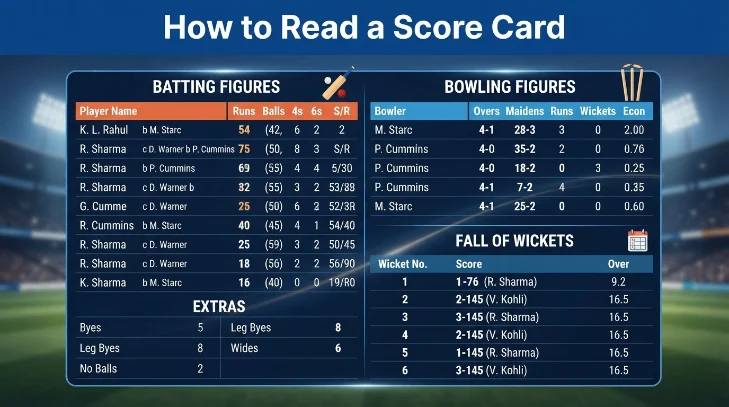

A score card in cricket is a comprehensive statistical document that records every aspect of a match, including batting figures, bowling analysis, extras, and fall of wickets. It displays each player’s individual performance with runs scored, balls faced, fours, sixes, overs bowled, wickets taken, and runs conceded. The score card serves as the official record of the match, allowing fans and analysts to understand how the game unfolded. Modern scorecards also include advanced statistics like strike rates and economy rates, making them invaluable tools for cricket analysis and player evaluation.
Cricket is a sport built on statistics, and at the heart of every match lies the score card. Whether you’re a newcomer to the game or a seasoned fan looking to deepen your understanding, knowing how to read a scorecard is essential to fully appreciate cricket’s rich complexity. From the moment the first ball is bowled, every run, wicket, and delivery is meticulously recorded, creating a detailed narrative of the match. The score card tells a story beyond the numbers—it reveals batting partnerships, bowling spells, turning points, and individual brilliance. In this comprehensive guide, we’ll break down every element of the cricket score card, decode its symbols, and help you become an expert at interpreting cricket’s most important document.
What is a Score Card in Cricket?
- Definition and purpose
- Historical evolution of scorekeeping
- Importance in modern cricket
The Anatomy of a Cricket Score Card
- Header information (match details, teams, venue, date)
- Toss result and match officials
- Umpires and referee information
Batting Section Explained
- Understanding the batting order
- Reading runs scored (R)
- Balls faced (B) and minutes at crease
- Fours and sixes (4s and 6s)
- How to read batting average
- Duck and other notable symbols
- DNB (Did Not Bat) and how to interpret it
- Retired hurt explanation
Bowling Figures Made Simple
- Overs bowled (O)
- Maiden overs (M)
- Runs conceded (R)
- Wickets taken (W)
- Economy rate explained
- Understanding bowling averages
- What makes a good bowling spell
Extras and Their Meaning
- Wides (WD)
- No balls (NB)
- Byes (B)
- Leg byes (LB)
- Penalty runs
Fall of Wickets (FOW)
- Understanding partnership numbers
- Reading wicket progression
- How to analyze match momentum
- Key abbreviations in FOW
Modern Scorecards: Beyond the Basics
- Strike rate calculation
- Dot balls and their significance
- Balls per boundary
- Advanced analytics in digital scorecards
- Ball-by-ball data
Different Formats, Different Scorecards
- Test match scorecards
- ODI scorecards
- T20 scorecards
- Key differences between formats
How to Read a Baseball Scorecard
- Baseball scorecard basics
- Key differences from cricket
- Common baseball scorecard symbols
- Scoring positions and abbreviations
Digital Scorecards and Apps
- Popular platforms (ESPN Cricinfo, Cricbuzz)
- Interactive features
- Real-time updates
- Historical data access
Common Scorecard Abbreviations
- Complete list of standard abbreviations
- What each abbreviation means
- Usage in different contexts
Cricket Scoring Rules and Regulations
- Official ICC scoring rules
- Scorekeeper responsibilities
- How runs are awarded
- Penalties and adjustments
Tips for Reading Scorecards Like a Pro
- Quick reading techniques
- What to look for first
- Understanding match context
- Identifying key performances
History and Evolution of Scorekeeping
- Traditional scorebooks
- Introduction of computers
- Digital revolution
- Future of cricket scoring
Cricket Score Card Abbreviations Quick Reference
| Abbreviation | Full Form | Meaning |
| R | Runs | Total runs scored by a batsman or by a bowler’s bowling |
| B | Balls | Number of balls faced by a batsman |
| M | Minutes | Time spent at the crease by a batsman |
| 4s | Fours | Number of boundaries hit by the batsman (4 runs) |
| 6s | Sixes | Number of sixes hit by the batsman (6 runs) |
| SR | Strike Rate | Runs scored per 100 balls faced |
| O | Overs | Number of overs bowled by a bowler |
| M | Maiden | Number of maiden overs (no runs conceded) |
| W | Wickets | Number of wickets taken by a bowler |
| NB | No Ball | Illegal delivery, one extra run awarded |
| WD | Wide | Ball outside the batsman’s reach, one extra run |
| B | Bye | Runs scored without bat touching the ball |
| LB | Leg Bye | Runs scored off the body, not the bat |
| DNB | Did Not Bat | Batsman who didn’t come out to bat |
| FOW | Fall of Wickets | Order in which batsmen were dismissed |
Ideal Batting and Bowling Figures by Format
| Format | Good Batting Figure | Good Bowling Figure | Economy Rate |
| Test Match | 50+ runs | 3 wickets | Under 3.00 |
| ODI | 70+ runs | 2 wickets | Under 5.00 |
| T20 | 40+ runs | 2 wickets | Under 8.00 |
Score Card Comparison – Cricket vs Baseball
| Feature | Cricket Score Card | Baseball Score Card |
| Format | Runs, wickets, overs | Runs, hits, errors |
| Individual Stats | Batting average, bowling figures | Batting average, ERA |
| Time Element | Overs and balls faced | Innings and pitches thrown |
| Scoring Symbols | 4s, 6s, wickets | 1B, 2B, 3B, HR |
| Key Statistics | Strike rate, economy | OBP, SLG, WHIP |
Fall of Wickets (FOW) Reading Guide
| FOW Number | Order of Dismissal | Partnerships |
| 1st Wicket | First batsman dismissed | Opening partnership total |
| 2nd Wicket | Second batsman dismissed | Total runs at 2nd wicket |
| 3rd Wicket | Third batsman dismissed | Total runs at 3rd wicket |
| 4th Wicket | Fourth batsman dismissed | Total runs at 4th wicket |
| …and so on | Continues until all out | Partnership totals between wickets |
FAQs
1. What is the difference between runs (R) and balls faced (B) on a cricket scorecard?
Runs (R) represent the total number of runs scored by a batsman, while balls faced (B) indicates how many deliveries they faced. The relationship between these two gives you the batsman’s strike rate. For example, 50 runs from 40 balls shows aggressive batting, while 50 runs from 100 balls suggests a more defensive approach.
2. What does “DNB” mean in cricket scorecards?
DNB stands for “Did Not Bat” and appears next to a player’s name when they were part of the playing XI but never came out to bat during their team’s innings. This typically happens when the innings ends before they get a chance to bat, often because their team’s top order performed exceptionally well.
3. How are bowling figures read on a cricket scorecard?
Bowling figures are typically displayed as Overs-Maidens-Runs-Wickets (O-M-R-W). For example, 10-2-35-4 means the bowler bowled 10 overs, delivered 2 maiden overs, conceded 35 runs, and took 4 wickets. The economy rate is calculated by dividing runs by overs, so 35/10 = 3.50 runs per over.
4. What do the symbols WD, NB, B, and LB mean in cricket scoring?
WD stands for Wide (extra run for a ball too wide for the batsman), NB is No Ball (illegal delivery giving an extra run), B is Bye (runs scored without bat contact), and LB is Leg Bye (runs scored off the body). These are all types of extras, which are additional runs awarded to the batting team.
5. How do you read the Fall of Wickets (FOW) section?
The FOW section shows the order in which batsmen were dismissed. It lists each wicket number, the total score at that time, and the batsman dismissed. For example, “1/23” means the first wicket fell when the team score was 23 runs. This helps understand partnerships and match momentum.
6. What is considered a good strike rate in cricket?
A good strike rate varies by format. In Test cricket, a strike rate of 45-50 is considered solid. In ODIs, batsmen typically aim for 80-90. T20 cricket demands higher strike rates, with 130-150 considered excellent. However, these numbers can vary based on match situation and pitch conditions.
7. How do you calculate economy rate from bowling figures?
Economy rate is calculated by dividing the total runs conceded by the number of overs bowled. For example, if a bowler concedes 35 runs in 10 overs, the economy rate is 3.50. In T20 cricket, an economy under 8.00 is considered good, while in Test cricket, under 3.00 is excellent.
8. What is a “duck” in cricket scoring?
A duck refers to a batsman being dismissed without scoring any runs. On the scorecard, it appears as “0” in the runs column. There are several types of ducks, including golden duck (out on the first ball), diamond duck (out without facing a ball), and platinum duck (out on the first ball of the innings).
9. What does “retired hurt” mean on a scorecard?
Retired hurt indicates that a batsman left the field due to injury and could not continue their innings. The scorecard notes “retired hurt” next to their name, and they are considered not out. If they recover and the innings continues, they may return to bat.
10. How is a baseball scorecard different from a cricket scorecard?
Baseball scorecards focus on runs, hits, errors, and individual batting averages, while cricket scorecards include bowling figures, extras, and detailed ball-by-ball information. Baseball uses different abbreviations like 1B (single), 2B (double), 3B (triple), and HR (home run), while cricket uses 4s and 6s for boundaries.
CONCLUSION
Understanding how to read a score card is an essential skill for any cricket enthusiast. It transforms what might appear as a confusing list of numbers into a rich narrative of the match, revealing the ebb and flow of the game, the brilliance of individual performances, and the key moments that decided the outcome. From batting averages to bowling economies, from fall of wickets to extras, every statistic tells a story.
Whether you’re watching a Test match spanning five days or a fast-paced T20 game, the score card provides context and depth, helping you appreciate the game beyond the surface level. As cricket continues to evolve with advanced analytics and real-time data, the scorecard becomes even more valuable for fans, analysts, and players alike.
In today’s digital age, accessing and interpreting scorecards has never been easier. Platforms like ESPN Cricinfo and Cricbuzz offer interactive scorecards with ball-by-ball commentary, player comparisons, and historical data. Embracing these tools enhances your understanding of the game and deepens your enjoyment of cricket.