
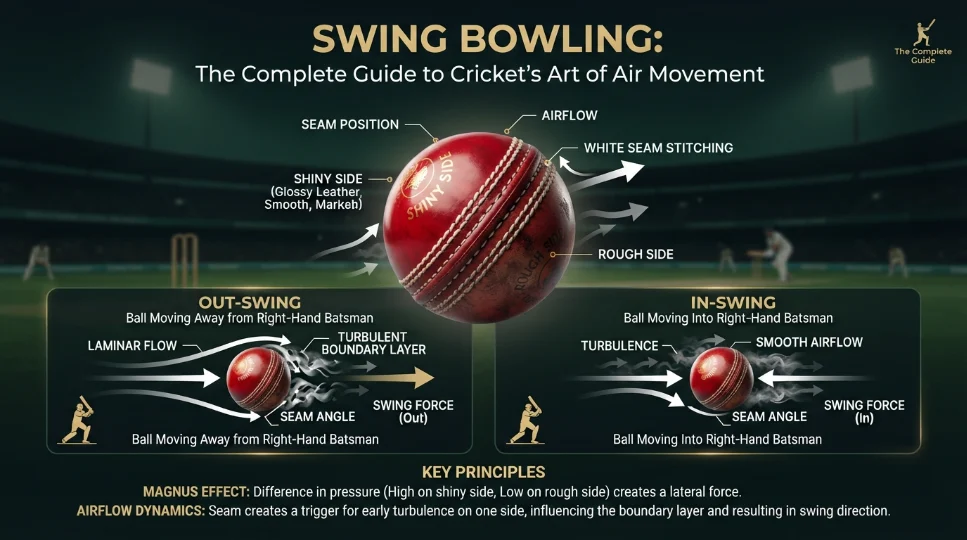

Swing bowling is a fast bowling technique in cricket where the ball curves laterally through the air before reaching the batsman. It works by exploiting the aerodynamic difference between a polished shiny side and a rougher side of the cricket ball. The two main types are inswing, which moves toward the batsman, and outswing, which moves away. Reverse swing occurs with an older ball, moving opposite to conventional swing.
Mastering swing bowling requires precise grip, wrist position, seam orientation, and an understanding of weather and pitch conditions.
There are few sights in cricket more captivating than a fast bowler making the ball dance in the air. Swing bowling is that art—the ability to make a leather sphere curve sideways mid-flight, leaving batsmen guessing and often playing false shots. It is not about sheer pace alone; it is about skill, control, and reading the conditions.
Whether you are a young fast bowler wanting to add swing to your arsenal, a cricket fan keen to understand the craft, or a coach looking for teaching points, this guide covers everything. From the basic grip and seam position to the science behind reverse swing, we will break down swing bowling into clear, actionable insights.
What Is Swing Bowling?
Swing bowling is a technique in cricket where the bowler makes the ball deviate laterally while it is in the air, before it bounces on the pitch. It is a subcategory of fast bowling and relies on the aerodynamic properties of the cricket ball rather than spin or extreme pace. The goal is to deceive the batsman by changing the ball’s flight path, forcing them to misjudge the line and length.
Swing bowling is not the same as spin bowling. Spin bowlers rely on revolutions to make the ball turn off the pitch, while swing bowlers use air movement to beat the bat before the ball even reaches the ground.
The Science Behind Swing Bowling
The cricket ball has a prominent stitched seam that divides it into two hemispheres. To generate swing, the bowling side polishes one side of the ball until it is shiny and smooth, while the other side becomes rough through natural wear. This asymmetry in surface texture creates a difference in air pressure as the ball travels through the air.
When the ball is released with the seam angled, air flows faster over the smooth side and slower over the rough side. This pressure differential causes the ball to move toward the rough side (and away from the shiny side). It is the same principle that makes a golf ball curve or a tennis ball slice.
Reverse swing occurs when the ball is older and more worn. The airflow becomes turbulent on both sides, and the ball swings in the opposite direction toward the shiny side. Reverse swing typically requires higher bowling speeds and is often more lethal because it happens very late in the ball’s trajectory.
Types of Swing Bowling
Inswinger
An inswinger curves toward the batsman. For a right-handed batsman, the ball starts outside the off stump and moves in toward the body and stumps. Inswingers are dangerous because they can trap batsmen LBW or bowled through the gate. The grip involves holding the seam vertically with the first two fingers slightly across the seam, angled toward the leg side.
Outswinger
An outswinger curves away from the batsman. For a right-handed batsman, the ball moves from the stumps toward the slips. Outswingers are designed to draw the batsman into a drive and catch the outside edge. The seam is angled slightly toward the slips, with the rough side on the left.
Reverse Swing
Reverse swing is the phenomenon where an older ball swings in the opposite direction to conventional swing. A ball that would normally swing away from the batsman (outswinger) instead swings in, and vice versa. It was pioneered by Pakistani bowlers in the late 1970s and 1980s and became a game-changing weapon. Reverse swing requires a well-maintained old ball—one side rough and dry, the other shiny—and bowling speeds above 80 mph.
| Type | Movement | Ball Condition | Key Bowler |
| Inswinger | Toward batsman | New / shiny | Wasim Akram |
| Outswinger | Away from batsman | New / shiny | James Anderson |
| Reverse Swing | Opposite to conventional | Old / worn | Waqar Younis |
How to Bowl Swing: Technique Guide
Grip
Hold the ball with your index and middle fingers close together along the upright seam. The seam should be vertical, not horizontal. Your thumb rests underneath for support. For an inswinger, the fingers sit slightly across the seam toward the leg side. For an outswinger, they sit slightly across toward the off side.
Wrist Position
The wrist must be firm and locked. For conventional swing, tilt the wrist slightly in the direction you want the ball to swing. A straight wrist helps maintain the seam angle through release. Elite bowlers report that wrist position is more critical than the sideways action of the body.
Seam Orientation
The seam must remain upright and angled at approximately 10–20 degrees to the direction of travel. If the seam wobbles or falls flat, the ball will not swing consistently. The fingers should come straight down behind the ball at release, imparting backspin.
Run-up and Delivery
Maintain a steady, balanced run-up to generate momentum. Focus on a smooth, repeatable action. Most bowlers naturally create either inswing or outswing through their technique, and variations are used to produce swing in the opposite direction. Coaches recommend pitching the ball closer to the batsman and varying release positions along the crease to increase effectiveness.
Conditions That Help Swing Bowling
Weather
It is widely believed that overcast, humid conditions are ideal for swing bowling. Cloud cover and high humidity are thought to increase how much a ball swings. However, scientific evidence on this is mixed—some studies suggest the effect is more psychological than physical.
Pitch
A hard pitch offers better bounce, while a grassy pitch aids swing movement. Green tops with moisture in the surface are traditionally associated with swing-friendly conditions.
Ball Condition
Conventional swing is most effective with a new, well-polished ball. As the ball wears, swing diminishes until reverse swing becomes possible with an older, well-maintained ball.
Swing Bowling vs Seam Bowling
Many people confuse swing and seam bowling, but they are different. Swing bowling is movement in the air the ball curves before it bounces. Seam bowling is movement off the pitch the ball deviates when the seam hits the ground.
A seam bowler pitches the ball slightly shorter and hits the pitch harder to get more deviation off the surface. A swing bowler focuses on the seam angle and air movement. Research suggests seam movement is more effective than swing for both producing dot balls and taking wickets in 50-over cricket.
Greatest Swing Bowlers of All Time
| Bowler | Country | Key Attribute | Test Wickets |
| Wasim Akram | Pakistan | Left-arm, both ways, vicious inswinger | 414 |
| James Anderson | England | Master of outswing, especially in England | 700+ |
| Waqar Younis | Pakistan | Reverse swing, toe-crushing yorkers | 373 |
| Terry Alderman | Australia | Outswing genius, Ashes legend | 170 |
| Zaheer Khan | India | Swung new ball and reversed old on flat pitches | 311 |
Wasim Akram, known as the “Sultan of Swing,” is widely regarded as the greatest swing bowler of all time. His ability to swing the ball both ways at high speed made him virtually unplayable. James Anderson, England’s all-time leading wicket-taker, is the modern master of outswing.
Common Mistakes in Swing Bowling
- Seam falling flat – If the seam is not upright, the ball will not swing.
- Inconsistent wrist position – A loose wrist destroys seam angle.
- Bowling too short – Swing needs time in the air; full lengths are more effective.
- Trying too hard – Swing comes from technique, not extra effort.
- Neglecting the shine – The shiny side must be maintained throughout the innings.
Training Drills for Swing Bowling
- Seam drill – Practice releasing the ball with the seam perfectly upright. Mark a target on the pitch and aim to hit it with the seam straight.
- One-side shine practice – Polish one side of an old ball and practice bowling with the seam angled correctly.
- Cone drill – Set up cones to represent inswing and outswing targets. Practice hitting each consistently.
- Video analysis – Record your action and check your wrist position and seam angle at release.
Swing Bowling Types Comparison Table
| Feature | Inswinger | Outswinger | Reverse Swing |
| Movement | Toward batsman | Away from batsman | Opposite to conventional |
| Ball Age | New | New | Old |
| Seam Angle | Toward leg side | Toward slips | Varies |
| Wrist Tilt | Toward leg side | Toward off side | Strong and firm |
| Danger | LBW, bowled | Caught behind | Late, unpredictable |
Swing Bowling vs Seam Bowling
| Aspect | Swing Bowling | Seam Bowling |
| Movement | In the air | Off the pitch |
| Key Factor | Shiny side vs rough side | Seam hitting the ground |
| Length | Full | Shorter |
| Ball Condition | New ball preferred | Any condition |
FAQs
1. What is swing bowling in cricket? Swing bowling is a fast bowling technique where the bowler makes the cricket ball curve sideways in the air before it reaches the batsman. It is achieved by maintaining one shiny side and one rough side of the ball, creating an aerodynamic pressure difference that causes lateral movement.
2. What is the difference between inswing and outswing? An inswinger moves toward the batsman, while an outswinger moves away from the batsman. For a right-handed batsman, the inswinger angles in toward the stumps, and the outswinger angles toward the slips.
3. How do you bowl reverse swing? Reverse swing requires an older ball with one side very rough and dry, and the other side polished shiny. The ball must be bowled at high speed (above 80 mph) with a strong wrist position. When released correctly, it swings in the opposite direction to conventional swing.
4. Who is the best swing bowler of all time? Wasim Akram of Pakistan is widely considered the greatest swing bowler ever. Known as the “Sultan of Swing,” he could swing the ball both ways at high speed and took 414 Test wickets.
5. What conditions help swing bowling? Overcast, humid conditions are traditionally believed to help swing bowling. A hard or grassy pitch also aids movement. However, scientific studies have questioned the effect of weather, suggesting the seam and ball condition matter more.
6. Is swing bowling the same as seam bowling? No. Swing bowling is movement in the air, while seam bowling is movement off the pitch when the seam hits the ground. A seamer pitches shorter to get more deviation from the surface.
7. Why does a cricket ball swing? A cricket ball swings because of the aerodynamic difference between the polished shiny side and the rough side. Air flows faster over the smooth side, creating lower pressure, and the ball moves toward the rough side.
8. Can you swing the ball with a tennis ball? Yes, you can practice swing bowling with a tennis ball. Tape one side of the ball to simulate the rough/shiny asymmetry and practice your seam position and wrist action.
9. What is the correct grip for swing bowling? Hold the ball with your index and middle fingers close together along the upright seam. For an inswinger, angle the seam slightly toward the leg side; for an outswinger, angle it toward the slips.
10. Why is reverse swing so dangerous? Reverse swing is dangerous because it happens very late in the ball’s flight, giving batsmen little time to adjust. It also works with an old ball, which skids off the pitch, and is often bowled at yorker length, making it hard to score runs.
CONCLUSION
Swing bowling remains one of cricket’s most cherished and effective arts. It transforms a fast bowler from a mere pace merchant into a thinking player who can outwit batsmen with subtle changes in grip, seam angle, and wrist position. From the conventional inswing and outswing of a new ball to the late, vicious reverse swing of an old one, each variation demands hours of practice and a deep understanding of the game’s conditions.
The legends—Wasim Akram, James Anderson, Waqar Younis have shown that swing bowling is not just about talent but about relentless refinement of technique. For aspiring fast bowlers, the path is clear: master the grip, keep the seam upright, maintain the ball’s shine, and learn to read the conditions. With dedication, swing bowling can become your most potent weapon. Whether you are bowling on a green English seamer or a dusty subcontinental track, the ability to make the ball talk in the air is what separates good bowlers from great ones.