
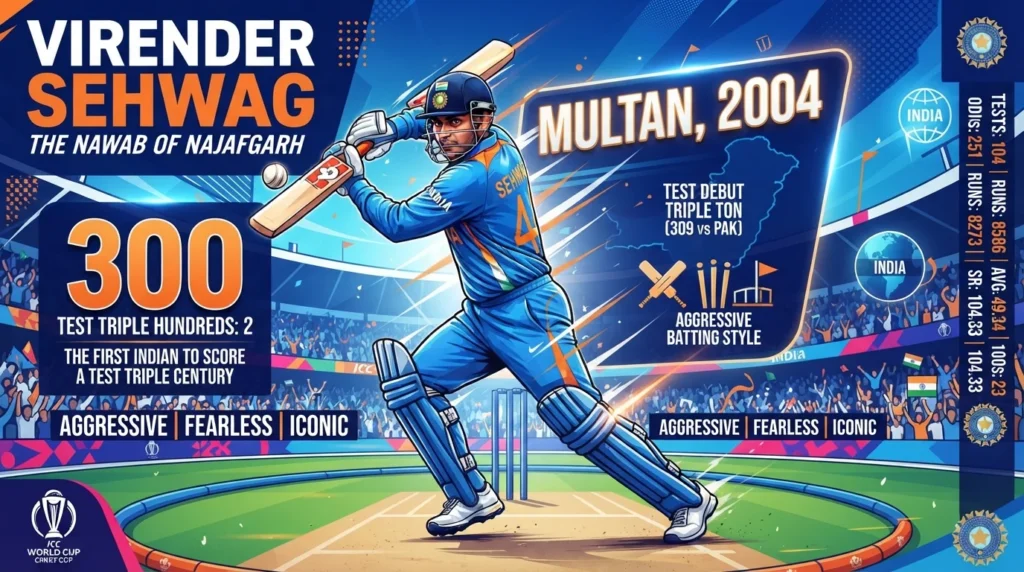

Virender Sehwag is a former Indian cricketer who revolutionized opening batting with his fearless, attacking approach. He played 104 Tests, scoring 8,586 runs at an average of 49.34 with 23 centuries. He remains the only Indian to score two Test triple centuries, including 319 against South Africa. Sehwag was part of India’s 2007 T20 World Cup and 2011 ODI World Cup-winning squads and was inducted into the ICC Hall of Fame in 2023.
Birth and Childhood
Virender Sehwag was born on October 20, 1978, in Najafgarh, Delhi. He grew up in a family that ran a flour mill, far from the polished cricket academies of urban India. Like many youngsters of his generation, he idolized Sachin Tendulkar and dreamed of emulating his hero.
Family Background
Sehwag married Aarti Ahlawat in December 2004. The couple has two sons: Aryavir, born in 2007, and Vedant, born in 2010.
Nicknames
Sehwag is affectionately known by several nicknames: “Viru,” “Nawab of Najafgarh,” and “Sultan of Multan”—the last earned after his historic triple century in Multan.
International Career Overview
Debut and Rise
Sehwag made his One Day International debut on April 1, 1999, against Pakistan. His Test debut followed on November 3, 2001, against South Africa in Bloemfontein. On that fiery pitch, he announced his arrival with a century, matching his idol Sachin Tendulkar stroke for stroke.
Career Span
Sehwag represented India from 1999 to 2013. His last Test was against Australia in March 2013, his last ODI against Pakistan in January 2013, and his final T20I against South Africa in October 2012.
Team India Captaincy
Sehwag occasionally served as India’s stand-in captain and also held the position of vice-captain. He was also the captain of Delhi Daredevils in the IPL and the Delhi Ranji team.
Career Statistics
Batting Summary
| Format | Matches | Runs | Average | Strike Rate | 100s | 50s | Highest Score |
| Test | 104 | 8,586 | 49.34 | 82.23 | 23 | 32 | 319 |
| ODI | 251 | 8,273 | 35.05 | 104.34 | 15 | 38 | 219 |
| T20I | 19 | 394 | 21.89 | 145.39 | 0 | 2 | 68 |
| IPL | 104 | 2,728 | 27.56 | 155.44 | 2 | 16 | 122 |
Bowling Summary
| Format | Matches | Wickets | Average | Best Bowling |
| Test | 104 | 40 | 47.35 | 5/104 |
| ODI | 251 | 96 | 40.14 | 4/6 |
Sehwag was a right-arm off-break bowler who provided useful part-time options throughout his career.
Records and Milestones
Triple Centuries
Virender Sehwag remains the only Indian batsman to score two triple centuries in Test cricket:
- 319 against South Africa at M.A. Chidambaram Stadium, Chennai—the highest score by an Indian in Test cricket. He reached 300 off just 278 balls, making it the fastest triple century in international cricket history.
- 309 against Pakistan in Multan—the first triple century by an Indian.
He came within seven runs of becoming the first batsman to score three triple centuries, falling for 293 against Sri Lanka at the Brabourne Stadium in Mumbai.
Highest ODI Score
Sehwag held the record for the highest individual score in ODIs with his astonishing 219 against West Indies in Indore. He completed his double-century with more than six overs to spare.
Test Double Centuries
Sehwag holds the Indian record for the highest number of Test double centuries, with six scores of 200 or more.
Fastest Centuries
- Maiden ODI century: 69 balls against New Zealand in 2001
- Fastest ODI century by an Indian: 60 balls against New Zealand in 2009
Strike Rate Record
Sehwag’s Test strike rate of 82.23 is among the highest for any batsman with over 8,000 runs. He piled up Test runs at a faster pace than anyone in cricket history.
Batting Style and Technique
The Sehwag Philosophy
Sehwag’s approach to batting was uncomplicated: scoring runs quickly was the only objective. His policy of “see ball, hit ball” symbolized his mantra towards life and cricket: simple, uncomplicated, and deadly.
Technical Uniqueness
Sehwag possessed perhaps the most original technique in modern cricket. His signature style meant that the faster the bowler, the faster the ball sped off the bat—deflecting full-length balls behind point and dispatching shorter balls over slips and third man for six.
Minimal Footwork, Maximum Handwork
With minimal footwork but brilliant hand-eye coordination, Sehwag created space for his handwork. His lack of footwork, which troubled him against the moving ball, was mostly an advantage, allowing him to hit the ball harder square on the off side than almost anyone.
Spin Assassin
Few batsmen have dreadful spin bowling like Sehwag. The sight of a spinner brought out the dreadful in him. Former Pakistan captain Rashid Latif described Sehwag as a “fearless cricketer” with a unique technique and great balance.
Street-Smart Cricket Mind
Behind the seemingly reckless approach was a sharp and street-smart cricket mind. Sehwag had a keen grasp of his own strengths and his opponents’ weaknesses, exploiting them in a forensic manner. What appeared risky to others was merely an opportunity for him.
Major Achievements and Honors
ICC Hall of Fame
In 2023, Sehwag was inducted into the ICC Cricket Hall of Fame, cementing his legacy among the all-time greats.
Wisden Leading Cricketer
In April 2009, Sehwag became the first Indian to be honored as the Wisden Leading Cricketer in the World for his performances in 2008. He subsequently became the first player of any nationality to retain the award for 2009.
World Cup Victories
Sehwag was part of three major ICC tournament victories:
- 2002 ICC Champions Trophy (joint winners)—he was the leading run-scorer with 271 runs
- 2007 T20 World Cup winners
- 2011 Cricket World Cup winners
Notable Innings
319 vs South Africa, Chennai (2008)
Sehwag’s highest Test score came against a formidable South African attack. He reached 300 off just 278 balls—the fastest triple century in Test cricket history.
309 vs Pakistan, Multan (2004)
This was the first triple century by an Indian batsman, earned him the nickname “Sultan of Multan,” and announced his arrival as a truly special player.
293 vs Sri Lanka, Mumbai (2009)
Sehwag fell just seven runs short of a third triple century, but the innings epitomized his brand of batsmanship: imagination, daring, power, skills, and clarity of vision.
219 vs West Indies, Indore (2011)
This innings set the record for the highest ODI score at the time. Sehwag completed his double-century with more than six overs to spare.
IPL Career
Sehwag was a key figure in the Indian Premier League, representing:
- Delhi Daredevils (2008–2013)
- Kings XI Punjab (2014–2015)
- He scored 2,728 runs in 104 IPL matches at a strike rate of 155.44
Post-Retirement Life
Media and Commentary
Since retiring, Sehwag has become a prominent cricket analyst and commentator. He has worked with Cricbuzz and various other media outlets. His candid and often humorous commentary style has made him a fan favorite.
Recent Activities (2026)
In 2026, Sehwag has remained in the public eye:
- He visited Ayodhya on Independence Day, seeking blessings at the Hanumangarhi temple and Ram Lalla
- He made headlines with a witty remark about having his own web series
- He commented on India’s chances in the T20 World Cup
- A viral controversy emerged regarding a comment about David Miller, though the quote was later verified as being taken out of context
Personal Life Updates
In early 2025, reports emerged about Sehwag and his wife Aarti living separately, though details remain speculative.
FAQs
1. How many runs did Virender Sehwag score in Test cricket?
Sehwag scored 8,586 runs in 104 Test matches at an impressive average of 49.34. He also hit 23 centuries and 32 half-centuries in the longest format.
2. Is Virender Sehwag the only Indian to score a triple century in Tests?
Yes, Sehwag is the only Indian batsman to score a triple century in Test cricket—and he did it twice, with scores of 319 against South Africa and 309 against Pakistan.
3. When did Virender Sehwag retire from international cricket?
Sehwag announced his retirement from international cricket on October 20, 2015. However, his last international appearance was in March 2013 against Australia in Tests.
4. What is Virender Sehwag’s highest score in ODI cricket?
Sehwag’s highest ODI score is 219, scored against West Indies in Indore. At the time, this was the highest individual score in ODI cricket history.
5. Why is Virender Sehwag called the “Nawab of Najafgarh”?
Sehwag earned the nickname “Nawab of Najafgarh” because he hails from Najafgarh, a suburb of Delhi. The title “Nawab” (meaning “ruler” or “nobleman”) reflects his regal and dominant batting style.
6. What was Virender Sehwag’s batting style?
Sehwag was a right-handed opening batsman with a uniquely aggressive approach. He relied on minimal footwork but brilliant hand-eye coordination, specializing in hitting the ball hard square on the off side.
7. How many centuries did Virender Sehwag score in international cricket?
Sehwag scored 38 international centuries in total—23 in Tests and 15 in ODIs. He never scored a century in T20Is.
8. Was Virender Sehwag part of India’s 2011 World Cup-winning team?
Yes, Sehwag was a crucial member of the Indian squad that won the 2011 ICC Cricket World Cup. He was also part of the 2007 T20 World Cup-winning team.
9. When was Virender Sehwag inducted into the ICC Hall of Fame?
Sehwag was inducted into the ICC Cricket Hall of Fame in 2023, recognizing his extraordinary contributions to the game.
10. What is Virender Sehwag’s Test strike rate?
Sehwag’s Test strike rate is 82.23, which is among the highest for any batsman with more than 8,000 Test runs. He scored Test runs at a faster pace than anyone in cricket history.
Conclusion
Virender Sehwag was more than just a cricketer—he was a phenomenon who changed the way Test cricket was played at the top of the order. In an era dominated by technically correct, safety-first openers, Sehwag stood apart with his audacious, no-holds-barred approach. His philosophy was simple: batting is about scoring runs, and the faster you score them, the better.
His numbers speak for themselves 8,586 Test runs at 49.34, two triple centuries, the Indian record for most Test double hundreds, and a strike rate that redefined what was possible in the longest format. But statistics only tell part of the story. Sehwag brought joy to the game. He made batting look effortless, even against the world’s best bowlers. His square cuts and lofted drives over the slips were works of art.
Off the field, Sehwag remains equally captivating candid, witty, and refreshingly honest. From his humble beginnings in Najafgarh to the ICC Hall of Fame, his journey is an inspiration. Virender Sehwag didn’t just play cricket; he conquered it on his own terms. He remains, in every sense, a true original.