
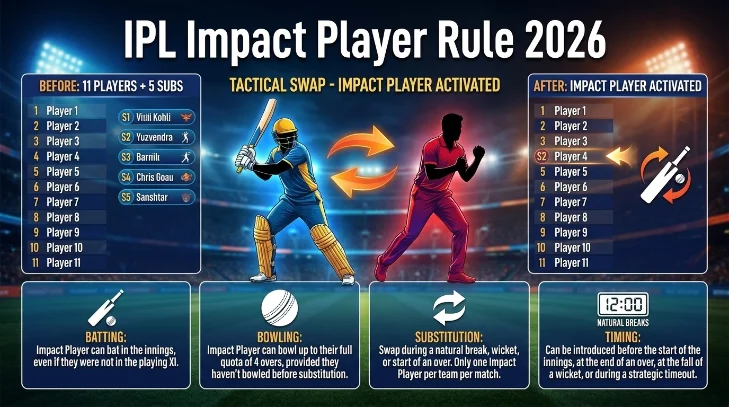

The Impact Player rule in IPL 2026 allows each team to make one tactical substitution per match from a pre-named list of five substitutes. The substitution can occur at specific natural breaks start of an innings, end of an over, fall of a wicket, or batter retirement. The incoming player can bat and bowl their full quota, making teams effectively play with 12 players across the match.
Introduced in 2023, the rule continues through the 2027 season. Teams typically use it to replace a batter with a specialist bowler while defending, or vice versa while chasing. The substitute must be Indian unless the starting XI has fewer than four overseas players.
Cricket has always been a game of strategy, but few innovations have sparked as much debate as the Impact Player rule in the Indian Premier League. Since its introduction in 2023, this tactical substitution regulation has fundamentally changed how teams approach T20 cricket.
The Impact Player rule in IPL 2026 allows franchises to substitute one player during a match, effectively giving them a 12th player to deploy based on match situations. While traditionalists argue it disrupts the game’s balance, proponents see it as an exciting tactical evolution. As the IPL enters its 19th edition in 2026, understanding this rule has become essential for every cricket fan.
The rule has already survived four seasons of intense scrutiny, with the BCCI confirming its extension through 2027. But what exactly is the Impact Player rule? How does it work in practice? And why are so many players and captains calling for its removal? This comprehensive guide answers all your questions about the Impact Player rule in IPL 2026.
What Is the Impact Player Rule in IPL?
The Impact Player rule is a tactical substitution regulation introduced by the BCCI in IPL 2023. It allows teams to replace one member of their playing XI with a substitute during a match. Unlike traditional cricket substitutions which are typically permitted only for injuries the Impact Player can be deployed for purely strategic reasons.
At its core, the rule gives every team the option to add an extra batter and bowler to its lineup. The identity of the Impact Player varies based on match situations, squad dynamics, and tactical needs.
The rule was first trialled in the Syed Mushtaq Ali Trophy before being introduced to the IPL. It has since been adopted by several other T20 leagues worldwide.
How Does the Impact Player Rule Work in IPL 2026?
Before the Match
Before the toss, each team submits not only their playing XI but also a list of five substitute players. Any one of these five can later be designated as the team’s Impact Player.
When Can the Impact Player Be Introduced?
The Impact Player can be activated only during specific natural breaks in the game:
| Activation Window | Description |
| Start of innings | Before either innings begins |
| End of an over | After any completed over |
| Fall of a wicket | Immediately after a dismissal |
| Batter retires | When a batter retires out (tactical or injury) |
Important restriction: If a bowling side introduces an Impact Player mid-over (following a wicket), the incoming player cannot bowl the remaining deliveries of that over. They must wait until the next over begins.
The Substitution Process
Once the Impact Player enters the field, the player being replaced is completely substituted and cannot return for any further participation in the match not even as a substitute fielder or runner.
Each team is allowed only one Impact Player substitution per match.
Bowling Quota Rules for Impact Player
One of the most significant aspects of the Impact Player rule is how it handles the bowling quota.
Under standard T20 regulations, a bowler is limited to 4 overs per innings. The Impact Player rule respects this limit but provides a crucial advantage: the incoming Impact Player receives a completely clean slate for their bowling quota.
Example: A team can use an opening swing bowler for 4 overs at the start of the innings, substitute them out, and bring in a death-overs specialist who can bowl another full 4 overs. This allows teams to extract up to 8 overs from what is essentially a single slot in the team sheet, maximising bowling resources throughout the match.
Overseas Player Limitation
The BCCI has implemented a specific rule to protect the development of Indian cricketers:
| Starting XI Overseas Players | Impact Player Eligibility |
| 4 overseas players | Impact Player must be Indian |
| 3 or fewer overseas players | Impact Player can be overseas |
This rule ensures that teams cannot field more than four overseas players at any point in the match, maintaining the IPL’s commitment to showcasing Indian talent.
Why Was the Impact Player Rule Introduced?
The BCCI introduced the Impact Player rule primarily as a tactical and entertainment-driven innovation. In their official statement, the IPL described it as adding “a new tactical, strategic dimension to the game.”
Key objectives included:
- Enhancing entertainment value by enabling more aggressive batting and higher scores
- Increasing tactical complexity for captains and coaches
- Creating more opportunities for players to impact matches
- Testing innovations that could potentially shape the future of T20 cricket
The rule was first trialled in domestic tournaments like the Syed Mushtaq Ali Trophy before being implemented in the IPL.
Tactical Usage in IPL 2026
The Impact Player rule has fundamentally changed how teams approach match strategy. Here are the most common tactical applications in IPL 2026:
Batting-First Strategy
Teams batting first often start with an extra bowling option and bring in a specialist batter when they begin their chase.
Bowling-First Strategy
Teams bowling first can load up on bowlers and substitute one out for a batter during their innings.
Batting Collapse Response
When teams suffer early wickets, they can bring in an additional specialist batter to stabilise the innings.
Injury Management
Teams have used the Impact Player to manage injured players for instance, substituting a player after they have batted to minimise injury risk. Rohit Sharma was managed this way during IPL 2026 after returning from a hamstring injury.
Unused Impact Player
Interestingly, teams sometimes name an Impact Player but choose not to use them. Mumbai Indians did this twice in IPL 2026 naming Raghu Sharma and Shardul Thakur as Impact Players but leaving them completely unutilised.
Impact on Batting Scores and Match Dynamics
The Impact Player rule has dramatically altered scoring patterns in the IPL. In IPL 2026, par scores jumped to the 220-run mark, and even these totals were chased down “without breaking a sweat.”
Krunal Pandya of Royal Challengers Bengaluru explained the transformation: earlier, teams relied on all-rounders at No. 6 and 7, but with the Impact Player rule, sides can field up to eight specialist batters, making line-ups far more aggressive.
The average run rate climbed from 8.5 in 2023 to over 9 in 2025. This batting boom, aided by flat pitches and small grounds, has been both celebrated and criticised.
Criticism and Controversy
The Impact Player rule has faced sustained opposition from players, captains, and cricket legends.
Player Opposition
Axar Patel (Delhi Capitals captain): “I don’t like this rule as I am an all-rounder myself. Earlier we used to pick all-rounders for this role. Now the team management goes with a particular batter or bowler. Being an all-rounder myself I don’t like it.”
Rohit Sharma: “You are taking out so much from the game just to make it a little entertaining for the people around. I can give you so many examples, guys like Washington Sundar and Shivam Dube are not getting to…”
Shubman Gill: Criticised the rule for “taking the skill out of the game.”
Kieron Pollard: “I don’t like this rule, honestly, because I am an all-rounder. Earlier, you would pick an all-rounder for batting and bowling. Because of this rule, the team management goes for a particular batsman or bowler.”
Key Criticism Points
| Criticism | Explanation |
| Reduces all-rounder value | Teams prefer specialists over versatile players |
| Hampers development | Young all-rounders get fewer opportunities |
| Unbalances the game | Favours batters over bowlers |
| Creates uneven playing field | Teams with deeper squads benefit more |
| International disadvantage | Indian players don’t get Impact Player practice for international cricket |
Legendary Voices
Sachin Tendulkar has proposed removing the Impact Player rule, suggesting it unfairly benefits batters and has led to higher scores. He advocates for alternative innovations like a “Power Surge” (similar to BBL) and allowing one bowler to bowl five overs per innings to restore balance.
BCCI’s Position and Future of the Rule
Despite widespread criticism, the BCCI has stood firm on the Impact Player rule.
Current Status (IPL 2026)
The Impact Player rule remains in effect for IPL 2026 and has been extended through the 2027 season.
Key BCCI Statements
- No mid-season review is planned
- Formal review will only take place after the 2027 season
- No official request from IPL teams to rethink the rule has been received
Future Outlook
The BCCI has indicated that the rule will be reconsidered after the 2026 season, with a formal review expected after the conclusion of the league’s 20th season.
However, BCCI secretary Devajit Saikia has noted that there has been no official request from teams to revisit the rule, adding that they will review it after IPL 2026 if teams request.
Impact Player Rule vs Traditional Cricket Substitutions
| Aspect | Traditional Cricket | Impact Player Rule |
| Substitution reason | Injury/concussion only | Tactical/strategic |
| Number of substitutes | 1 (injury) | 1 tactical per match |
| Pre-named substitutes | No | Yes (5 players) |
| Bowling quota | Standard | Clean slate for incoming player |
| Return to field | Yes (if fit) | No (completely substituted) |
| Strategic purpose | None | Match situation optimisation |
FAQs
1. What is the Impact Player rule in IPL 2026?
The Impact Player rule allows each team to make one tactical substitution per match from a pre-named list of five substitutes. The substitution can happen at specific natural breaks start of an innings, end of an over, fall of a wicket, or batter retirement. The rule has been in effect since 2023 and continues through 2027.
2. How many Impact Players can a team use in one IPL match?
Each team can use only one Impact Player per match. However, they must name five potential substitutes before the toss. Any one of these five can be activated as the Impact Player during the game. Once used, no further substitutions are permitted.
3. Can an Impact Player bat and bowl in IPL?
Yes, an Impact Player can both bat and bowl. The incoming player has a completely clean slate for their bowling quota they can bowl their full 4 overs regardless of how many overs the replaced player had already bowled.
4. When can a team introduce the Impact Player in IPL?
The Impact Player can be introduced only during natural breaks: at the start of either innings, at the completion of a full over, after the fall of a wicket, or when a batter retires out. However, if introduced mid-over, they cannot bowl the remaining deliveries of that over.
5. Can an overseas player be used as an Impact Player?
Yes, but with conditions. If a team has four overseas players in their starting XI, the Impact Player must be Indian. If they have three or fewer overseas players, they can bring in an overseas substitute.
6. Why is the Impact Player rule controversial?
Critics argue the rule reduces the importance of all-rounders, hampers their development, unbalances the game in favour of batters, and creates an uneven playing field. Players like Rohit Sharma, Axar Patel, and Shubman Gill have openly opposed it.
7. Will the Impact Player rule continue after IPL 2026?
The BCCI has confirmed the rule will remain in effect through the 2027 season. A formal review is expected after the 2027 season to decide its future beyond that. No mid-season or immediate review is planned.
8. What happens to the player who is substituted out?
The substituted player is completely removed from the match. They cannot return to the field for any purpose not even as a substitute fielder or runner. The substitution is permanent for that match.
9. How has the Impact Player rule changed IPL scoring?
The rule has led to significantly higher scores. In IPL 2026, par scores reached 220 runs, and even those totals were chased regularly. The average run rate climbed from 8.5 in 2023 to over 9 in 2025.
10. Did the Impact Player rule exist before IPL 2023?
No. The rule was introduced in IPL 2023. It was first trialled in the Syed Mushtaq Ali Trophy (a domestic T20 tournament) before being implemented in the IPL. It has since been adopted by several other T20 leagues worldwide.
CONCLUSION
The Impact Player rule in IPL 2026 represents one of the most significant tactical innovations in modern cricket. Since its introduction in 2023, it has transformed how teams approach T20 cricket enabling deeper batting line-ups, more aggressive scoring, and unprecedented tactical flexibility.
Yet this innovation comes at a cost. The rule’s impact on all-rounders has sparked intense debate, with players, captains, and legends like Sachin Tendulkar calling for its removal. The BCCI, however, has remained steadfast, extending the rule through 2027 and planning a formal review only after that.
For fans, the Impact Player adds an exciting strategic layer to every match. Will a team bring in an extra batter to chase down a target? Or an additional bowler to defend a total? These decisions have become as crucial as the toss itself.
As IPL 2026 unfolds, the Impact Player rule continues to shape every match. Whether you love it or hate it, understanding this rule is essential for anyone following the world’s most exciting T20 league. The debate will likely continue, but for now, the Impact Player is here to stay at least until 2027