
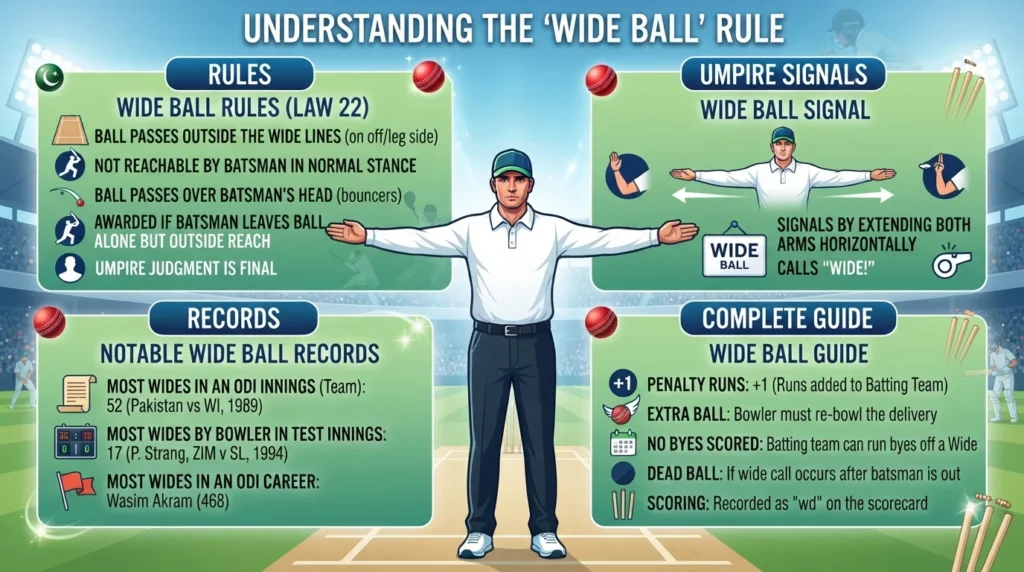

A wide ball in cricket is a delivery that passes outside the batter’s reach, making it impossible to play a normal cricket stroke. The umpire signals a wide by extending both arms horizontally. When called, the batting side receives one penalty run, and the ball must be bowled again. A wide does not count as a legitimate delivery in the over.
Wides are common in limited-overs cricket where bowlers face pressure to restrict runs. The ICC has introduced rule changes in 2026 to give bowlers more leeway on the leg side, using the batter’s leg position at delivery as the reference point for judging wides.
What Is a Wide Ball? – Definition
A wide ball is a delivery bowled by the bowler that the umpire considers to be out of the batter’s reach. According to Law 22 of the MCC Laws of Cricket, a ball is adjudged a wide if it passes wide of where the striker is standing and would also have passed wide of the striker standing in a normal batting position.
The key principle is that the ball must be “sufficiently within reach for the batter to be able to hit it with the bat by means of a normal cricket stroke.”If the ball is too far to the left (off side) or too far to the right (leg side) – or passes above the batter’s head height when standing upright – the umpire will call it a wide.
Official Rules of the Wide Ball
The MCC’s Law 22 provides the foundational rules for wide balls in cricket:
| Rule | Description |
| 22.1 – Judging a Wide | A wide is called if the ball passes wide of where the striker is standing and would have passed wide of a normal batting position. |
| 22.1.2 – Reach | The ball is not wide if it is within reach for a normal cricket stroke. |
| 22.2 – Call and Signal | The umpire signals a wide by extending both arms horizontally as soon as the ball passes the striker’s wicket. |
| 22.3 – Revoking a Call | The umpire can revoke the wide call if the batter hits the ball or if the delivery is called a no-ball. |
| 22.6 – Penalty | One penalty run is awarded instantly on the call of a wide. |
| 22.7 – Scoring | All runs scored from a wide (including overthrows) are scored as wides and debited against the bowler. |
| 22.8 – Not Counting | A wide does not count as one of the six balls in the over. |
| 22.9 – Out from a Wide | A batter can be out from a wide only by hit wicket, obstructing the field, run out, or stumped. |
ICC Playing Conditions
The ICC supplements the MCC Laws with specific playing conditions for international cricket. Under Section 22.1 of the ICC’s white-ball playing conditions, a wide is judged unless the ball is “sufficiently within reach for the batter to be able to hit it with the bat by means of a normal cricket stroke.”
Why Does the Wide Ball Rule Exist?
The wide ball rule serves two essential purposes:
- Preventing Negative Bowling: Without the wide rule, bowlers could simply bowl miles outside the off stump or down the leg side, making it nearly impossible for batters to score. The rule ensures the game remains a contest between bat and ball.
- Maintaining Fair Play: The rule protects batters from dangerous or unplayable deliveries, including balls that pass above head height or far outside their reach.
In limited-overs cricket, the wide rule is enforced particularly strictly because of the over limits. Bowlers can’t afford to concede extra runs, and teams can’t waste deliveries.
The New ICC Wide Ball Rule (2026 Trial and Permanent Adoption)
In a significant development, the ICC has been trialling a new wide ball rule aimed at giving bowlers more leeway on the leg side. The rule change was permanently adopted in 2026.
What Was the Problem?
Batters had started exploiting the existing rule by shuffling across their stumps before or during a delivery. When a batter moved to the off side, a delivery that would have been perfectly hittable in a normal stance suddenly appeared to be down the leg side – and was called a wide. This gave batters an unfair advantage.
What Changed?
Under the new rule, the position of the batter’s legs at the point of delivery is used as the reference point for judging a wide.
A ball that passes the popping crease between the leg stump and the protected area marker will NOT be called a wide. The protected area marker line has been extended to the popping crease to act as a guide for umpires.
In practice, this means deliveries that go down the leg side but remain within the protected area marker are now considered legitimate – even if the batter has shuffled across.
Impact of the Change
- Bowlers have more margin for error on the leg side
- Batters can no longer manipulate wide calls by shuffling
- The change encourages more attacking bowling on the leg side
- It brings new skills and forgotten strokes into play
Shaun Pollock, the former South African captain, has been a vocal advocate for giving bowlers more leeway, reflecting a broader sentiment within the cricketing community.
Umpire Signals and Procedures
How Umpires Signal a Wide
When an umpire adjudges a delivery to be a wide, they:
- Call “Wide ball” as soon as the ball passes the striker’s wicket
- Signal by extending both arms horizontally
- The call is considered to have been a wide from the instant the bowler entered their delivery stride
Revoking a Wide Call
An umpire can revoke a wide call if:
- The batter makes contact with the ball (bat or person) before it reaches any fielder
- The delivery is called a no-ball (no-ball overrides wide)
What Happens After a Wide?
- One penalty run is awarded to the batting side
- The ball does NOT count as one of the six deliveries in the over
- The ball remains live – batters can score runs off a wide
- Any additional runs scored are added to the wide total and debited against the bowler
Wide Ball vs No Ball – Key Differences
| Feature | Wide Ball | No Ball |
| Definition | Ball outside batter’s reach | Illegal delivery (overstepping, above waist, etc.) |
| Penalty | 1 run | 1 run |
| Counts in Over? | No | No |
| Free Hit? | No (except in some formats) | Yes (in limited-overs cricket) |
| Can Batter Be Out? | Limited modes (run out, stumped, etc.) | All modes except stumped |
| Umpire Signal | Arms horizontal | One arm raised |
Common Mistakes That Lead to Wide Balls
Bowlers bowl wides for various reasons, often related to technical flaws or pressure situations:
| Mistake | Explanation |
| Poor wrist position | Incorrect wrist angle at release can cause the ball to drift wide |
| Lack of control with the white ball | White balls swing more and are harder to control than red balls |
| Slinging action | Bowlers with slingy actions (like Malinga) risk releasing the ball too early |
| Trying to bowl wide yorkers | Missing the yorker length often results in a wide |
| Pressure situations | Bowlers under pressure, especially at the death overs, often lose their radar |
| Batters shuffling | Batters moving across the crease can make a legitimate ball appear wide (now addressed by the new rule) |
Fast bowlers with the new ball are particularly prone to bowling wides, especially when trying to generate extra pace or swing.
Famous Wide Ball Moments and Records
Most Wides in a Single Over
| Bowler | Wides | Over Length | Format | Year |
| Arshdeep Singh | 7 | 13 balls | T20I | 2025 |
| Tinashe Panyangara | 7 | 13 balls | Champions Trophy | 2004 |
| Naveen-ul-Haq | 6 | 13 balls | T20I | 2024 |
| Shardul Thakur | 5 (consecutive) | 11 balls | IPL | 2025 |
Most Wides in an IPL Innings
Lucknow Super Giants bowled 15 wides against Kolkata Knight Riders in IPL 2025 – the most by a team in an IPL innings. Shardul Thakur alone bowled 8 wides in that match, the most by any bowler in an IPL game.
Team Record – Most Wides in an ODI Innings
The West Indies bowled 37 wides against Pakistan in the Benson & Hedges World Series at Brisbane on January 7, 1989 – one of the most wayward bowling performances in ODI history.
Infamous Wide – Inzamam-ul-Haq to Sachin Tendulkar
Inzamam-ul-Haq, primarily a batter, bowled a delivery so wide against Sachin Tendulkar that legendary commentator Tony Greig called it “one of the biggest wides of all time.” Inzamam recorded 5 wides in a single over across his international career.
The Infamous Wide – Steve Harmison to Michael Hussey
England’s Steve Harmison bowled a delivery so wide in the 2006/07 Ashes that it went straight to the slips instead of the keeper – a moment that became a symbol of England’s disastrous tour.
The Virat Kohli Wide Ball Controversy (2023 World Cup)
One of the most talked-about wide ball incidents in recent memory occurred during the 2023 ICC World Cup match between India and Bangladesh. Virat Kohli was batting on 97, and India needed just two runs to win. Bangladesh spinner Nasum Ahmed bowled a delivery down the leg side. Umpire Richard Kettleborough did not signal a wide.
Former India batter Mohammad Kaif claimed the wide was bowled “purposely” to deny Kohli a century.However, Bangladesh captain Najmul Hossain Shanto dismissed the notion, and Wasim Akram called the controversy “cr*p” created by people with nothing better to do.
Kohli went on to hit a six to finish the match and complete his century – his 48th ODI hundred.
Statistics and Trends
Wide Ball Averages in World Cups
| Tournament | Average Wides Per Game |
| 1975 World Cup | 3.3 |
| 1979 World Cup | 4.4 |
| 1983 World Cup | 9.6 |
| 1999 World Cup (after 11 matches) | ~27 per game |
The steady increase in wide balls reflects the growing pressure on bowlers in limited-overs cricket and the evolution of batting tactics.
Most Wides by India in T20Is
India bowled 17 wides against Sri Lanka in 2009 and 16 wides against West Indies in 2018.They also conceded 16 wides against South Africa in 2025.
How to Avoid Bowling Wides – Tips for Bowlers
- Work on wrist position – A consistent wrist position at release is crucial for control
- Practice with the white ball – White balls behave differently; practice extensively with them
- Focus on run-up consistency – A stable, repeatable run-up helps maintain line and length
- Use practice pitch markings – Wide lines painted on practice pitches help bowlers develop accuracy
- Stay calm under pressure – Death overs require composure; practice high-pressure scenarios
- Adapt to batter movement – With the new rule changes, bowlers must adjust to batters’ positions at delivery
Giving away wides and no-balls is “akin to handing the opposition another batsman” – a costly mistake that no bowler can afford.
FAQs
What is a wide ball in cricket?
A wide ball is a delivery that the umpire considers to be outside the batter’s reach, making it impossible to play a normal cricket stroke. The umpire signals it by extending both arms horizontally. The batting side receives one penalty run, and the ball is bowled again.
How many runs is a wide ball worth?
A wide ball awards one penalty run to the batting side immediately on the call.Any additional runs scored off the wide (including overthrows) are also added to the total and recorded as wides, debited against the bowler.
Does a wide ball count as a delivery in the over?
No. A wide ball does not count as one of the six legitimate deliveries in the over.The bowler must bowl an extra delivery to complete the over.
Can a batsman be out off a wide ball?
Yes, but only in specific ways. A batter can be out from a wide by hit wicket, obstructing the field, run out, or stumped.They cannot be out bowled, caught, LBW, or handled the ball from a wide.
What is the difference between a wide and a no-ball?
A wide is a ball outside the batter’s reach, while a no-ball is an illegal delivery (overstepping, above waist height, etc.). Both give one penalty run and don’t count in the over. However, a no-ball results in a free hit in limited-overs cricket, while a wide does not.
What is the new wide ball rule introduced by the ICC?
The ICC has introduced a rule where the position of the batter’s legs at the point of delivery is used as the reference point for judging a wide. A ball passing between the leg stump and the protected area marker is no longer called a wide, giving bowlers more leeway on the leg side.
Who has bowled the most wides in a single over?
Arshdeep Singh holds the record for the most wides in a T20I over – 7 wides in a 13-ball over against South Africa in 2025.Tinashe Panyangara also bowled 7 wides in a Champions Trophy match in 2004.
Why do bowlers bowl wides?
Bowlers bowl wides due to technical issues like poor wrist position, lack of control with the white ball, pressure situations, or attempting risky deliveries like wide yorkers. Batters shuffling across the crease can also make a legitimate ball appear wide.
What is the umpire’s signal for a wide ball?
The umpire signals a wide ball by extending both arms horizontally at shoulder height.They also call “Wide ball” verbally as soon as the ball passes the striker’s wicket.
Are wides more common in Test cricket or limited-overs cricket?
Wides are more common and more strictly enforced in limited-overs cricket (ODIs and T20Is) because of the over limits and the need to prevent negative bowling tactics. In Test cricket, the wide rule is applied more leniently, especially for deliveries down the leg side that are not considered negative tactics.
Conclusion
A wide ball in cricket may seem like a small mistake, but it can have a significant impact on the game. It gives the batting team an extra run, does not count as a legal delivery, and provides an additional opportunity to score. Understanding the rules of wide balls helps players, umpires, and fans better understand the flow of a cricket match. Whether caused by poor line and length, pressure, or an attempt to deceive the batter, controlling wides is an important part of effective bowling.