
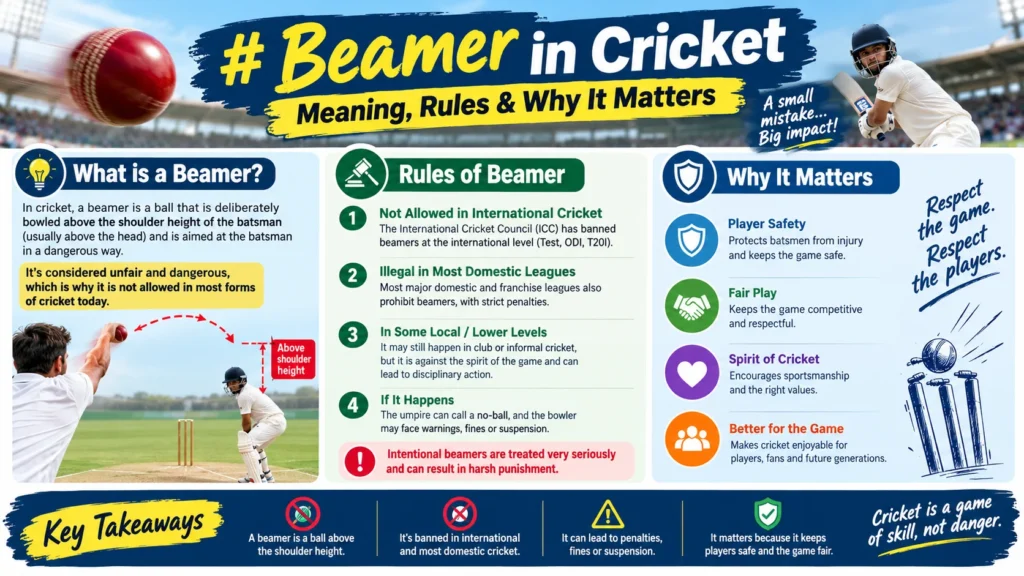

A beamer in cricket is an illegal delivery where the ball reaches the batsman above waist height without bouncing. It is considered dangerous and unfair because batsmen expect the ball to pitch before reaching them. The umpire signals an immediate no-ball, and in limited-overs cricket, the next delivery becomes a free hit. Bowlers receive a warning for a first beamer, while a second beamer in the same innings can result in being barred from bowling for the remainder of the match.
Cricket is a sport rich with terminology, from googlies to yorkers to silly mid-offs. But few terms carry the weight of danger and controversy quite like the beamer. Whether you’re a newcomer to the sport or a seasoned fan, understanding what a beamer is and why it sparks such strong reactions is essential to appreciating the game’s intricate rules and the delicate balance between aggression and safety.
What Is a Beamer in Cricket?
A beamer (also known as a beam ball) is a type of delivery in cricket where the ball reaches the batsman above waist height without bouncing on the pitch. In technical terms, it is a high full toss that passes the batsman at or above waist level when the batsman is standing upright at the popping crease.
What makes the beamer particularly dangerous is the element of surprise. Batsmen are trained to expect the ball to pitch before reaching them, allowing them to judge its trajectory and play accordingly. When a ball doesn’t bounce, it gives the batsman far less time to react, making it difficult to evade or play the delivery.
How Does a Beamer Differ from a Bouncer?
It’s important to distinguish between a beamer and a bouncer, as they are often confused:
| Aspect | Beamer | Bouncer |
| Bounces | No reaches batsman on the full | Yes bounces before reaching batsman |
| Legality | Illegal | Legal |
| Height | Passes above waist without bouncing | Can rise to head height after bouncing |
| Penalty | No-ball + possible suspension | No penalty (unless dangerous repetition) |
| Intent | Usually accidental, sometimes deliberate | Often tactical/intimidatory |
A bowler can legally target a batsman’s head with a ball that bounces that’s a bouncer, and it’s part of the game’s tactical fabric. However, a beamer that reaches the batsman above waist height without bouncing is always illegal, regardless of intent.
Why Do Beamers Happen?
Beamers are usually accidental. The most common causes include:
- Sweaty hands causing the ball to slip during release
- A wet ball from dew or damp outfield conditions
- A misjudged yorker that goes wrong bowlers aiming for the blockhole sometimes release the ball too late, resulting in a full toss that rises to waist height
However, beamers can be deliberate. Some fast bowlers have been accused of using the beamer as an intimidatory tactic, aiming to unsettle or even injure batsmen. This is considered highly contrary to the spirit of cricket and sportsmanship.
The Rules and Penalties for a Beamer
Beamers are governed by Law 41.7 of the Laws of Cricket, which concerns the bowling of dangerous and unfair non-pitching deliveries.
Immediate Penalties
| Format | Penalty |
| All formats | Umpire signals no-ball immediately |
| Twenty20 & ODIs | Next delivery becomes a free hit |
| Test matches | No free hit (currently) |
Warnings and Suspension
- First beamer: The umpire issues a formal warning to the bowler for dangerous bowling
- Second beamer (same innings): The umpire suspends the bowler from bowling for the remainder of the innings
In a famous incident, Pakistani spinner Abdur Rehman bowled three consecutive beamers in the 2014 Asia Cup against Bangladesh. He was banned from the match without having bowled a single legitimate delivery the first time this had happened in cricket history.
Beamer vs Full Toss: What’s the Difference?
A full toss is simply a delivery that reaches the batsman without bouncing. Not all full tosses are beamers. A full toss that passes below waist height is perfectly legal. It only becomes a beamer when it passes above waist height.
Key distinction: All beamers are full tosses, but not all full tosses are beamers.
The MCC Law Change (2017-2018)
In October 2017, the MCC introduced a stricter version of Law 41.7. The amended law stated that any bowler who delivered more than one beamer in a game regardless of speed or height had to be taken out of the attack.
However, this proved controversial. The rule was seen as overly harsh, particularly for spin bowlers whose full tosses might drift above waist height at much slower speeds. In November 2018, the MCC amended the law again, giving umpires greater discretion to judge whether a delivery was genuinely dangerous rather than applying an automatic suspension.
Famous Beamer Incidents
Brett Lee’s Controversies
Australian fast bowler Brett Lee faced persistent accusations of bowling beamers deliberately. He was involved in multiple incidents, including a notorious beamer to England’s Marcus Trescothick at Lord’s and another to New Zealand’s Brendon McCullum.
Former Australian Test bowler Rodney Hogg admitted that the beamer was part of his own bowling arsenal: “It was part of the game. There was no rule that said you couldn’t.”
Waqar Younis (2003 World Cup)
Pakistani fast bowler Waqar Younis was barred from bowling for the remainder of a match during the 2003 Cricket World Cup after bowling a beamer.
Rohit Sharma and Rubel Hossain (2015 World Cup)
During the 2015 ICC World Cup quarter-final between India and Bangladesh, Rubel Hossain bowled a high full toss to Rohit Sharma. The umpire ruled it a no-ball (beamer), allowing Rohit to survive and go on to score 137 runs. The decision sparked outrage among Bangladeshi fans and intense social media debate.
Shaheen Afridi’s BBL Debut (2025)
In his Big Bash League debut, Pakistani paceman Shaheen Afridi was pulled from the attack after bowling two waist-high no-balls (beamers) in the same over.
Can a Spinner Bowl a Beamer?
Yes, spin bowlers can bowl beamers too, though they are generally less dangerous than those from fast bowlers because of the reduced pace. The rules apply equally to all bowlers, though the MCC’s 2018 amendment gave umpires discretion to consider the speed of the delivery when deciding on sanctions.
Beamer in Baseball: The Beanball Connection
Interestingly, cricket’s beamer has a close cousin in baseball: the beanball. A beanball is a pitch thrown intentionally at a batter’s head with the aim of causing harm or intimidation. The terms are directly equivalent, and some people even use “beaner” to describe the cricket delivery.
Beamer Frequency by Bowler Type
| Bowler Type | Beamer Likelihood | Danger Level | Common Cause |
| Fast bowler | Higher | Very high | Slipped release, misjudged yorker |
| Spin bowler | Lower | Moderate | Drift, wet ball |
| Young/inexperienced | Highest | Variable | Poor technique |
| Experienced pro | Low | High (if deliberate) | Intimidation tactic |
FAQs
1. What is a beamer in cricket?
A beamer is an illegal delivery in cricket where the ball reaches the batsman above waist height without bouncing. It is considered dangerous because batsmen expect the ball to pitch first, making it difficult to react to or evade.
2. Is a beamer a no-ball?
Yes, a beamer is automatically called a no-ball by the umpire. The umpire signals it immediately, and the batting side receives an extra run. In limited-overs cricket, the next delivery becomes a free hit.
3. What happens if a bowler bowls a beamer?
The umpire calls a no-ball and issues a warning. If the bowler bowls a second beamer in the same innings, they are suspended from bowling for the remainder of the innings.
4. What’s the difference between a beamer and a bouncer?
A bouncer bounces on the pitch before reaching the batsman and is legal. A beamer doesn’t bounce and reaches the batsman above waist height, making it illegal. Bouncers are easier to play because batsmen can track the ball off the pitch.
5. Can a spinner bowl a beamer?
Yes, spin bowlers can bowl beamers too. However, they are generally less dangerous than those from fast bowlers due to the reduced pace. The rules apply equally to all bowlers.
6. Why do bowlers bowl beamers?
Most beamers are accidents caused by sweaty hands, a wet ball, or a misjudged yorker that goes wrong. However, some bowlers have been accused of bowling beamers deliberately to intimidate batsmen.
7. What is Law 41.7 in cricket?
Law 41.7 governs the bowling of dangerous and unfair non-pitching deliveries (beamers). It states that any delivery passing above waist height without bouncing is deemed dangerous and unfair, resulting in a no-ball.
8. Has anyone been banned for bowling beamers?
Yes. Pakistani spinner Abdur Rehman was banned from a match in the 2014 Asia Cup after bowling three consecutive beamers. Waqar Younis was also barred from bowling in a 2003 World Cup match.
9. Is a beamer the same as a full toss?
No. A full toss is any delivery that reaches the batsman without bouncing. It only becomes a beamer when it passes above waist height. Full tosses below waist height are perfectly legal.
10. What is a beamer called in baseball?
In baseball, the equivalent of a beamer is called a beanball a pitch thrown intentionally at a batter’s head. The terms are directly related, and some people use “beaner” to describe the cricket delivery
CONCLUSION
The beamer occupies a unique and controversial place in cricket. It’s a delivery that can be accidental or deliberate, a moment of misfortune or a calculated act of intimidation. Either way, it’s a reminder that cricket, despite its reputation as a gentleman’s game, carries real risks and that the laws of the sport must constantly evolve to protect players.
Understanding beamers is about more than just learning a cricket term. It’s about appreciating the balance between aggression and safety, the role of umpires in maintaining fair play, and the ongoing conversation about how to keep the game both competitive and safe. From the infamous incidents involving Brett Lee to the dramatic law changes of recent years, the beamer has shaped cricket’s history and will continue to influence its future.
Whether you’re a player, a fan, or simply curious about cricket’s fascinating terminology, knowing what a beamer is and why it matters deepens your appreciation for one of the world’s most complex and captivating sports.