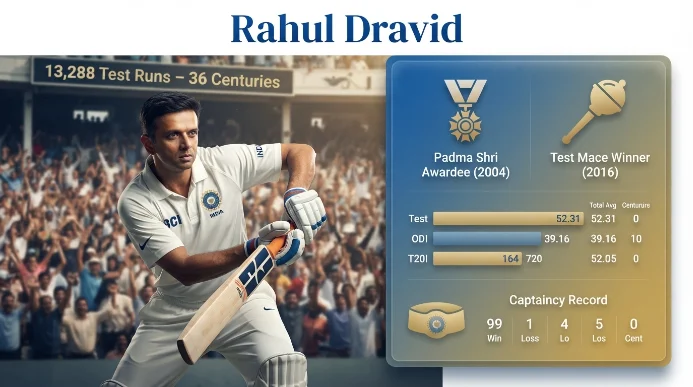

Rahul Dravid, famously known as “The Wall,” is one of the greatest batsmen in cricket history. He scored 13,288 runs in Test cricket and 10,889 runs in ODIs, with a total of 48 international centuries. Beyond his playing career, Dravid served as the head coach of the Indian cricket team, guiding them to the 2023 ODI World Cup final. He is a recipient of the Padma Bhushan and was inducted into the ICC Hall of Fame in 2018.
Cricket has produced many greats, but few have embodied resilience, discipline, and technical perfection like Rahul Dravid. The man from Karnataka didn’t just play cricket – he redefined what it meant to be a Test batsman. In an era dominated by flamboyant stroke-makers, Dravid stood tall as the ultimate anchor, the player who could bat for days and wear down the best bowling attacks in the world.
Rahul Sharad Dravid was born on January 11, 1973, in Indore, Madhya Pradesh, but grew up in Bangalore, Karnataka. Cricket was in his blood – his mother, Pushpa, was a professor of architecture, and his father, Sharad, worked as a food scientist. Young Rahul showed exceptional talent early, representing Karnataka at the under-15, under-17, and under-19 levels.
He made his first-class debut for Karnataka in 1991 during the Ranji Trophy. His technique was impeccable from the start – a high elbow, a straight bat, and an unshakeable temperament. By the time he was called up to the national team, he had already scored heavily in domestic cricket, catching the selectors’ attention with his hunger for runs and patience at the crease.
International Debut
Rahul Dravid made his ODI debut on April 3, 1996, against Sri Lanka in the Singer Cup in Singapore. His Test debut followed shortly after, on June 20, 1996, at Lord’s – the Mecca of cricket – against England. Walking in at No. 7, he scored 95 runs in a losing cause, but the cricket world had witnessed the arrival of something special. He followed it up with a fighting 84 in the second innings at Trent Bridge.
That England tour marked the beginning of a 16-year international career that would see Dravid become India’s most reliable batsman in pressure situations.
Test Cricket Legacy – The Wall
Dravid’s Test career is the stuff of legends. He played 164 Test matches and scored 13,288 runs at an average of 52.31. He registered 36 Test centuries and 63 half-centuries, with a highest score of 270 against Pakistan in Rawalpindi (2004).
What set Dravid apart was his ability to bat in all conditions. Whether it was the swinging conditions of England, the bouncy tracks of Australia, or the turning pitches of India, Dravid had a method for every challenge. He scored centuries in all major Test-playing nations – a testament to his adaptability and skill.
His most famous innings came in 2001 against Australia in Kolkata, where he scored 180 runs in the second innings, partnering VVS Laxman in a 376-run stand that turned the match on its head. That series victory ended Australia’s 16-match winning streak and is considered one of the greatest comebacks in cricket history.
ODI Career
While Dravid was primarily a Test specialist, his ODI career was equally impressive. He played 344 ODIs, scoring 10,889 runs at an average of 39.16, with 12 centuries and 83 half-centuries. He also kept wickets for India in the 2003 World Cup, showcasing his versatility and team-first attitude.
Dravid was the highest run-scorer for India in the 1999 World Cup and played a crucial role in India’s run to the 2003 World Cup final. His ability to anchor the innings and accelerate when needed made him a vital cog in India’s ODI setup.
Captaincy Tenure
Rahul Dravid captained India in 25 Test matches (winning 8) and 79 ODIs (winning 42). He took over the captaincy in 2005 after Sourav Ganguly stepped down. While his captaincy record wasn’t as glittering as some of his predecessors or successors, Dravid led the team with dignity and tactical acumen.
One of his finest moments as captain came in 2006 when India won a Test series in the West Indies after 35 years. He also led India to a historic Test series win in England in 2007. His calm demeanor and thoughtful approach earned him respect from teammates and opponents alike.
Playing Style and Technique
Why was Rahul Dravid called “The Wall”? The nickname came from his ability to block out the best bowlers for hours on end. His defensive technique was flawless – high elbow, straight bat, soft hands, and perfect footwork. He rarely played away from his body and had an exceptional ability to leave the ball outside off-stump.
But Dravid wasn’t just a blocker. He had a full range of shots – the cover drive, the square cut, the flick off the pads, and even the occasional hook shot. He was particularly strong against spin bowling, using his feet to get to the pitch of the ball and play with the turn.
Dravid’s mental strength was his greatest asset. He could concentrate for hours, sometimes days, without losing focus. His 12-hour innings of 270 against Pakistan in 2004 remains one of the longest individual innings in Test cricket.
Key Partnerships and Iconic Knocks
- *233* vs Australia, Adelaide (2003)* – One of the finest fourth-innings knocks, guiding India to a historic win
- 180 vs Australia, Kolkata (2001) – The partnership with Laxman that changed the series
- 270 vs Pakistan, Rawalpindi (2004) – His highest Test score
- 148 vs England, Headingley (2002) – A masterclass in swinging conditions
- *103* vs England, The Oval (2002)* – Another match-winning knock
Awards and Honours
Rahul Dravid’s trophy cabinet is as impressive as his run tally:
| Award | Year |
| ICC Hall of Fame Inductee | 2018 |
| Padma Bhushan (India’s third-highest civilian award) | 2013 |
| Padma Shri (India’s fourth-highest civilian award) | 2004 |
| ICC Player of the Year | 2004 |
| Wisden Cricketer of the Year | 2000 |
| Sir Garfield Sobers Trophy (ICC Cricketer of the Year) | 2004 |
Post-Retirement Coach and Mentor
After retiring from international cricket in 2012, Dravid didn’t walk away from the game. He took on the role of mentor for the Rajasthan Royals in the IPL and later became the head of the National Cricket Academy (NCA) in Bengaluru. At the NCA, he worked tirelessly to develop young talent, shaping the careers of players like Rishabh Pant, Shubman Gill, and Prithvi Shaw.
In November 2021, Dravid was appointed the head coach of the Indian cricket team. His tenure, which lasted until the 2023 ODI World Cup, was marked by a focus on player welfare, clear communication, and a positive team culture. He guided India to the final of the 2023 ODI World Cup, where they lost to Australia in a heartbreaking match. He stepped down after the tournament but left behind a legacy of professionalism and humility.
In 2026, Dravid continues to be involved with Indian cricket in various advisory capacities, though he has stepped back from full-time coaching roles.
Rahul Dravid’s Records at a Glance
| Format | Matches | Runs | Highest | Average | 100s | 50s |
| Test | 164 | 13,288 | 270 | 52.31 | 36 | 63 |
| ODI | 344 | 10,889 | 153 | 39.16 | 12 | 83 |
| T20I | 1 | 0 | 0 | 0.00 | 0 | 0 |
| First-Class | 298 | 23,794 | 270 | 55.22 | 68 | 117 |
| IPL | 89 | 2,174 | 75* | 28.23 | 0 | 11 |
Interesting Facts
- Dravid is one of only four Indian cricketers to have scored over 10,000 runs in both Tests and ODIs – the others being Sachin Tendulkar, Sourav Ganguly, and Virat Kohli.
- He holds the record for the most catches by a non-wicketkeeper in Test cricket – 210 catches in 164 matches.
- Dravid was the first Indian cricketer to score a century in all 10 Test-playing nations at the time.
- He has been involved in 88 century partnerships in Test cricket, the most by any batsman.
- Dravid was offered a scholarship to study at Harvard University but chose cricket instead.
- He is one of the few cricketers to have batted in all 11 positions in ODIs, showcasing his team-first attitude.
- Dravid holds the record for the longest individual innings in terms of minutes – 270 against Pakistan took him 12 hours and 39 minutes.
- He was the player of the tournament in the 1999 World Cup for India.
- Dravid’s nickname “The Wall” was coined by former India captain Sourav Ganguly.
- He is an avid reader and has a personal library of over 2,000 books.
Comparison Rahul Dravid vs Other Indian Batting Greats (Test Stats)
| Player | Matches | Runs | Average | 100s | 50s |
| Sachin Tendulkar | 200 | 15,921 | 53.78 | 51 | 68 |
| Rahul Dravid | 164 | 13,288 | 52.31 | 36 | 63 |
| Sunil Gavaskar | 125 | 10,122 | 51.12 | 34 | 45 |
| VVS Laxman | 134 | 8,781 | 45.97 | 17 | 56 |
| Virat Kohli | 113 | 8,848 | 49.15 | 29 | 30 |
Dravid’s Century Breakdown by Country
| Country | Number of Centuries |
| India | 10 |
| England | 6 |
| West Indies | 5 |
| Australia | 4 |
| Pakistan | 3 |
| Sri Lanka | 3 |
| New Zealand | 2 |
| South Africa | 2 |
| Bangladesh | 1 |
| Zimbabwe | 1 |
FAQs
1. Why is Rahul Dravid called “The Wall”?
Rahul Dravid earned the nickname “The Wall” because of his impenetrable defensive technique and his ability to bat for long hours without getting dismissed. He could block the best bowlers in the world on the toughest pitches, making him almost impossible to dislodge. Former captain Sourav Ganguly is credited with coining this iconic nickname.
2. How many Test runs did Rahul Dravid score in his career?
Rahul Dravid scored 13,288 runs in Test cricket from 164 matches at an impressive average of 52.31. He remains India’s second-highest run-scorer in Test cricket, behind only Sachin Tendulkar (15,921 runs).
3. How many international centuries did Rahul Dravid score?
Dravid scored a total of 48 international centuries – 36 in Test matches and 12 in ODIs. He also scored 146 half-centuries across both formats (63 in Tests and 83 in ODIs), making him one of the most consistent run-getters in cricket history.
4. Is Rahul Dravid in the ICC Hall of Fame?
Yes, Rahul Dravid was inducted into the ICC Hall of Fame in July 2018. He joined an elite group of cricketing legends, including his former teammates Sachin Tendulkar, Anil Kumble, and VVS Laxman, who were also inducted in the same year.
5. What was Rahul Dravid’s highest Test score?
Dravid’s highest Test score is 270, which he scored against Pakistan in Rawalpindi in April 2004. This innings lasted 12 hours and 39 minutes and remains one of the longest individual innings in Test cricket history.
6. When did Rahul Dravid retire from international cricket?
Rahul Dravid announced his retirement from international cricket on March 9, 2012. His last Test match was against Australia in Adelaide in January 2012, and his final ODI was against England in Cardiff in September 2011.
7. Was Rahul Dravid a good captain for India?
Dravid captained India in 25 Tests (winning 8) and 79 ODIs (winning 42). While his win percentage wasn’t the highest, he led India to historic Test series wins in England (2007) and the West Indies (2006). His calm and tactical approach earned him respect, even if results didn’t always go his way.
8. What is Rahul Dravid doing now (2026)?
As of 2026, Rahul Dravid continues to be involved with Indian cricket in advisory and mentoring roles. He stepped down as the head coach of the Indian team after the 2023 ODI World Cup but remains a respected figure in the BCCI setup, often consulted for talent development and strategic decisions.
9. How did Rahul Dravid perform as India’s head coach?
Dravid’s tenure as India’s head coach (2021–2023) was widely praised. He guided India to the final of the 2023 ODI World Cup, the final of the World Test Championship (2023), and the semi-finals of the 2022 T20 World Cup. His emphasis on player welfare, clear communication, and a positive team culture transformed the dressing room.
10. What awards has Rahul Dravid won?
Dravid has received numerous awards, including the Padma Bhushan (2013), Padma Shri (2004), ICC Player of the Year (2004), and the Sir Garfield Sobers Trophy. He was also named Wisden Cricketer of the Year in 2000 and inducted into the ICC Hall of Fame in 2018.
CONCLUSION
Rahul Dravid is more than a cricketer – he is an institution. In an era of flamboyance and aggression, he stood as a beacon of classical batting, proving that patience, discipline, and technical perfection could conquer the best bowling attacks in the world. His 13,288 Test runs, 48 international centuries, and 210 catches in the slips are not just numbers – they are a testament to a career built on hard work and humility.
But Dravid’s legacy extends far beyond his playing days. As a mentor at the National Cricket Academy and later as India’s head coach, he shaped the next generation of Indian cricketers. He taught them not just how to bat, but how to conduct themselves on and off the field. His influence can be seen in players like Rishabh Pant, Shubman Gill, and KL Rahul – all of whom have spoken about the impact Dravid had on their careers.
“The Wall” didn’t just block deliveries – he blocked out distractions, egos, and shortcuts. He showed that cricket is a game of character as much as skill. Whether you are a young cricketer dreaming of playing for India or a fan who grew up watching him bat for hours, Rahul Dravid’s story is a reminder that greatness is not about flashiness – it’s about showing up every single day and giving your best. That, perhaps, is his greatest legacy.