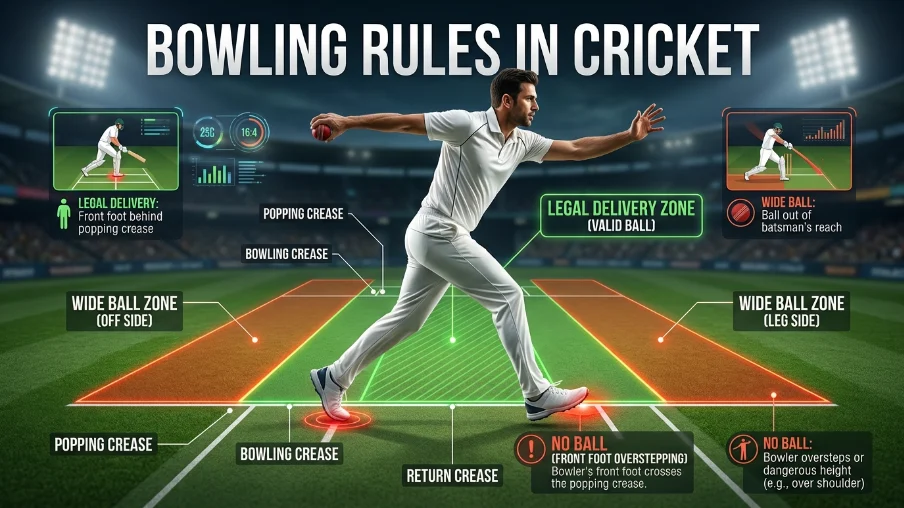

Bowling rules in cricket define how a bowler delivers the ball legally toward the batter. A legal delivery must be bowled overarm, without bending the elbow excessively, and with the front foot behind the popping crease. If a bowler violates rules such as overstepping (no ball) or bowling too wide it results in penalties, extra runs, and sometimes free hits depending on the format.
Cricket is a game of precision, discipline, and strategy and bowling sits right at its core. Understanding bowling rules in cricket is essential whether you’re a beginner, a player, or just a fan trying to follow the game more closely.
Bowling isn’t just about throwing the ball toward the batter. It involves strict laws that govern how the ball is delivered, how many balls are bowled in an over, and what counts as a mistake. These rules ensure fairness, maintain game balance, and keep the contest between bat and ball competitive.
In this guide, you’ll learn everything from basic rules to advanced regulations used in international cricket.
What Is Bowling in Cricket?
Bowling is the act of delivering the cricket ball toward the batter with the aim of dismissing them or restricting runs.
Unlike throwing, bowling must follow a specific overarm motion. The bowler runs up, releases the ball, and tries to outsmart the batter using speed, spin, or accuracy.
Basic Bowling Rules in Cricket
Here are the core rules every bowler must follow:
- Must bowl with a straight arm (no throwing)
- Ball must be delivered overarm
- Front foot must land behind the popping crease
- Deliveries must be within the batter’s reachable area (not too wide)
- Each over consists of 6 legal balls
What Is a Legal Delivery?
A delivery is considered legal when:
- The bowler’s arm does not straighten illegally
- The front foot stays within the crease
- The ball is not thrown
- The ball is not dangerously high
If any of these conditions fail, the delivery becomes illegal.
Types of Illegal Deliveries
1. No Ball
A no ball occurs when a bowler breaks key rules.
Common reasons:
- Overstepping the crease
- Throwing instead of bowling
- Dangerous full toss above waist height
- More than one bounce before reaching batter
Penalty:
- 1 extra run
- Ball does NOT count in over
- Free hit (limited overs cricket)
2. Wide Ball
A wide is called when the ball is too far from the batter to hit.
Key points:
- Outside reachable area
- Above head height (in limited formats)
- Adds 1 extra run
No Ball vs Wide Ball (Comparison Table)
| Rule Aspect | No Ball | Wide Ball |
|---|---|---|
| Cause | Illegal action | Poor line |
| Extra Run | Yes (1 run) | Yes (1 run) |
| Counts in Over | No | No |
| Free Hit | Yes (limited overs) | No |
| Main Fault | Technique | Accuracy |
Bowling Creases Explained
Bowling rules depend heavily on the pitch markings.
Key Creases:
- Popping Crease: Front foot must stay behind this line
- Bowling Crease: Marks bowler’s position
- Return Crease: Limits sideways movement
Understanding these is crucial to avoid no balls.
Over Rules in Cricket
An over is a set of 6 legal deliveries.
Key Points:
- Illegal deliveries (no ball/wide) are not counted
- Overs rotate between bowlers
- Same bowler cannot bowl consecutive overs
Bowling Action Rules
One of the strictest rules in cricket.
Legal Action:
- Arm must not bend more than 15 degrees
- Must use a smooth overarm motion
Illegal Action (Throwing/Chucking):
- Sudden elbow straightening
- Leads to suspension after testing
Fielding Restrictions for Bowlers
In modern cricket formats, bowlers must follow field placement rules.
Example (T20/ODI Powerplay):
- Limited fielders outside circle
- Helps batting team score more
Bowling Limits in Different Formats
| Format | Overs per Bowler |
|---|---|
| Test | Unlimited |
| ODI | Max 10 overs |
| T20 | Max 4 overs |
Types of Bowling in Cricket
Bowling styles must still follow rules.
Fast Bowling
- Focus on speed
- Requires strict control to avoid no balls
Spin Bowling
- Uses turn instead of speed
- More control, fewer wides
Why Bowling Rules Exist
These rules ensure:
- Fair competition
- Player safety
- Balanced gameplay
- Standardized international matches
Without rules, bowlers could dominate unfairly.
Common Bowling Mistakes
- Overstepping (no ball)
- Bowling too wide
- Illegal action
- Poor line and length
Beginners often struggle with accuracy more than rules.
TABLE (Common Penalties)
| Violation | Result |
|---|---|
| No Ball | 1 run + free hit |
| Wide Ball | 1 run extra |
| Dangerous Bowling | Warning or suspension |
| Illegal Action | Ban after review |
FAQ
1. What are the basic bowling rules in cricket?
Bowling rules require the bowler to deliver the ball overarm with a straight arm, keep the front foot behind the crease, and bowl within a fair line. Any violation results in penalties like no balls or wides.
2. What is a no ball in cricket?
A no ball occurs when the bowler breaks rules such as overstepping, throwing, or delivering a dangerous ball. It results in an extra run and does not count as a legal delivery.
3. What is a wide ball?
A wide ball is delivered too far from the batter to reach or hit properly. It results in an extra run and must be re-bowled.
4. How many balls are in an over?
An over consists of six legal deliveries. Illegal deliveries like no balls and wides are not counted.
5. Can a bowler bowl consecutive overs?
No, a bowler cannot bowl two consecutive overs. Overs must alternate between bowlers.
6. What is illegal bowling action?
An illegal action involves excessive bending or straightening of the arm beyond allowed limits, often called chucking.
7. What happens on a free hit?
After a no ball in limited-overs cricket, the next delivery is a free hit where the batter cannot be dismissed in most ways.
8. What is the popping crease?
The popping crease is the line a bowler must not cross with their front foot while delivering the ball.
9. Are bowling rules different in T20 and Test cricket?
The core rules remain the same, but limits on overs and field restrictions vary across formats.
10. Why is bowling regulated strictly?
Strict rules ensure fairness, prevent injury, and maintain balance between bat and ball.
CONCLUSION
Understanding bowling rules in cricket is essential for anyone who wants to truly appreciate the game. From legal delivery techniques to penalties like no balls and wides, every rule plays a role in keeping cricket fair and competitive.
Bowling is not just about speed or spin it’s about discipline, precision, and control. Whether you’re watching a Test match or a fast-paced T20 game, these rules ensure that every delivery counts and every mistake has consequences.
As cricket continues to evolve in 2026 and beyond, the fundamentals of bowling remain the same. Mastering these rules will not only improve your understanding but also deepen your enjoyment of the sport.