
A cricket umpire counter is a small device used by cricket umpires to keep track of balls, overs, and other match details during play. It helps an umpire maintain an accurate count without relying only on memory, especially during long or busy innings.
If you searched for the cricket umpire counter meaning, how it works, or what the buttons on one of these counters do, this guide explains it in simple terms.
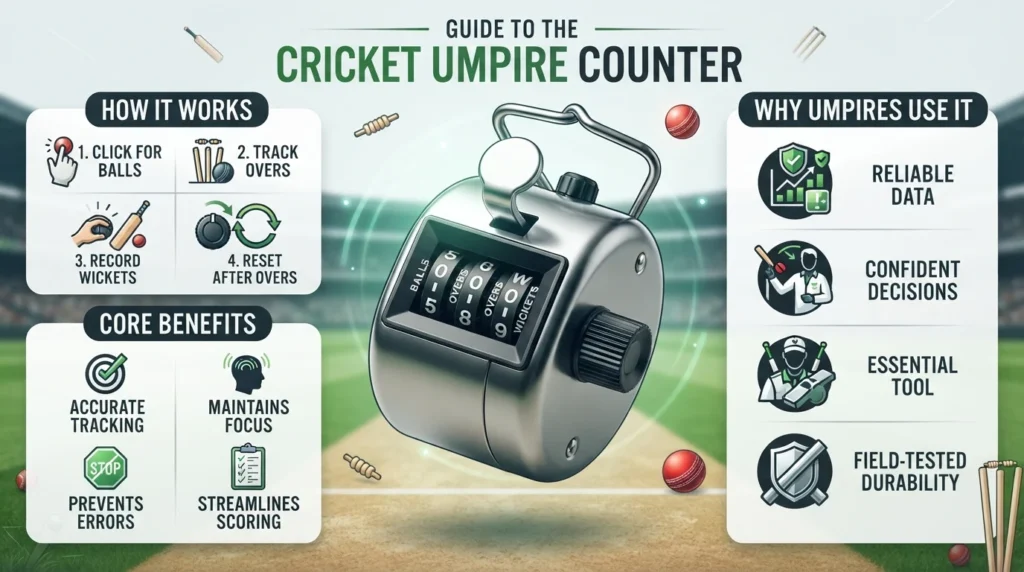
A cricket umpire counter is a handheld counting device used by umpires to track deliveries and other match information. Most traditional counters have separate controls for balls, overs, wickets, or similar events. It helps reduce counting mistakes and keeps the umpire focused on the match.
What Does Cricket Umpire Counter Mean?
The term refers to a counting device carried by a cricket umpire.
During an over, the umpire needs to know how many legal deliveries have been bowled. A counter provides a simple way to keep track of that number.
For example, if an umpire has recorded five legal deliveries, the counter can help show that five balls have been completed. After the sixth legal delivery, the over finishes and the count resets for the next over.
The exact design varies between counters. Some are basic mechanical clickers, while others are designed specifically for cricket and include multiple counting functions.
Is It a Cricket Umpire Counter or Umpire Clicker?
You may see several terms used for the same type of equipment.
Common descriptions include:
- Cricket umpire counter
- Umpire clicker
- Cricket counting clicker
- Ball counter
- Umpire tally counter
- Cricket over counter
- Handheld cricket counter
Umpire clicker usually describes the physical clicking action of a mechanical counter. Cricket umpire counter is a broader term that can include both mechanical and electronic models.
How Does a Cricket Umpire Counter Work?
A traditional counter normally has small buttons or controls that increase a number each time they are pressed.
A simple example looks like this:
- The umpire starts an over.
- A legal ball is bowled.
- The umpire presses the ball-count button.
- The display or mechanical dial increases.
- The process continues for each legal delivery.
- After six legal deliveries, the over ends.
- The umpire resets the ball count for the next over.
Some models contain separate counters, allowing an umpire to record more than one type of event.
Why Do Umpires Use Counters?
Counting deliveries may sound simple, but an umpire has several things to watch at the same time.
The umpire may need to monitor:
- Whether the delivery is legal
- The batter and non-striker
- The crease and popping crease
- No-balls
- Wides
- Run-outs
- Wickets
- Fielding positions
- Appeals
- Other match events
A counter provides an additional memory aid.
It does not replace the umpire’s judgment. It simply helps with one part of match management.
Legal Balls and Why the Counter Matters
One of the most useful reasons for using a counter is keeping track of legal deliveries.
A standard over consists of six legal balls. However, a wide or no-ball does not normally count as one of the six legal deliveries.
For example:
| Delivery | Legal Ball Count |
|---|---|
| Legal delivery | 1 |
| Legal delivery | 2 |
| Wide | Still 2 |
| Legal delivery | 3 |
| No-ball | Still 3 |
| Legal delivery | 4 |
| Legal delivery | 5 |
| Legal delivery | 6 |
The bowler therefore may deliver more than six actual balls during an over while still completing only six legal deliveries.
This is where a counter can be useful.
Mechanical vs Electronic Counters
There are two common styles of counting devices.
Mechanical Counter
A mechanical counter uses physical buttons and internal number wheels.
Advantages:
- Simple to operate
- Does not require batteries
- Usually lightweight
- Easy to understand
- Useful for basic umpiring
Limitations:
- Limited counting functions
- Mechanical parts can wear over time
- Small displays can be harder to read
Electronic Counter
An electronic model uses a digital display and buttons.
Advantages:
- Easy-to-read numbers
- Can offer multiple counters
- May provide additional functions
- Often more compact
Limitations:
- Requires a battery
- Electronic components can fail
- More features can make operation less simple
In professional cricket, umpires also have access to official scoring systems and support staff, but a physical counter can still serve as a personal aid.
What Other Things Can an Umpire Counter Track?
This depends on the model.
Some cricket-specific counters may allow the user to keep track of:
- Balls
- Overs
- Wickets
- Runs
- Innings
- Other match events
A basic tally counter may only count upward by one each time the button is pressed.
Before buying one, check the functions rather than assuming every cricket counter has the same controls.
How Is an Umpire Counter Different From a Cricket Scoreboard?
The two serve different purposes.
| Equipment | Main Purpose |
|---|---|
| Umpire counter | Helps the umpire keep track of events |
| Scoreboard | Shows match information to players and spectators |
| Scoring app | Records and manages detailed match statistics |
| Scorebook | Provides a written match record |
| Ball-tracking system | Provides more advanced match data |
A counter is mainly a personal counting aid.
When Should You Use One?
A counter can be useful if you are:
- Learning to umpire
- Umpiring club cricket
- Working with junior players
- Running practice matches
- Umpiring without a nearby scorer
- Looking for a simple backup counting method
For beginners, a basic mechanical counter can also help develop awareness of over progression.
When Should You Avoid Relying on One?
A counter should not become your only method of following the match.
An umpire still needs to understand the Laws of Cricket and watch what happens on every delivery.
Do not focus so heavily on pressing a button that you miss:
- A catch
- A run-out
- A no-ball
- A boundary
- An appeal
- Batter movement
- Fielding infringements
The match action always comes first.
Is Cricket Umpire Counter Formal or Informal?
The phrase is neutral and professional.
It is suitable for:
- Cricket equipment descriptions
- Coaching materials
- Umpire training documents
- Club cricket websites
- Product descriptions
- Cricket articles
- Sports discussions
It is not slang and does not have a special texting or social media meaning.
You would not normally use terms such as cricket umpire counter in casual conversation unless you are actually discussing cricket equipment.
Common Misunderstandings
It Does Not Count Every Ball in the Same Way
A cricket over contains six legal deliveries, not necessarily six physical deliveries.
Wides and no-balls can increase the number of deliveries bowled without increasing the legal-ball count.
It Does Not Replace the Scorer
A counter helps an umpire. It does not provide the detailed record produced by an official scorer.
Not Every Counter Is Made for Cricket
A standard tally counter can count numbers, but it may not have features designed for cricket.
Different Models Have Different Functions
One counter may only record balls, while another may have separate controls for several match events.
FAQs
What does cricket umpire counter mean?
It means a handheld counting device used by a cricket umpire to track deliveries and sometimes other match events.
How many balls does an umpire count in an over?
An over contains six legal deliveries. Wides and no-balls normally do not count toward those six legal balls.
Is an umpire counter the same as a clicker?
Often, yes. Umpire clicker is a common informal description of a mechanical counting device, while cricket umpire counter is a more specific term.
Can an umpire counter track wickets?
Some models can track wickets or other events, but basic tally counters may only count upward. Check the functions of the specific model.
Does an umpire counter replace the scorer?
No. It mainly helps the umpire keep track of selected events. An official scorer records much more detailed match information.
Is a cricket umpire counter useful for beginners?
Yes. It can help new umpires keep track of legal deliveries while they develop confidence and match awareness.
What is the main purpose of a cricket umpire counter?
Its main purpose is to help the umpire accurately track deliveries during an over and reduce counting mistakes.
Conclusion
A cricket umpire counter is a simple but useful tool that helps an umpire keep track of legal deliveries and, depending on the model, other match events. Its main value comes from reducing the mental effort involved in counting while the umpire concentrates on the action.
For beginners, club umpires, and cricket coaches, a basic counter can make over management easier. The key point is that the device supports the umpire’s work rather than replacing proper knowledge of cricket rules and match awareness.