
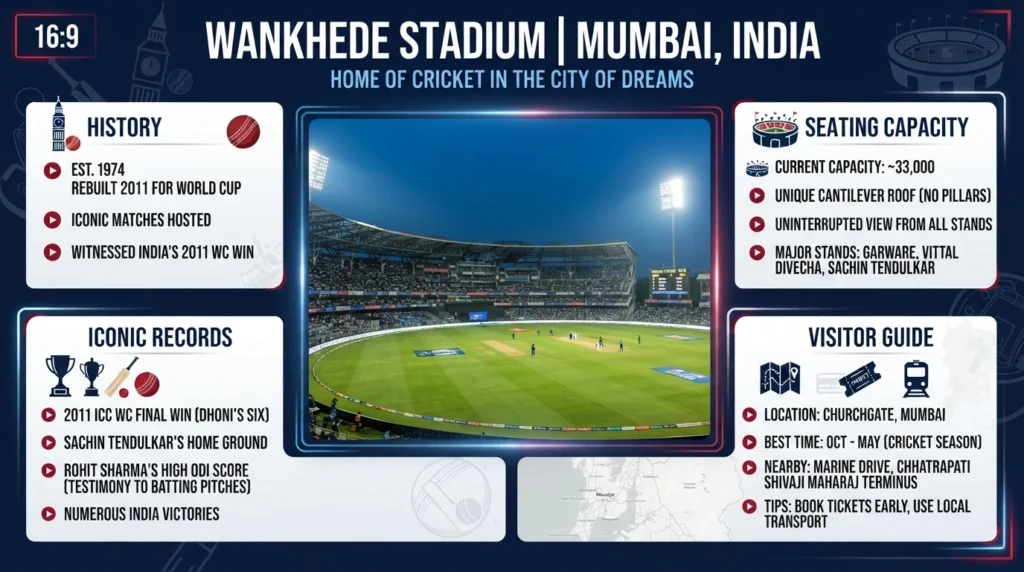

Wankhede Stadium is an international cricket ground in Mumbai, India, with a seating capacity of approximately 33,108. Built in 1974, it serves as the home ground of the Mumbai Indians and houses the headquarters of the BCCI. The stadium is renowned for its batting-friendly pitch with true bounce, though fast bowlers can exploit early swing due to the coastal sea breeze.
Wankhede Stadium has hosted numerous historic matches, including the 2011 ICC Cricket World Cup Final, where India lifted the trophy. The venue also witnessed Sachin Tendulkar’s emotional farewell Test in 2013. With modern facilities and a passionate crowd, it remains one of cricket’s most iconic venues.
Cricket in Mumbai pulses through the veins of millions, and at its heart stands the iconic Wankhede Stadium. Few sporting venues in the world can match the electric atmosphere, rich history, and sheer cricketing significance of this ground nestled in the Churchgate neighbourhood of South Mumbai. Whether you’re a die-hard cricket fan planning to catch an IPL match, a traveller curious about Mumbai’s sporting heritage, or someone researching cricket venues, understanding what makes Wankhede Stadium special is essential.
Why Was Wankhede Stadium Built?
The story of Wankhede Stadium begins with a dispute. Before its construction, Mumbai’s premier cricket venue was the Brabourne Stadium, owned by the Cricket Club of India (CCI). However, a disagreement between the CCI and the Bombay Cricket Association (BCA) – later renamed the Mumbai Cricket Association – over ticket allocations for matches forced the BCA to build its own stadium.
The BCA constructed the Wankhede Stadium just a mile away from Brabourne, naming it after the association’s president, Barrister Sheshrao Krishnarao Wankhede. The stadium was completed in 1974 and staged its first Test match during the 1974-75 season, when the West Indies toured India. Clive Lloyd scored an unbeaten 242 in that match, and India lost by 201 runs in what was also Mansur Ali Khan Pataudi’s final Test.
The stadium underwent major renovations ahead of the 2011 ICC Cricket World Cup, which reduced its capacity from around 45,000 to approximately 33,000. The renovations included upgraded facilities, bucket seating, improved floodlights, and the installation of suspended cantilever roofs that offer unobstructed views for spectators.
Location & How to Reach
| Detail | Information |
| Address | Netaji Subhash Chandra Bose Rd, Churchgate, Mumbai, Maharashtra, India |
| Neighbourhood | Churchgate, South Mumbai |
| Nearest Railway Station | Churchgate Station (Western Line) |
| Public Transport | Local trains, buses, taxis, and auto-rickshaws |
The stadium’s central location makes it easily accessible from anywhere in Mumbai. Churchgate railway station is just a short walk away, and several bus routes service the area.
Capacity & Seating
Wankhede Stadium’s capacity has changed over the years:
| Period | Capacity |
| 1974–2010 | ~45,000 |
| 2011–present | 33,108 |
The reduction in capacity resulted from the installation of individual bucket seats and upgraded facilities ahead of the 2011 World Cup. The stadium features a closed amphitheatre-type formation, which helps amplify crowd noise and creates one of the most intimidating atmospheres in world cricket.
Notable Stands:
- Sunil Gavaskar Stand
- Sachin Tendulkar Stand
- Vijay Merchant Stand
- Garware Pavilion
- Vithal Divecha Pavilion
- MCA Pavilion
- North Stand
In 2026, the Mumbai Cricket Association approved naming the Level 1 Stand below the Press Box after Ravi Shastri. Gates at the stadium have also been named after Vinoo Mankad, Polly Umrigar, Dilip Sardesai, Eknath Solkar, and Diana Edulji.
Pitch Conditions & Playing Surface
The Wankhede Stadium pitch is one of the most fascinating in world cricket, offering something for everyone.
Key Characteristics:
- Batting-friendly: The pitch traditionally offers true bounce and good pace, making it a batter’s paradise. The average first innings score in IPL matches is above 170.
- Red soil construction: The red soil ensures good bounce and some turn for spinners, especially during the later stages of a Test match.
- Sea breeze effect: The stadium’s proximity to the Arabian Sea means fast bowlers can extract early swing with the new ball, particularly during the morning and evening sessions.
- Spin assistance: Spinners come into play as the pitch wears, with significant turn available on days four and five of a Test match.
Historic Matches & Iconic Moments
Wankhede Stadium has been the stage for some of cricket’s most unforgettable moments:
2011 ICC Cricket World Cup Final (April 2, 2011)
India defeated Sri Lanka by six wickets to win the World Cup on home soil – the first time a host nation had achieved this feat. MS Dhoni’s famous winning six remains etched in every Indian cricket fan’s memory.
Sachin Tendulkar’s Farewell Test (November 2013)
The Master Blaster played his 200th and final Test match at Wankhede Stadium, bidding an emotional farewell to international cricket in front of his home crowd.
Ravi Shastri’s Six Sixes (1984-85)
In a Ranji Trophy match, Ravi Shastri hit six sixes in an over off Baroda’s Tilak Raj, en route to the then-fastest double-century in first-class cricket. India’s 2023 World Cup Semi-Final
India defeated New Zealand in the 2023 ICC Cricket World Cup semi-final at Wankhede, continuing the venue’s tradition of hosting high-stakes knockout matches.
First Test (1975)
The stadium’s first Test match saw Clive Lloyd score an unbeaten 242 as West Indies defeated India by 201 runs.
Vinod Kambli’s 224 (1992-93)
The highest score by an Indian at Wankhede remains Vinod Kambli’s 224 against England in only his third Test.
7. Ian Botham’s Heroics (1980)
In the Jubilee Test, Ian Botham scored a century and took 13 wickets to lead England to a 10-wicket victory.
FAQs
1. What is the capacity of Wankhede Stadium?
Wankhede Stadium has a seating capacity of approximately 33,108 following renovations for the 2011 Cricket World Cup. Originally, the stadium could hold around 45,000 spectators, but the installation of bucket seats and upgraded facilities reduced the capacity.2. When was Wankhede Stadium built?
Wankhede Stadium was built in 1974. It was constructed after a dispute between the Cricket Club of India (CCI) and the Bombay Cricket Association over ticket allocations for matches at Brabourne Stadium.3. Who owns Wankhede Stadium?
The stadium is owned and operated by the Mumbai Cricket Association (MCA). It also houses the headquarters of the Board of Control for Cricket in India (BCCI) and the Indian Premier League (IPL).4. Which IPL team plays at Wankhede Stadium?
The Mumbai Indians (MI) play their home matches at Wankhede Stadium. They are the most successful IPL franchise with five titles and have a strong home record at the venue.5. Is Wankhede Stadium a batting or bowling pitch?
Wankhede is primarily a batting-friendly pitch with true bounce and good pace. However, fast bowlers can get early swing due to the sea breeze, and spinners find assistance as the match progresses.6. What was the 2011 World Cup Final at Wankhede Stadium?
India defeated Sri Lanka by six wickets in the 2011 ICC Cricket World Cup Final at Wankhede Stadium on April 2, 2011. It was the first time a host nation won the World Cup on home soil.7. What is the highest individual score at Wankhede Stadium?
The highest individual score at Wankhede Stadium is 242* by Clive Lloyd of the West Indies, scored in the stadium’s first Test match in 1975. In the IPL, the record is 133* by AB de Villiers.8. How can I reach Wankhede Stadium?
The stadium is located in Churchgate, South Mumbai. The nearest railway station is Churchgate on the Western Line. It is also accessible by bus, taxi, and auto-rickshaw.9. What facilities does Wankhede Stadium offer?
The stadium features corporate boxes, a media centre, floodlights, 20 elevators, bucket seating, restrooms, food courts, and player dressing rooms. It also has statues of cricket legends like Sachin Tendulkar and Sunil Gavaskar.10. What matches are coming up at Wankhede Stadium?
In IPL 2026, Wankhede Stadium will host MI vs KKR (March 29), MI vs RCB (April 12), MI vs PBKS (April 16), MI vs CSK (April 23), MI vs SRH (April 29), MI vs LSG (May 4), and MI vs RR (May 24).
CONCLUSION
Wankhede Stadium stands as a monument to Indian cricket’s passion, history, and glory. From its origins born out of a administrative dispute to hosting the 2011 World Cup final and Sachin Tendulkar’s emotional farewell, this ground has witnessed the full spectrum of cricketing emotion. Its batting-friendly pitch, amplified by the sea breeze and the roar of 33,000 fans, creates an atmosphere that few venues in the world can match.
Whether you’re watching the Mumbai Indians defend their fortress in the IPL, witnessing a Test match under the famous Mumbai sun, or simply visiting to soak in the history, Wankhede Stadium offers an experience like no other. The venue continues to evolve – with new stands named after legends like Ravi Shastri and gates honouring Dilip Sardesai, Diana Edulji, and Eknath Solkar – ensuring that its legacy grows with each passing year.
For cricket fans around the world, a visit to Wankhede Stadium is more than just watching a game it’s a pilgrimage to one of cricket’s most sacred grounds.