
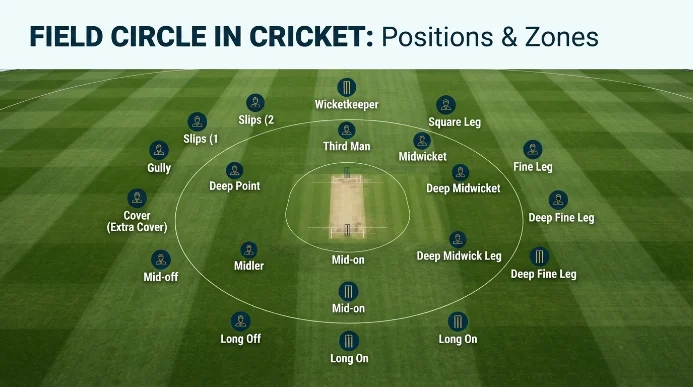

The field circle in cricket is a 30-yard radius circle from the center of the pitch that defines the infield area. Fielding restrictions apply based on this circle, with a maximum of two fielders allowed outside the circle during non-powerplay overs. The 30-yard circle is fundamental to cricket’s fielding regulations and powerplay rules, directly influencing batting and fielding strategies throughout limited-overs matches.
The cricket field circle, also known as the 30-yard circle, is one of the most crucial elements shaping modern limited-overs cricket. This circular boundary determines where fielders can stand during different phases of an innings, creating the tactical chess match between bat and ball. For players, understanding the field circle concept is essential for both batting and fielding strategies. As cricket evolved into a dynamic, high-scoring format, the field circle became a strategic tool that enhances the game’s excitement while maintaining fairness. Whether you’re a player, coach, or enthusiastic spectator, mastering the field circle rules and regulations is fundamental to comprehending the sport’s strategic depth.
What is Field Circle in Cricket?
The field circle in cricket refers to a circular area drawn on the ground with a radius of 30 yards (27.43 meters) from the center of the pitch. This circle divides the field into two main areas: the inner circle (inside the 30-yard circle) and the outer circle (outside the 30-yard line). The primary purpose of this marking is to enforce fielding restrictions, ensuring that teams cannot place all their fielders on the boundary to prevent scoring. The field circle is typically marked with white paint or temporary markers.
Official Rules and ICC Regulations
The International Cricket Council (ICC) has established clear regulations governing the field circle. During non-powerplay overs, a maximum of two fielders can be positioned outside the 30-yard circle. During powerplay overs, the number of fielders allowed outside the circle reduces to two or three, depending on the format and specific powerplay phase. The field circle rules are strictly enforced by on-field umpires, with penalties for violations including awarding five penalty runs to the batting side.
Why Does the Field Circle Exist in Cricket?
The field circle serves several essential purposes in cricket:
- Balancing bat and ball: The 30-yard circle ensures that fielding teams cannot simply place all fielders on the boundary, preventing one-sided matches where boundaries become too easy to score.
- Powerplay structure: The circle forms the basis of the powerplay system, where certain overs force fielding teams to have most fielders inside the circle, increasing scoring opportunities.
- Encouraging strategic fielding: Teams must carefully decide where to position their fielders based on opposition batsmen, match situation, and available fielding positions.
- Improving entertainment: The field circle rules create more competitive and exciting cricket, with a balanced contest between batting and bowling sides.
Fielding Positions Inside the Circle
Traditional Infield Positions:
- Slip: Behind the batsman on the off-side
- Gully: Just behind the slip area
- Point: At the off-side, perpendicular to the batsman
- Cover: Slightly straighter than point
- Mid-off: At the bowling end on the off-side
- Mid-on: At the bowling end on the leg-side
- Midwicket: In front of square on the leg side
- Square leg: At right angles to the batsman on the leg side
Inner Circle Positions (Inside 30-Yard Circle):
- Most close-in catching positions
- All traditional infield positions
- Close fielding positions like short leg and silly point
Fielding Positions Outside the Circle
The outer circle contains more specialized positions designed to stop boundaries and catch lofted shots. These include deep positions like:
- Third man: Behind the batsman on the off-side boundary
- Fine leg: Behind square on the leg-side boundary
- Deep square leg: Boundary position on the leg side
- Deep cover: Boundary position on the off side
- Long-off: Boundary position straight down the ground on the off side
- Long-on: Boundary position straight down the ground on the leg side
- Deep midwicket: Deep position behind square on the leg side
Powerplay and Fielding Restrictions
The powerplay system represents the strategic use of the field circle. Fielding restrictions are applied during different phases:
ODI Powerplay Rules:
- Powerplay 1 (overs 1-10): Maximum 2 fielders outside the circle
- Powerplay 2 (overs 11-40): Maximum 4 fielders outside the circle
- Powerplay 3 (overs 41-50): Maximum 5 fielders outside the circle
T20I Powerplay Rules:
- Powerplay (overs 1-6): Maximum 2 fielders outside the circle
- Post-powerplay: Maximum 5 fielders outside the circle
Test Cricket Rules:
- No powerplay overs
- No field circle restrictions
- Fielding teams can place all fielders on the boundary if desired
How is the Field Circle Measured and Marked?
The 30-yard circle is measured from the center of the pitch, with the mark placed at the exact center point between the two sets of stumps. The measurement is taken to the inner edge of the circle, not the outer edge, ensuring consistency across all cricket grounds. Groundsmen use specialized tools and templates to ensure the circle is accurately painted, often using temporary white paint that wears off after the match. The ICC requires all international cricket grounds to have clearly visible field circle markings that meet specific criteria.
Tactical Use of Field Circle in Cricket
Batting Strategies:
- Batsmen target specific gaps during powerplay overs when fielding restrictions are favorable
- Identifying fielders outside the circle helps batsmen plan scoring shots
- Understanding field placements allows batsmen to rotate strike effectively
Fielding Strategies:
- Captains must position fielders strategically based on batsmen’s strengths
- The number of fielders outside the circle determines bowling tactics
- Bowlers use the field circle to set up wickets while preventing runs
Bowling Considerations:
- Different bowling types require specific field placements
- Spinners and fast bowlers need different fielding arrangements
- Defensive bowling lines target areas where fielders can stop runs
Variations in Field Circle Across Cricket Formats
Limited-Overs Cricket (ODI and T20I):
- Strict fielding regulations with enforceable penalties
- Multiple powerplay phases with different restrictions
- Emphasizes aggressive batting and attacking bowling
Test Cricket:
- No field circle restrictions
- Unlimited fielders on the boundary
- Focuses on defensive bowling and patient batting
T10 Cricket:
- Even stricter powerplay rules
- Maximum 2 fielders outside circle for 4 overs
- Designed for maximum entertainment and scoring
Common Mistakes in Field Circle Understanding
- Not accounting for powerplay overs: Many new players and spectators don’t fully understand that fielding restrictions change after the powerplay ends.
- Misunderstanding boundary placements: The 30-yard circle is often confused with the boundary, though they are completely different.
- Ignoring fielding position classifications: Not all positions are clearly inside or outside the circle, and some positions require specific positioning.
- Overlooking ICC rule changes: Fielding regulations evolve frequently, and not staying updated can lead to confusion.
Evolution of Field Circle Rules
The 30-yard circle has evolved significantly since its introduction:
- 1960s-1990s: Basic field restrictions introduced to prevent negative bowling
- 2000s: Powerplay system introduced to improve entertainment value
- 2010s: Further refinements to powerplay rules for better balance
- 2020s: Modern field circle regulations optimized for all formats
Cricket Field Circle Knowledge Test
Test Your Understanding:
- What is the exact radius of a cricket field circle?
- A) 25 yards
- B) 30 yards
- C) 35 yards
- D) 40 yards
- During ODI powerplay 1, how many fielders can be outside the 30-yard circle?
- A) 2
- B) 4
- C) 5
- D) 6
- Which cricket format has no field circle restrictions?
- A) T20I
- B) ODI
- C) Test cricket
- D) T10
Answers: 1-B, 2-A, 3-C
Latest Updates in Field Circle Regulations
Recent changes to field circle rules include:
- Powerplay alignment: Fielding restrictions are now uniform across all international formats
- Stricter enforcement: Umpires now have automatic systems to detect fielding violations
- New fielding positions: Some positions are now officially recognized as inside the circle
- Enhanced technology: Third umpires can review fielding placements using advanced tracking systems
Field Circle Regulations by Tournaments
ICC Events:
- Standard field circle rules apply
- Uniform regulations for all ICC tournaments
- Strict enforcement by match officials
Domestic T20 Leagues:
- Consistent field circle rules with international cricket
- Some leagues have modified powerplay regulations
- Focus on maintaining consistent playing standards
Field Circle Rules Across Cricket Formats
| Format | Powerplay Overs | Fielders Outside Circle | Circle Radius | Boundary Length |
| T20I | Overs 1-6 | 2 | 30 yards | 65-80 yards |
| T20I (Post-PP) | Overs 7-20 | 5 | 30 yards | 65-80 yards |
| ODI (PP1) | Overs 1-10 | 2 | 30 yards | 65-85 yards |
| ODI (PP2) | Overs 11-40 | 4 | 30 yards | 65-85 yards |
| ODI (PP3) | Overs 41-50 | 5 | 30 yards | 65-85 yards |
| Test Cricket | No powerplays | No restrictions | No circle | 65-90 yards |
| T10 | Overs 1-4 | 2 | 30 yards | 60-75 yards |
Fielding Position Classification Table
| Position | Inside Circle | Outside Circle | Boundary |
| Slip | ✓ | ✗ | ✗ |
| Point | ✓ | ✗ | ✗ |
| Cover | ✓ | ✗ | ✗ |
| Midwicket | ✓ | ✗ | ✗ |
| Deep Cover | ✗ | ✓ | ✓ |
| Long-on | ✗ | ✓ | ✓ |
| Third Man | ✗ | ✓ | ✓ |
| Deep Square Leg | ✗ | ✓ | ✓ |
| Fine Leg | ✗ | ✓ | ✓ |
| Long-off | ✗ | ✓ | ✓ |
Field Circle Dimension Comparison
| Measurement | Meters | Yards | Feet |
| Circle Radius | 27.43 | 30 | 90 |
| Circle Diameter | 54.86 | 60 | 180 |
| Circle Circumference | 172.33 | 188.5 | 565.5 |
| Circle Area | 2,364 | 2,826 | 25,434 |
FAQs
1. What exactly is the field circle in cricket?
The field circle in cricket is a marked 30-yard radius circle from the center of the pitch that determines fielding restrictions. Fielders inside this circle cannot be counted as outside for powerplay purposes. The circle is crucial for enforcing fielding regulations and maintaining competitive balance between batting and bowling sides in limited-overs formats.
2. How many fielders can stand outside the 30-yard circle?
The number of fielders allowed outside the 30-yard circle varies by format and phase. In ODI powerplay overs, maximum 2 fielders; in ODI non-powerplay, maximum 5 fielders. In T20I powerplay, maximum 2 fielders; after powerplay, maximum 5 fielders. Test cricket has no field circle restrictions.
3. What is the difference between field circle and boundary?
The field circle is a marked 30-yard area from the pitch center, while the boundary marks the edge of the playing area. The field circle determines fielder placement restrictions, while the boundary determines how runs are scored. Fielders can stand anywhere, but restrictions apply based on the 30-yard circle.
4. Does the field circle exist in Test cricket?
Test cricket does not have field circle restrictions or powerplay overs. Teams can place any number of fielders on the boundary without restrictions. However, Test matches have other regulations, including over rate and fielding standards, but no specific field circle rules like limited-overs cricket.
5. How is the field circle measured accurately?
The field circle is measured from the exact center of the pitch, marked between the two sets of stumps. Groundsmen use measuring tapes, templates, and specialized equipment to draw accurate circles. The measurement is taken to the inner edge, ensuring the circle is precisely 30 yards in radius. International matches require ICC-approved circle markings.
6. What happens if a team violates field circle rules?
If a team violates field circle rules by having too many fielders outside the circle, umpires can signal and penalize the batting side with 5 penalty runs for each violation. The umpires can also warn the fielding captain and enforce additional restrictions if violations persist, ensuring fair play.
7. Why does the field circle have different rules for T20 vs ODI?
T20 and ODI have different powerplay systems to optimize each format’s unique characteristics. T20 matches have a shorter powerplay period (first 6 overs) to maximize early scoring, while ODI matches have three distinct powerplay phases (10, 30, and 10 overs) to balance different game stages. The field circle rules reflect these format-specific requirements.
8. Can a fielder be partially outside the circle?
For legal purposes, a fielder is considered outside the circle if any part of their body or equipment touches the ground outside the 30-yard line. This rule ensures clear boundaries for fielding restrictions and prevents players from gaining unfair advantages by positioning on the line.
9. How has technology impacted field circle enforcement?
Technology has significantly enhanced field circle enforcement. Modern cricket uses artificial intelligence, tracking systems, and camera-based monitoring to ensure fielding regulations are followed. Third umpires can review field placements using advanced technology, and automated systems help detect violations instantly for fair play.
10. What is the tactical significance of the field circle?
The field circle is strategically crucial as it determines how teams can position their fielders, affecting batting strategies, bowling tactics, and run-scoring opportunities. Captains and coaches must carefully plan field placements based on pitch conditions, batsmen’s strengths, and match situations to maximize their team’s chances of winning.
CONCLUSION
The field circle in cricket represents far more than a simple white mark on the ground it is the strategic foundation of modern limited-overs cricket. Understanding the 30-yard circle’s rules, regulations, and tactical implications is essential for players, coaches, and enthusiasts alike. From determining fielding positions to shaping powerplay strategies, the field circle transforms cricket into the dynamic, thrilling contest we witness today.
As cricket continues to evolve, the field circle remains at the heart of the game’s tactical evolution. Whether you’re watching the early powerplay overs in a T20 match or analyzing field placements in an ODI run-chase, the 30-yard circle constantly influences every ball bowled. The balance between bat and ball, maintained through field circle restrictions, ensures that cricket remains a fair and exciting sport where both batting brilliance and bowling