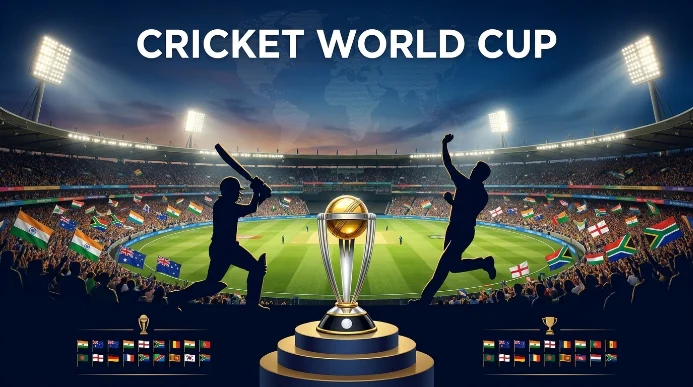

The ICC Cricket World Cup is the pinnacle of One Day International cricket, contested every four years since 1975. Australia holds the record with six titles, followed by India and West Indies with two each. The tournament features 14 teams in a newly revamped format including a Super Series preliminary round, group stage, and Super 7 round before the semi-finals and final.
The 2027 edition will be co-hosted by South Africa, Zimbabwe, and Namibia, marking cricket’s return to African soil after 24 years. This 14th edition runs from October to November 2027 across 12 venues.
Cricket’s greatest spectacle returns every four years, captivating billions of fans across the globe. The ICC Cricket World Cup stands as the sport’s most prestigious tournament a month-long festival of skill, drama, and national pride where cricketing legends are forged and history is written.
Since the first edition at England’s iconic Lord’s in 1975, the World Cup has grown from an eight-team invitational to a 14-team global showdown. The tournament has witnessed unforgettable moments: Kapil Dev’s 1983 underdogs shocking the mighty West Indies, Imran Khan lifting the trophy for Pakistan in 1992, and England’s boundary-count victory over New Zealand in the 2019 final.
Today, the World Cup continues to evolve. The ICC has introduced a dynamic new three-stage format featuring a Super Series, group stage, and Super 7 round to make every match count. With the 2027 edition heading to Africa, cricket’s flagship tournament promises to deliver more excitement than ever before.
Whether you are a lifelong fan or new to the game, understanding the ICC Cricket World Cup is essential to appreciating cricket’s rich heritage and its exciting future.
ARTICLE STRUCTURE
1. History of the ICC Cricket World Cup
Origins (1975) The inaugural ICC Cricket World Cup was held in England in 1975, featuring eight teams. West Indies, led by Clive Lloyd, defeated Australia in the final at Lord’s to become the first world champions.
The West Indies Era (1975 & 1979) West Indies dominated the early years, winning consecutive titles in 1975 and 1979. Clive Lloyd became the first captain to lead a team to back-to-back World Cup victories.
India’s Historic Upset (1983) In one of cricket’s greatest upsets, Kapil Dev’s India defeated the two-time champions West Indies in the 1983 final. India scored just 183 runs but bowled out West Indies for 140 to claim their first title.
Australia’s Rise (1987) Australia won their first World Cup in 1987, co-hosted by India and Pakistan, defeating England by seven runs.
Pakistan’s Triumph (1992) Imran Khan’s “cornered tigers” won Pakistan’s first World Cup in Australia and New Zealand, beating England in the final.
Sri Lanka’s Breakthrough (1996) Sri Lanka, led by Arjuna Ranatunga, became the third Asian team to win the World Cup, defeating Australia in the final at Lahore.
Australian Dominance (1999, 2003, 2007, 2015) Australia established themselves as the tournament’s most successful nation with five World Cup victories during this period, including three consecutive titles from 1999 to 2007.
India’s Home Glory (2011) India, co-hosts with Sri Lanka and Bangladesh, won their second World Cup, defeating Sri Lanka in the final in Mumbai.
England’s Dramatic Win (2019) In the most dramatic final in World Cup history, England defeated New Zealand on boundary count after a tied match and Super Over at Lord’s.
Australia’s Sixth Title (2023) Australia won a record-extending sixth World Cup in India, defeating the host nation in the final.
2. World Cup Winners List
| Year | Host(s) | Winner | Runner-up | Result |
| 1975 | England | West Indies | Australia | Won by 17 runs |
| 1979 | England | West Indies | England | Won by 92 runs |
| 1983 | England | India | West Indies | Won by 43 runs |
| 1987 | India & Pakistan | Australia | England | Won by 7 runs |
| 1992 | Australia & NZ | Pakistan | England | Won by 22 runs |
| 1996 | India, Pak & SL | Sri Lanka | Australia | Won by 7 wickets |
| 1999 | England | Australia | Pakistan | Won by 8 wickets |
| 2003 | South Africa | Australia | India | Won by 125 runs |
| 2007 | West Indies | Australia | Sri Lanka | Won by 53 runs (DLS) |
| 2011 | India, SL & Ban | India | Sri Lanka | Won by 6 wickets |
| 2015 | Australia & NZ | Australia | New Zealand | Won by 7 wickets |
| 2019 | England & Wales | England | New Zealand | Boundary count after Super Over |
| 2023 | India | Australia | India | Australia won |
3. Most Successful Teams
| Team | Titles | Winning Years |
| Australia | 6 | 1987, 1999, 2003, 2007, 2015, 2023 |
| India | 2 | 1983, 2011 |
| West Indies | 2 | 1975, 1979 |
| Pakistan | 1 | 1992 |
| Sri Lanka | 1 | 1996 |
| England | 1 | 2019 |
4. Tournament Format
Previous Format The tournament previously featured 14 teams divided into two groups of seven. The top three from each group advanced to the Super Six stage, followed by semi-finals and final.
New Format (2027 onwards) The ICC has approved a major format overhaul:
- Round 1 Super Series: The three lowest-ranked teams (12th, 13th, 14th) compete in a round-robin. Only the winner progresses.
- Round 2 Group Stage: 12 teams divided into two groups of six (30 matches). Top three from each group plus the best fourth-placed team qualify for Super 7.
- Round 3 Super 7: Seven teams compete in a round-robin (21 matches). The top four qualify for semi-finals.
- Knockouts: Semi-finals and final determine the world champion.
This new structure creates greater consequence from the opening match while maintaining opportunities for emerging nations.
5. ICC Cricket World Cup 2027
Hosts: South Africa, Zimbabwe, and Namibia marking the tournament’s return to Africa after 24 years.
Dates: October 4 to November 21, 2027 (provisional).
Venues: 12 venues across three countries:
| Country | Venues |
| South Africa (8) | Wanderers Stadium (Johannesburg), SuperSport Park (Centurion), Newlands (Cape Town), Kingsmead (Durban), St George’s Park (Gqeberha), plus Paarl, Bloemfontein, KuGompo City |
| Zimbabwe (3) | Harare Sports Club, Queens Sports Club (Bulawayo), Mosi-oa-Tunya International Cricket Stadium |
| Namibia (1) | Namibia Cricket Ground (Windhoek) |
Teams: 14 teams will participate, up from 10 in the previous two editions. Automatically qualified teams include hosts South Africa and Zimbabwe, plus India, Australia, New Zealand, Pakistan, England, Sri Lanka, Bangladesh, and Afghanistan.
6. World Cup Records
Batting Records
| Record | Player | Achievement |
| Most runs in career | Sachin Tendulkar (India) | 2,278 runs in 45 matches |
| Most runs in a single tournament | Virat Kohli (India) | 765 runs (2023) |
| Highest individual score | (Multiple) | Various records |
Bowling Records
| Record | Player | Achievement |
| Most wickets in career | Glenn McGrath (Australia) | 71 wickets in 39 matches |
| Most wickets in career (previous record) | Wasim Akram (Pakistan) | 55 wickets |
7. Qualification Process
Nine teams secured automatic qualification via ICC ODI rankings. The remaining spots are determined through:
- Cricket World Cup League 2 A structured competition involving Associate nations
- Challenge League For emerging cricket nations
- Global Qualifier A 10-team tournament where the top four advance to the World Cup
The two lowest-ranked Full Members (excluding hosts) receive direct entry into the Qualifier.
8. Evolution of the Game
60 to 50 Overs The 1987 tournament reduced matches from 60 to 50 overs per side due to shorter daylight hours in Asia.
White Ball and Coloured Clothing The 1992 World Cup introduced white balls and coloured clothing for the first time.
Expansion From 8 teams in 1975 to 14 teams today, the World Cup has consistently grown to include more nations.
FAQs
1. When was the first ICC Cricket World Cup held?
The first ICC Cricket World Cup was held in England in 1975. Eight teams participated, and West Indies defeated Australia in the final at Lord’s to become the inaugural champions.
2. Which country has won the most Cricket World Cups?
Australia holds the record with six World Cup titles (1987, 1999, 2003, 2007, 2015, and 2023). They are the most successful team in tournament history.
3. How often is the Cricket World Cup held?
The ICC Cricket World Cup is held every four years, similar to the FIFA World Cup in football. The tournament has been organized quadrennially since its inception in 1975.
4. Where is the next Cricket World Cup in 2027?
The 2027 ICC Cricket World Cup will be co-hosted by South Africa, Zimbabwe, and Namibia. It runs from October to November 2027 across 12 venues eight in South Africa, three in Zimbabwe, and one in Namibia.
5. How many teams play in the Cricket World Cup?
The 2027 edition will feature 14 teams, up from the 10-team format used in 2019 and 2023. The tournament has expanded from the original 8 teams in 1975.
6. Who is the highest run-scorer in World Cup history?
India’s Sachin Tendulkar holds the record for the most runs in Cricket World Cup history with 2,278 runs scored across 45 matches from 1992 to 2011.
7. Who has taken the most wickets in Cricket World Cup history?
Australian fast bowler Glenn McGrath holds the record for most wickets in World Cup history with 71 wickets in 39 matches.
8. What is the new Cricket World Cup format?
The new format features a three-stage structure: a Super Series preliminary round for teams ranked 12-14, a group stage with two groups of six, and a Super 7 round before the semi-finals and final.
9. Has England ever won the Cricket World Cup?
Yes, England won their first and only Cricket World Cup in 2019, defeating New Zealand in a dramatic final at Lord’s that was decided on boundary count after a tied match and Super Over.
10. What is the Super 7 stage in the World Cup?
The Super 7 is a new round introduced in the revamped format where seven qualifying teams compete in a single round-robin league. The top four teams from this stage advance to the semi-finals.
CONCLUSION
The ICC Cricket World Cup represents the pinnacle of One Day International cricket a tournament that has defined careers, created legends, and united billions of fans across generations. From West Indies’ dominance in the 1970s to Australia’s unprecedented six titles, from India’s 1983 miracle to England’s 2019 drama, the World Cup has delivered cricket’s most unforgettable moments.
As the tournament evolves with a new Super Series and Super 7 format, it remains cricket’s ultimate prize. The 2027 edition in South Africa, Zimbabwe, and Namibia promises to be historic the tournament’s return to African soil after 24 years. With 14 teams competing, emerging nations getting more opportunities, and every match carrying greater consequence, the future of the ICC Cricket World Cup looks brighter than ever.
Whether you are a seasoned cricket fan or discovering the sport for the first time, the World Cup offers something extraordinary the chance to witness history being written, one delivery at a time