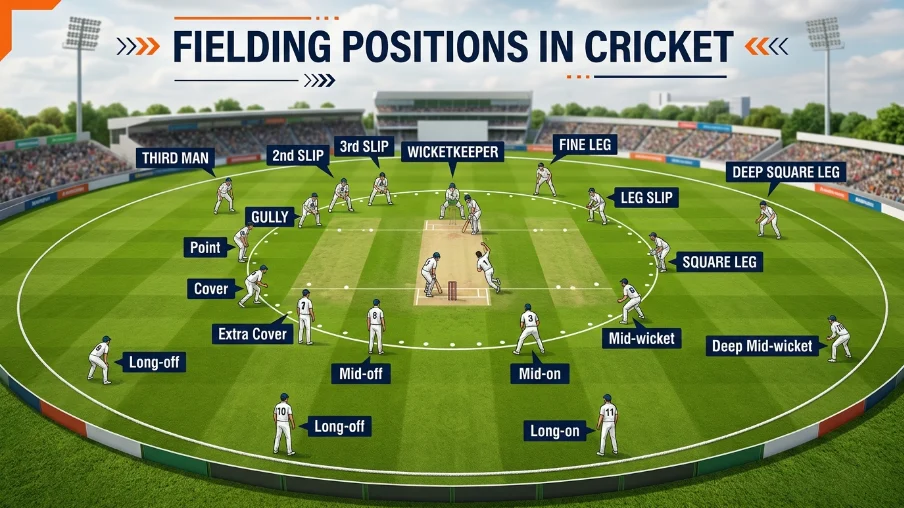

Fielding positions in cricket refer to the specific spots where players stand on the field to stop runs, take catches, and support the bowler. These positions are divided into off side, leg side, infield and outfield areas.
Understanding fielding positions in cricket is essential if you want to truly follow or play the game. Every fielder has a purpose, and their placement can completely change the outcome of a match.
Whether you’re watching a Test match or a fast-paced T20, you’ll notice players constantly moving across the field. That’s not random it’s strategy. Captains adjust positions based on the batsman, bowler, and match situation.
In this guide, you’ll learn all the key fielding positions, how they’re named, and why they matter.
WHAT ARE FIELDING POSITIONS IN CRICKET?
Fielding positions are pre-defined areas on the cricket ground where players stand to defend against runs and take wickets.
These positions depend on:
- The bowler’s style
- The batsman’s strengths
- Match format (Test, ODI, T20)
- Game situation
CRICKET FIELD DIVISION (BASIC UNDERSTANDING)
Before learning positions, you need to understand how the field is divided.
1. Off Side
- The side of the field in front of the batsman (based on stance)
2. Leg Side (On Side)
- The side behind the batsman
3. Infield
- Close to the pitch (within 30-yard circle)
4. Outfield
- Near the boundary
ALL FIELDING POSITIONS IN CRICKET
CLOSE-IN FIELDING POSITIONS (ATTACKING)
These are used to take catches, especially in Test cricket.
- Slip
- Second Slip
- Third Slip
- Gully
- Leg Slip
- Short Leg
- Silly Point
- Forward Short Leg
OFF SIDE FIELDING POSITIONS
These positions cover the front side of the batsman.
- Point
- Cover
- Extra Cover
- Mid-off
- Deep Cover
- Third Man
LEG SIDE FIELDING POSITIONS
These are on the batsman’s leg side.
- Square Leg
- Fine Leg
- Mid-on
- Deep Square Leg
- Long Leg
STRAIGHT FIELDING POSITIONS
These are aligned straight with the pitch.
- Mid-on
- Mid-off
- Long-on
- Long-off
COMPLETE FIELDING POSITIONS TABLE
| Position | Side | Area | Role |
|---|---|---|---|
| Slip | Off Side | Close | Catch edges |
| Gully | Off Side | Close | Stop cuts |
| Point | Off Side | Infield | Field square shots |
| Cover | Off Side | Infield | Stop drives |
| Mid-off | Off Side | Straight | Support bowler |
| Mid-on | Leg Side | Straight | Stop drives |
| Square Leg | Leg Side | Infield | Field flicks |
| Fine Leg | Leg Side | Boundary | Stop glances |
| Third Man | Off Side | Boundary | Stop edges |
| Long-on | Leg Side | Boundary | Prevent sixes |
| Long-off | Off Side | Boundary | Boundary defense |
WHY FIELDING POSITIONS MATTER
Field placements are not random. They are tactical decisions.
Key Purposes:
- Control scoring areas
- Force mistakes
- Support bowling strategy
- Take wickets
For example:
- Slip fielders are placed to catch edges from fast bowlers
- Deep fielders prevent boundaries in T20 matches
ATTACKING VS DEFENSIVE FIELD SETTINGS
| Type | Purpose | Example Positions |
|---|---|---|
| Attacking | Take wickets | Slips, Gully, Short Leg |
| Defensive | Stop runs | Deep Cover, Long-on, Fine Leg |
COMMON BEGINNER MISTAKES
- Confusing off side and leg side
- Thinking positions are fixed (they change constantly)
- Ignoring match format differences
- Not understanding fielding angles
HOW FIELDING POSITIONS CHANGE BY FORMAT
Test Cricket
- More close fielders
- Focus on wickets
ODI Cricket
- Balanced field
- Powerplay restrictions
T20 Cricket
- More boundary riders
- Defensive setups
FAQs
1. How many fielding positions are there in cricket?
There are dozens of named fielding positions in cricket, but only 11 players field at a time. The exact positions vary depending on strategy, match format, and the captain’s decisions during play.
2. What is the most important fielding position?
The wicketkeeper is the most important position because they are involved in almost every delivery. They catch edges, perform stumpings, and guide field placements alongside the captain.
3. What is slip in cricket?
Slip is a close fielding position behind the batsman on the off side. It is mainly used to catch edges from fast bowlers, especially in Test matches.
4. What is the difference between mid-on and mid-off?
Mid-on is on the leg side of the field, while mid-off is on the off side. Both are straight positions near the bowler and are key for stopping drives.
5. Why are fielding positions named differently?
Fielding positions are named based on angles, distance from the batsman, and historical cricket terminology. These names help players quickly understand placement instructions.
6. What is third man in cricket?
Third man is a boundary position on the off side behind the batsman. It is used to stop edges and guide balls played late.
7. What is fine leg used for?
Fine leg is placed on the leg side near the boundary to stop glances and deflections, especially from fast bowlers.
8. What are close-in fielders?
Close-in fielders stand very near the batsman to catch quick shots. Examples include slip, silly point, and short leg.
9. What is the difference between infield and outfield?
The infield is the inner area close to the pitch, while the outfield is near the boundary. Fielders are placed based on scoring risks.
10. Do fielding positions change during a match?
Yes, fielding positions change frequently depending on the batsman, bowler, and match situation. Captains adjust them constantly to gain an advantage.
CONCLUSION
Fielding positions in cricket are the backbone of the game’s strategy. They are not just names or spots on the field they represent tactical decisions that influence every ball.
When you understand these positions, the game becomes much more engaging. You’ll start noticing patterns, strategies, and captaincy decisions that casual viewers often miss.
Whether you’re a beginner or someone looking to deepen your cricket knowledge, mastering fielding positions gives you a strong foundation. It helps you read the game better, play smarter and appreciate the fine details that make cricket so fascinating.