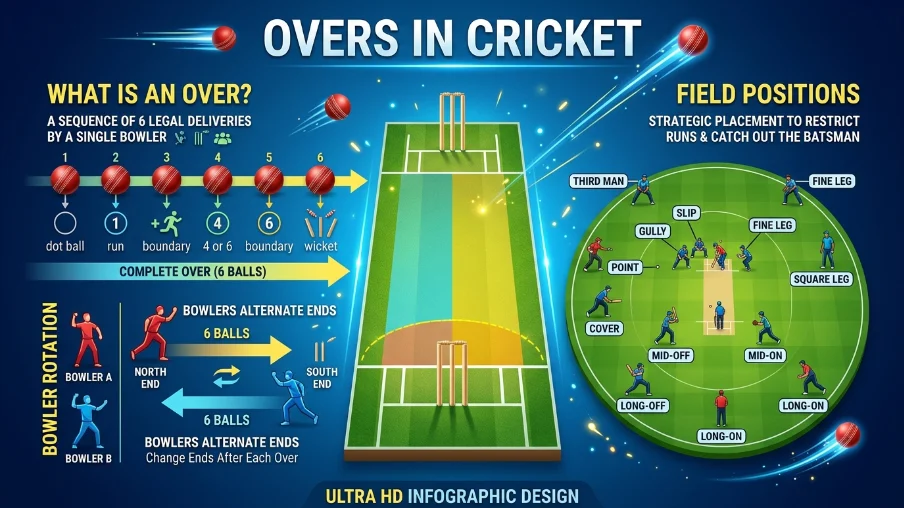

An over in cricket consists of six legal deliveries bowled by one bowler. After completing an over, another bowler takes over from the opposite end, forming the basic structure of every cricket match.
Cricket might seem complex at first, but once you understand the basics, everything starts to make sense. One of the most important concepts is overs in cricket. Whether you’re watching a fast-paced T20 match or a traditional Test game, overs define how the game flows, how strategies are built, and how results are decided.
In simple terms, overs act like the “clock” of cricket. They control how long a team bats, how bowlers rotate, and how the game progresses. If you’re new to cricket or just want a clearer understanding this guide breaks everything down in a simple, practical way.
WHAT ARE OVERS IN CRICKET?
An over is a set of six legal balls bowled by a single bowler from one end of the pitch.
Once those six balls are completed:
- The over ends
- A different bowler bowls the next over
- Play switches to the opposite end
This pattern continues throughout the match.
WHY DOES AN OVER HAVE 6 BALLS?
Historically, overs didn’t always have six balls. Early cricket formats experimented with:
- 4-ball overs
- 5-ball overs
- 8-ball overs
Eventually, the International Cricket Council standardized 6-ball overs because they provided the best balance between:
- Game duration
- Player fatigue
- Competitive fairness
STRUCTURE OF AN OVER
Here’s how a typical over works:
- Bowler delivers the ball
- Batsman attempts to score
- Fielders try to prevent runs or get a wicket
- Repeat for 6 legal deliveries
After the sixth ball:
- The umpire calls “Over”
- Fielding team changes ends
- New bowler starts
WHAT COUNTS AS A LEGAL DELIVERY?
Not every ball bowled counts toward the six.
Legal Deliveries
✔ Ball within rules
✔ Proper bowling action
✔ No boundary violations
Illegal Deliveries (Extras)
| Type | Description |
|---|---|
| No-ball | Illegal bowling action or overstep |
| Wide | Ball too far from batsman |
| Dead ball | Play stopped |
👉 These do NOT count in the 6 balls and must be re-bowled.
CAN AN OVER HAVE MORE THAN 6 BALLS?
Yes, technically.
If a bowler bowls extras:
- No-balls
- Wides
The over continues until 6 valid deliveries are completed.
Example:
- 6 legal balls
- 2 wides
➡ Total balls bowled = 8
➡ Official over = still 6 balls
TYPES OF OVERS IN CRICKET
1. Standard Over
Regular six-ball sequence.
2. Maiden Over
An over where:
- No runs are scored
- No extras conceded
3. Powerplay Over
Used in limited formats where:
- Fielding restrictions apply
- Scoring opportunities increase
OVERS IN DIFFERENT CRICKET FORMATS
| Format | Overs Per Team | Description |
|---|---|---|
| Test Cricket | Unlimited | Based on time (5 days) |
| ODI (One Day International) | 50 overs | Fixed innings |
| T20 Cricket | 20 overs | Fast-paced format |
ROLE OF OVERS IN MATCH STRATEGY
Overs are not just a counting system they shape the entire strategy.
Batting Strategy
- Aggression in final overs
- Careful play in early overs
- Target runs per over
Bowling Strategy
- Best bowlers used at key moments
- Death overs specialists
- Spin vs pace decisions
IMPORTANT TERMS RELATED TO OVERS
Run Rate
Runs scored per over.
Economy Rate
Runs conceded per over by a bowler.
Death Overs
Final overs where scoring is highest.
Powerplay Overs
Early overs with fielding restrictions.
COMMON BEGINNER MISTAKES
- Thinking all balls count (extras don’t)
- Confusing overs with innings
- Not understanding bowler rotation
- Ignoring format differences
FAQs
1. How many balls are in an over in cricket?
An over consists of six legal deliveries. If a bowler bowls extras like wides or no-balls, those deliveries don’t count, and additional balls are bowled until six valid deliveries are completed.
2. Why do bowlers change after each over?
Bowlers change to maintain fairness and balance. It prevents one bowler from dominating continuously and allows teams to rotate strategies, use different bowling styles, and manage player fatigue effectively.
3. What is a maiden over?
A maiden over is when a bowler delivers six legal balls without conceding any runs. It reflects excellent bowling performance and puts pressure on the batting team to score.
4. Can a bowler bowl two consecutive overs?
No, a bowler cannot bowl two consecutive overs. Another bowler must deliver the next over from the opposite end according to official cricket rules.
5. What happens at the end of an over?
At the end of an over, the fielding team switches ends, and a different bowler starts the next over. The batsmen also change ends depending on the last run scored.
6. What are death overs in cricket?
Death overs are the final overs of a limited-overs match. These overs are crucial as teams aim to maximize runs, and bowlers try to restrict scoring under high pressure.
7. How do overs affect the match result?
Overs determine how long a team bats. In limited formats, fewer overs mean less time to score, directly impacting strategies, run targets, and final outcomes.
8. What is a powerplay over?
Powerplay overs are specific overs in limited formats where fielding restrictions apply, allowing batsmen to score more freely due to fewer fielders outside the inner circle.
9. Are overs the same in all formats?
No. While each over has six balls, the total number of overs varies. Test cricket has no fixed limit, ODIs have 50 overs, and T20 matches have 20 overs per side.
10. What is run rate in relation to overs?
Run rate measures how many runs a team scores per over. It helps track scoring pace and is crucial in chasing targets or setting competitive totals.
CONCLUSION
Understanding overs in cricket is essential if you want to truly enjoy the game. Overs are much more than just a set of six balls they form the backbone of cricket’s structure, influencing everything from strategy to match outcomes. Whether it’s the steady rhythm of Test cricket or the explosive finish of a T20 game, overs control the pace, pressure, and excitement. As you watch more matches, you’ll start noticing how teams plan around overs when to attack, when to defend, and how to win. Once this concept clicks, cricket becomes far easier and far more enjoyable to follow.