
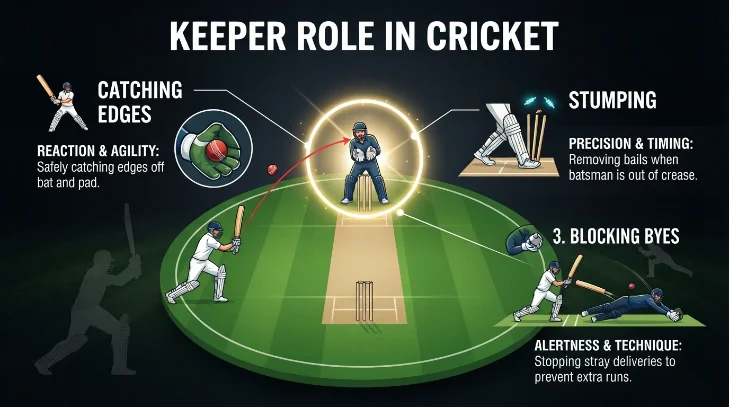

The wicketkeeper is one of cricket’s most specialized positions, positioned behind the stumps with the primary responsibility of collecting deliveries from the bowler. The keeper role involves catching edges, stumping batsmen, and preventing byes while providing crucial tactical input to the captain.
A wicketkeeper must remain alert on every delivery, anticipating where the ball might deviate. They work closely with slips and the bowler, often influencing field placements. The keeper’s role extends beyond keeping many great wicketkeepers have also been exceptional batsmen, contributing significantly with the bat.
Cricket is a game of fine margins, and few positions carry as much weight as the wicketkeeper. While batsmen score runs and bowlers take wickets, the player behind the stumps often decides matches through sharp reflexes, tactical awareness, and unwavering concentration. The keeper role has evolved dramatically from a purely defensive position to one that demands world-class batting skills too.
Whether you’re new to cricket or a seasoned follower, understanding the keeper role unlocks a deeper appreciation for the game’s strategic layers. The wicketkeeper sees everything every ball, every batsman’s weakness, every subtle deviation off the pitch. They are the eyes and ears of the captain on the field.
Introduction
- Hook: Why the wicketkeeper matters
- Brief overview of the keeper role in cricket
What is a Wicketkeeper? (Definition)
- Clear definition of the position
- Historical context and evolution of the role
Primary Responsibilities of a Wicketkeeper
- Catching edges behind the stumps
- Stumping batsmen
- Preventing byes and wides
- Tactical communication with captain and bowlers
Where Does the Keeper Stand?
- Standard fielding position
- Standing up to the stumps (slow bowling)
- Standing back (fast bowling)
- Adjusting based on pitch conditions and batting style
Wicketkeeping Rules and Regulations
- Official ICC Laws regarding wicketkeepers
- Glove regulations
- Positioning rules
- DRS involvement
Essential Skills for Wicketkeepers
- Reflexes and anticipation
- Hand-eye coordination
- Footwork
- Communication and leadership
- Fitness and endurance
Wicketkeeping Equipment
- Protective gear (gloves, pads, helmet)
- Differences in equipment vs. regular fielders
- Maintenance and care
Types of Wicketkeepers
- Traditional wicketkeeper-batsmen
- Specialist wicketkeepers
- Modern all-rounder keepers
The Dual Role Wicketkeeper-Batsman
- Evolution of batting expectations
- Famous wicketkeeper-batsmen
- Balancing keeping and batting duties
Famous Wicketkeepers in Cricket History
- Adam Gilchrist (Australia)
- MS Dhoni (India)
- Mark Boucher (South Africa)
- Kumar Sangakkara (Sri Lanka)
- Ian Healy (Australia)
Wicketkeeping Tips for Beginners
- Getting started
- Key drills for improvement
- Mental preparation
Common Mistakes Made by Wicketkeepers
- Issues with footwork
- Poor positioning
- Communication breakdowns
- Technical errors in taking catches
The Keeper’s Role in DRS
- How keepers influence reviews
- Communication with the captain
- Understanding technology
Advanced Wicketkeeping Techniques
- Standing up vs. standing back adjustments
- Taking spin vs. pace bowling
- Reading the batsman’s movement
Wicketkeeping in Different Formats
- Test cricket requirements
- One Day Internationals
- T20 cricket
- How the role changes by format
Comparison of Wicketkeeping Roles Across Cricket Formats
| Aspect | Test Cricket | ODI Cricket | T20 Cricket |
| Style | Defensive, patient | Balanced approach | Aggressive, attacking |
| Batting Expectations | High – often bats at 6-7 | High – finisher role | Very high – power hitting required |
| Fitness Demands | Moderate – long days | High – 50 overs | Very high – explosive movements |
| Standing Position | Mix of up/back based on bowler | Mostly back for pacers | Back for pacers, up for spinners |
| Experience Needed | Years of first-class cricket | Substantial experience | Can be developing talent |
| Communication Role | Extensive with captain | Moderate | Quick, decisive calls |
Equipment Comparison Keeper vs Standard Fielder
| Equipment | Wicketkeeper | Standard Fielder |
| Gloves | Specialized padded gloves | Standard fielding gloves or bare hands |
| Pads | Wicketkeeping pads (lighter) | Standard batting pads (if needed) |
| Helmet | Usually wears one | Optional, depends on fielding position |
| Inner Gloves | Always worn | Optional |
| Arm Guard | Often worn | Rarely |
| Chest Protector | Sometimes worn | Not typically |
FAQs
1. What is the wicketkeeper’s main role in cricket?
The wicketkeeper’s primary role is to field behind the stumps, catching any edges that come from the batsman’s bat. They’re responsible for stumping batsmen when they leave their crease, stopping byes from reaching the boundary, and providing tactical guidance to the captain and bowlers about the batsman’s movements and weaknesses.
2. Can a wicketkeeper bowl in cricket?
Yes, a wicketkeeper can bowl in cricket, but it’s extremely rare in professional matches. If a wicketkeeper bowls, they must surrender the keeping duties to another player for that over or the remainder of the innings. This typically only happens in emergency situations or lower-level cricket.
3. Where does the wicketkeeper stand during play?
The wicketkeeper stands directly behind the stumps at the batting end. Their position varies based on bowling speed: for fast bowling they stand further back (15-20 yards), while for spin bowling they stand closer, sometimes right up to the stumps to facilitate stumping opportunities.
4. Why is the wicketkeeper considered a specialized position?
The wicketkeeper requires unique skills exceptional reflexes, hand-eye coordination, and the ability to anticipate ball movement. They must handle fast deliveries (150+ km/h) and unpredictable spin while wearing bulky gloves. The mental concentration required makes it one of cricket’s most demanding roles.
5. What’s the difference between a wicketkeeper and a regular fielder?
A wicketkeeper is the only fielder permitted to wear specialized gloves and pads. They’re positioned behind the stumps with specific responsibilities like catching edges and executing stumpings. Unlike other fielders, they’re involved in every ball of the innings and must maintain intense focus throughout.
6. What equipment does a wicketkeeper need?
A wicketkeeper requires specialized wicketkeeping gloves with extra padding, lightweight wicketkeeping pads, a helmet with a face guard, inner gloves for comfort, shin pads, and occasionally a chest protector. Their equipment is designed for mobility while providing maximum protection from rapid deliveries.
7. Is stumping possible if the keeper fumbles the ball?
No. For a stumping to be valid, the keeper must take the ball cleanly and remove the bails while the batsman is out of their crease. If the keeper fumbles, the batsman can attempt to regain their ground before the stumping is completed. The keeper must maintain control of the ball throughout.
8. How many wickets can a wicketkeeper take in a match?
A wicketkeeper can theoretically claim all 10 wickets through catches and stumpings, though this has never happened in international cricket. The record for most dismissals in a Test match is 11 (by Wasim Bari), while the most in an ODI innings is 6 (by several keepers).
9. Can a wicketkeeper move before the bowler releases the ball?
No, the wicketkeeper must remain behind the stumps and cannot move forward until the ball is released by the bowler. If the keeper moves too early, the umpire may call a dead ball. The keeper must also not make excessive noise or movements that could distract the batsman.
10. What is the “keeper’s role” in DRS reviews?
In DRS reviews, the wicketkeeper plays a crucial role by advising the captain on whether to review decisions. They’re best positioned to see if the ball hit the bat or pad for LBW appeals, and whether a catch carried cleanly. The keeper’s input significantly influences review decisions.
CONCLUSION
The wicketkeeper’s role in cricket represents one of the sport’s most demanding and essential positions. From the early days of cricket when keepers were primarily defensive specialists, the role has evolved into a multidimensional position requiring world-class batting ability alongside exceptional keeping skills. Modern cricket demands wicketkeepers who can win matches with both gloves and bat.
Understanding the keeper role reveals cricket’s beautiful complexity the constant communication between keeper and bowler, the split-second decisions that change games, and the unwavering concentration required throughout long days in the field. Whether it’s the calmness of MS Dhoni behind the stumps or the explosive batting of Adam Gilchrist, wicketkeepers have shaped cricket’s history in countless ways.
For aspiring cricketers, the wicketkeeping position offers a unique pathway to the professional game. While it requires years of dedicated practice and countless drills, the rewards are immense becoming the player the team trusts most, the cricketer who influences every ball, and ultimately, the match-winner who can change the game with one spectacular catch or crucial stumping. The keeper role truly is the heartbeat of every cricket team.