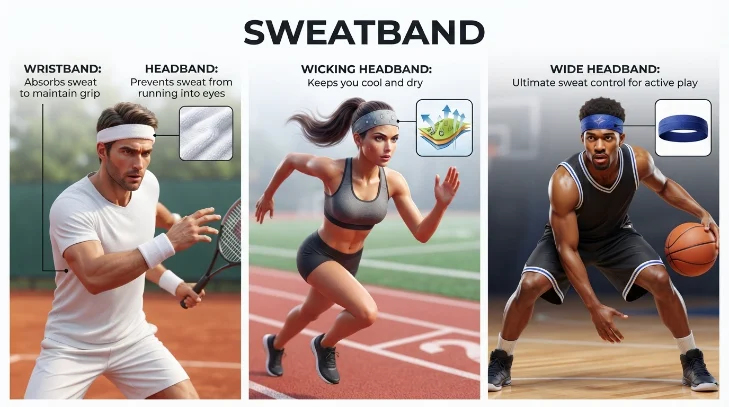

A sweatband is a sports accessory worn around the wrist or head to absorb perspiration during physical activity. It helps keep sweat out of your eyes and off your hands, improving grip and comfort during exercise. Made from moisture-wicking materials like cotton, terry cloth, or synthetic blends, sweatbands are essential gear for tennis, basketball, running, and fitness training.
Whether you choose a wristband or headband style, the right sweatband can significantly enhance your athletic performance by maintaining dryness and focus throughout your workout.
Picture this: you’re in the middle of an intense tennis match or a high-energy basketball game. Sweat is streaming down your face, stinging your eyes, and making your grip slippery. Your performance is suffering, and all you can think about is wiping your face. This is exactly where a sweatband becomes your most valuable piece of equipment.
A sweatband is more than just a strip of fabric it’s a performance-enhancing accessory designed to keep you dry, comfortable, and focused. From professional athletes to weekend warriors, millions of sports enthusiasts rely on sweatbands to manage perspiration effectively. Whether you’re hitting the gym, pounding the pavement, or competing on the court, understanding what makes a great sweatband can transform your sporting experience.
WHAT IS A SWEATBAND?
A sweatband is a strip of absorbent material worn around the wrist or head to absorb perspiration during physical activity. It is designed to keep sweat away from the eyes and off the hands, allowing athletes to maintain clear vision and a secure grip on their equipment.
Historically, sweatbands have been used in sports for decades. Early versions were simple cloth bands, but modern sweatbands incorporate advanced moisture-wicking technologies and ergonomic designs. Today, they are a staple in nearly every sport, from tennis and basketball to running and fitness training.
Sweatbands typically come in two main forms: wristbands worn around the wrist and headbands worn across the forehead. Both serve the same primary purpose sweat management but are used in slightly different ways depending on the sport and personal preference.
THE PURPOSE OF A SWEATBAND IN SPORTS
The primary purpose of a sweatband is moisture management. During intense physical activity, the body produces sweat to regulate temperature. This sweat can become problematic when it drips into the eyes (causing stinging and blurred vision) or onto the hands (making grip slippery and unsafe).
A sweatband addresses these issues by:
- Absorbing sweat before it reaches the eyes or hands
- Improving grip by keeping palms dry
- Enhancing comfort by reducing skin irritation
- Maintaining focus by eliminating constant wiping
- Preventing slippage of glasses or headgear
Beyond Sweat Absorption
Modern sweatbands also offer additional benefits:
- Temperature regulation: Some sweatbands feature cooling technology that activates when wet
- Sun protection: Certain designs provide UV protection for the forehead and eyes
- Style and identity: Many athletes wear sweatbands as part of their personal brand or team uniform
As one fitness retailer noted, sweatbands are making a comeback as both functional gear and fashion accessories, with designs catering to diverse needs and hair types.
TYPES OF SWEATBANDS
Wrist sweatbands are worn around the wrist and serve two main functions: absorbing sweat from the forehead (by wiping) and keeping the palms dry. They are particularly popular in:
- Tennis
- Badminton
- Squash
- Basketball
- General fitness training
Typical wristband dimensions range from 8 x 8 cm to 10 x 8 cm (length x width), with excellent elasticity to fit most wrist sizes.
Head Sweatbands (Headbands)
Head sweatbands are worn across the forehead to absorb sweat before it reaches the eyes. They are essential in:
- Running
- Cycling
- Basketball
- Soccer
- Yoga
- High-intensity interval training (HIIT)
Headbands typically measure around 19.5 x 5.5 cm (length x width) and are designed to stay in place during vigorous movement.
Specialty Sweatbands
Some sweatbands serve specialized purposes:
- Cooling sweatbands: Can be soaked in water for 2–3 minutes to activate cooling relief
- Hard hat sweatbands: Designed for industrial and construction use
- Multi-functional bands: Can be worn as neckwarmers, hoods, balaclavas, or hats
- Anti-perspirant sweatbands: Treated with materials that reduce sweating
MATERIALS USED IN SWEATBANDS
The material of a sweatband determines its effectiveness, comfort, and durability. Here’s a comparison of common materials:
| Material | Properties | Best For | Pros | Cons |
| Cotton | Soft, highly absorbent | General sports, casual use | Comfortable, natural, affordable | Retains moisture, slow drying |
| Terry Cloth | Looped fabric, highly absorbent | Intense sports, heavy sweating | Excellent absorption, soft texture | Can feel bulky, slower drying |
| Polyester | Synthetic, moisture-wicking | Running, cycling, high-intensity sports | Quick-drying, lightweight | Less absorbent than cotton |
| Nylon/Spandex Blend | Stretchy, breathable | Active sports, yoga | Excellent fit, retains shape | May not absorb as much sweat |
| Cotton/Spandex/Nylon Blend | Balanced properties | All-purpose sports | Combines absorption with stretch | Varies by blend ratio |
| Bamboo Blend | Eco-friendly, antimicrobial | Sensitive skin, eco-conscious athletes | Natural, odor-resistant | Can be more expensive |
Understanding Moisture-Wicking Technology
Modern sweatbands often feature moisture-wicking properties, which means they pull sweat away from the skin and allow it to evaporate quickly. This is achieved through:
- Hydrophilic fibers that attract moisture
- Engineered yarn structures that create capillary action
- Blended fabrics that balance absorption and evaporation
Some innovative sweatbands incorporate coffee yarn, which has natural odor-reducing and antibacterial properties. Others use neoprene cores for sweat diversion rather than absorption.
SPORTS THAT USE SWEATBANDS
Sweatbands are used across virtually every sport. Here’s a breakdown by sport type:
| Sport | Common Sweatband Type | Primary Benefit |
| Tennis | Wristband, Headband | Keeps palms dry for racket grip, sweat out of eyes |
| Basketball | Headband, Wristband | Prevents sweat from affecting vision and ball handling |
| Running | Headband | Keeps sweat from eyes, especially during long distances |
| Cycling | Headband, Multi-functional | Absorbs sweat under helmet, provides cooling |
| Fitness/Gym | Wristband, Headband | Keeps equipment grip secure, face dry |
| Yoga | Headband | Prevents sweat from dripping onto mat |
| Pickleball | Wristband | Keeps paddle grip dry |
| Badminton | Wristband, Headband | Maintains racket grip and vision |
| Squash | Wristband | Prevents racquet slippage |
| Soccer | Headband | Keeps sweat from eyes during play |
SWEATBAND VS HEADBAND WHAT’S THE DIFFERENCE?
Many people use the terms “sweatband” and “headband” interchangeably, but there are distinctions:
| Feature | Sweatband | Headband |
| Primary purpose | Sweat absorption | Sweat absorption + hair management |
| Typical material | Terry cloth, cotton | Polyester, spandex, cotton |
| Width | Usually wider (5–8 cm) | Can be narrower (2–5 cm) |
| Thickness | Often thicker for absorption | Often thinner for style |
| Sports usage | Tennis, basketball, running | Running, yoga, fashion |
| Function | Functional (performance) | Functional + aesthetic |
In practice, the terms overlap significantly. A headband sweatband combines both functions absorbing sweat while keeping hair in place.
HOW TO CHOOSE THE RIGHT SWEATBAND
Different sports have different sweat management needs:
- Racquet sports: Choose wristbands for grip and headbands for vision
- Running: Opt for lightweight, moisture-wicking headbands
- Basketball: Wide headbands and wristbands for maximum coverage
- Gym workouts: Versatile sets that include both wrist and headbands
Choose the Right Material
- Heavy sweating: Terry cloth or cotton for maximum absorption
- Quick drying: Polyester or synthetic blends
- Comfort and stretch: Cotton/spandex/nylon blends
- Sensitive skin: Bamboo or organic cotton blends
Check the Fit
- Wristbands: Should fit snugly but not restrict circulation
- Headbands: Should stay in place without being too tight
- Elasticity: Look for good stretch that retains shape
Consider Multi-Packs
Many brands offer sweatband sets that include multiple wristbands and headbands. These are cost-effective and ensure you always have a clean band ready.
Look for Added Features
- Cooling technology: Great for hot weather or intense workouts
- Antimicrobial properties: Reduces odor and bacteria
- Non-slip designs: Stay in place during vigorous movement
HOW TO CLEAN AND MAINTAIN YOUR SWEATBAND
Proper maintenance extends the life of your sweatband and ensures it remains hygienic and effective.
Washing Instructions
Machine Washing:
- Most sweatbands can be machine washed
- Use cold or warm water (not hot)
- Use mild detergent
- Avoid fabric softeners (they reduce absorbency)
Hand Washing:
- For delicate materials, hand wash with mild detergent
- Gently squeeze (don’t wring) to remove water
- Rinse thoroughly
Drying
- Air dry completely before reuse
- Avoid tumble drying (heat can damage elastic fibers)
- Do not use bleach or harsh chemicals
Storage
- Store in a cool, dry place
- Keep away from direct sunlight
- Avoid exposure to chemicals
When to Replace
Replace your sweatband when:
- The elastic loses its stretch
- The fabric becomes thin or holes appear
- It no longer absorbs effectively
- It develops persistent odors
Sweatband Material Comparison
| Material | Absorption | Drying Speed | Durability | Comfort | Price |
| Cotton | Excellent | Slow | Good | Excellent | Low |
| Terry Cloth | Excellent | Slow | Good | Excellent | Low-Medium |
| Polyester | Good | Fast | Excellent | Good | Medium |
| Nylon/Spandex | Moderate | Fast | Excellent | Excellent | Medium-High |
| Bamboo Blend | Good | Medium | Good | Excellent | High |
Sweatband Types by Sport
| Sport | Recommended Type | Recommended Material | Key Feature |
| Tennis | Wristband + Headband | Terry cloth or cotton | Maximum absorption |
| Running | Headband | Polyester or blend | Lightweight, quick-dry |
| Basketball | Headband + Wristband | Cotton or terry cloth | Wide coverage |
| Yoga | Headband | Cotton or bamboo | Comfort, non-slip |
| Cycling | Headband | Polyester or blend | Helmet-compatible |
| HIIT | Both | Moisture-wicking blend | Fast drying |
FREQUENTLY ASKED QUESTIONS
1. What is a sweatband used for?
A sweatband is used to absorb perspiration during physical activity. Worn around the wrist or head, it keeps sweat from dripping into your eyes or onto your hands, improving comfort, vision, and grip during sports and exercise.
2. What material is best for sweatbands?
The best material depends on your needs. Cotton and terry cloth offer maximum absorption, while polyester and synthetic blends dry faster. For a balance of comfort and performance, cotton/spandex/nylon blends are excellent choices.
3. Are sweatbands good for working out?
Yes, sweatbands are highly beneficial for working out. They keep sweat out of your eyes, prevent slippery hands, and help you stay focused on your performance. They’re particularly useful during high-intensity or endurance activities.
4. What is the difference between a headband and a sweatband?
While often used interchangeably, sweatbands typically focus on sweat absorption with thicker materials, while headbands may prioritize hair management and style. A headband sweatband combines both functions.
5. How do you wash sweatbands?
Most sweatbands can be machine washed with cold water and mild detergent. Avoid fabric softeners as they reduce absorbency. Air dry completely before reuse. For delicate materials, hand washing is recommended.
6. Why do tennis players wear wristbands?
Tennis players wear wristbands to keep their palms dry for a secure racket grip and to wipe sweat from their forehead during play. This helps maintain control and prevents the racket from slipping during shots.
7. Do sweatbands actually work?
Yes, sweatbands are effective at managing sweat during physical activity. They absorb moisture before it can drip into eyes or onto hands, keeping athletes comfortable and focused. The effectiveness depends on the material and fit.
8. What sports use sweatbands?
Sweatbands are used in tennis, basketball, running, cycling, fitness training, yoga, pickleball, badminton, squash, and soccer. They are versatile accessories suitable for virtually any sport involving physical exertion.
9. Can sweatbands be worn for fashion?
Absolutely. Sweatbands have become a fashion statement in recent years, with many brands offering stylish designs and colors. They’re worn both for function and as a retro-inspired accessory.
10. How tight should a sweatband be?
A sweatband should fit snugly enough to stay in place during movement but not so tight that it restricts circulation or causes discomfort. Most sweatbands are designed with excellent elasticity to fit a range of sizes.
CONCLUSION
The humble sweatband is far more than a simple strip of fabric it’s an essential piece of sports equipment that can make the difference between a focused, comfortable performance and a frustrating, sweat-filled struggle. Whether you’re a professional athlete or a weekend warrior, the right sweatband keeps perspiration in check, protecting your vision, grip, and overall performance.
From the classic terry cloth wristbands of tennis legends to the high-tech moisture-wicking headbands of modern marathon runners, sweatbands have evolved to meet the demands of every sport and every athlete. Understanding the different types, materials, and features available helps you make an informed choice that matches your specific needs.
Remember to consider your sport, sweat intensity, and personal comfort preferences when choosing a sweatband. And don’t forget proper maintenance a clean, well-cared-for sweatband performs better and lasts longer.
Invest in quality sweatbands, and you’ll wonder how you ever played without them. They’re affordable, durable, and genuinely effective a small investment that delivers big returns in comfort and performance. Whether you’re hitting the court, the track, or the gym, let a sweatband be your trusted companion in the pursuit of athletic excellence.