
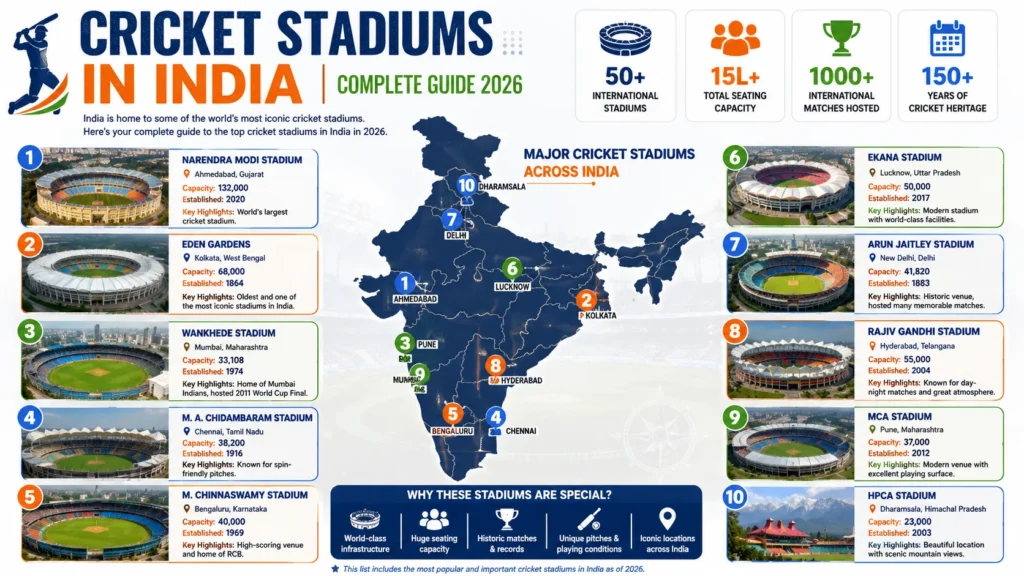

India has over 50 international and first-class cricket stadiums spread across the country. The Narendra Modi Stadium in Ahmedabad is the world’s largest cricket stadium with a capacity of 132,000 spectators. Eden Gardens in Kolkata, established in 1864, is India’s oldest and second-largest stadium.
Other major venues include the M.A. Chidambaram Stadium (Chepauk) in Chennai, established in 1916 and the second-oldest international stadium still in use, Wankhede Stadium in Mumbai, M. Chinnaswamy Stadium in Bangalore, and Arun Jaitley Stadium in Delhi. These stadiums host international matches, IPL games, and domestic tournaments throughout the year.
Cricket is more than a sport in India it is a religion, and its stadiums are the temples where millions of fans gather to worship their heroes. From the snow-capped backdrop of Dharamshala’s HPCA Stadium to the bustling streets of Kolkata surrounding Eden Gardens, cricket stadiums in India tell the story of a nation’s obsession with the game.
India boasts some of the world’s largest and most historic cricket venues. The Narendra Modi Stadium in Ahmedabad has redefined what a cricket stadium can be, while grounds like Chepauk and Eden Gardens carry over a century of cricketing memories. Whether you are planning to attend an IPL match, exploring India’s cricketing heritage, or simply curious about where the game’s greatest moments unfolded, understanding these iconic venues is essential. This guide takes you through the biggest, oldest, and most significant cricket stadiums across India, complete with their capacities, histories, pitch conditions, and unforgettable records.
Major Cricket Stadiums in India
| Stadium | Location | Capacity | Established | Notable Feature |
| Narendra Modi Stadium | Ahmedabad | 132,000 | 2020 | World’s largest cricket stadium |
| Eden Gardens | Kolkata | 68,000 | 1864 | Oldest stadium; third-largest globally |
| Arun Jaitley Stadium | Delhi | 68,000 | 1883 | Formerly Feroz Shah Kotla |
| M.A. Chidambaram Stadium | Chennai | 70,000 | 1916 | Second-oldest functional international stadium |
| Wankhede Stadium | Mumbai | 33,000 | 1974 | Hosted 2011 World Cup final |
| M. Chinnaswamy Stadium | Bangalore | 35,000 | 1969 | Known for high-scoring matches |
| Rajiv Gandhi International Stadium | Hyderabad | 55,000 | 2004 | Hosts IPL and international matches |
| HPCA Stadium | Dharamshala | 25,000 | 2003 | Stunning Himalayan backdrop |
| PCA Stadium | Mohali | 26,000 | 1993 | Known for bouncy pitches |
| Sawai Mansingh Stadium | Jaipur | 30,000 | 1969 | Rajasthan Royals’ home ground |
Pitch Characteristics by Stadium
| Stadium | Pitch Type | Typical Score | Best For |
| Narendra Modi Stadium | Balanced | 300-350 | All formats |
| Eden Gardens | Spin-friendly | 250-300 | Spinners |
| Wankhede Stadium | Bouncy | 280-330 | Pacers and batters |
| M. Chinnaswamy Stadium | Batting paradise | 320-380 | High scores |
| Chepauk | Slow turn | 220-280 | Spinners |
| Arun Jaitley Stadium | Low bounce | 250-300 | Spinners |
Overview of Cricket Stadiums in India
India is home to more than 50 international and first-class cricket stadiums, making it one of the most cricket-rich nations on earth. These venues range from historic grounds established in the 19th century to ultra-modern facilities with state-of-the-art amenities. The Board of Control for Cricket in India (BCCI) oversees the development and maintenance of these stadiums, many of which are managed by state cricket associations.
The scale of Indian cricket infrastructure is staggering. The Narendra Modi Stadium in Ahmedabad holds the Guinness World Record for the largest cricket stadium, surpassing the Melbourne Cricket Ground. Several other Indian stadiums rank among the world’s top ten by capacity, reflecting the country’s massive cricket-following population.
Narendra Modi Stadium Ahmedabad, Gujarat
Formerly known as Sardar Patel Stadium, this magnificent venue was reconstructed and renamed in 2020. It is the largest cricket stadium in the world and hosted the 2023 ICC Cricket World Cup final. The stadium features a modern design with three tiers of seating, excellent sightlines, and world-class facilities.
Eden Gardens Kolkata, West Bengal
Established in 1864, Eden Gardens is the oldest cricket stadium in India and the second-largest. Named after the sister of Lord Auckland, the then Governor-General of British India, this historic venue has witnessed countless legendary performances. It is the third-largest cricket stadium globally, after Narendra Modi Stadium and Melbourne Cricket Ground.
Arun Jaitley Stadium Delhi
Originally established as Feroz Shah Kotla Stadium in 1883, this ground was renamed in 2019. It has hosted numerous historic Test matches and is known for its spin-friendly pitch. The stadium has undergone several renovations to modernise its facilities.
M.A. Chidambaram Stadium Chennai, Tamil Nadu
Popularly known as Chepauk Stadium, this ground was established in 1916 and is the second-oldest international cricket stadium still functioning in India. It is owned by the Tamil Nadu Cricket Association and is famous for its turning pitch that assists spinners.
Rajiv Gandhi International Stadium Hyderabad, Telangana
Built in 2004, this modern stadium has hosted numerous IPL matches and international fixtures. It is known for its excellent drainage system and vibrant atmosphere during matches.
Shaheed Veer Narayan Singh International Cricket Stadium Raipur, Chhattisgarh
This stadium in Raipur has emerged as a prominent venue for international and domestic cricket.
Sardar Vallabhbhai Patel Stadium Ahmedabad, Gujarat
Before the Narendra Modi Stadium was rebuilt, this was Ahmedabad’s primary cricket venue. It continues to host various sporting events.
Dr. Bhupen Hazarika Cricket Stadium Guwahati, Assam
This stadium has brought international cricket to northeast India.
JSCA International Cricket Stadium Ranchi, Jharkhand
Home to MS Dhoni’s home ground, this stadium is known for its enthusiastic crowds.
Maharashtra Cricket Association Stadium Pune, Maharashtra
Located in Gahunje near Pune, this stadium regularly hosts IPL and international matches.
Historic Cricket Stadiums
Eden Gardens (1864)
India’s oldest cricket stadium, Eden Gardens, has been the stage for some of cricket’s most unforgettable moments. It was here that VVS Lakhsman and Rahul Dravid staged their famous comeback against Australia in 2001. The stadium’s atmosphere during India-Pakistan matches is legendary.
M.A. Chidambaram Stadium Chepauk (1916)
The second-oldest functional international stadium in India, Chepauk has hosted cricket since the days of the Madras Presidency. It was the venue for India’s first Test victory against England in 1952.
Arun Jaitley Stadium Feroz Shah Kotla (1883)
This Delhi ground has seen the likes of Sunil Gavaskar, Kapil Dev, and Sachin Tendulkar grace its pitch. It was the venue for Anil Kumble’s famous 10-wicket haul against Pakistan in 1999.
Modern Marvels
The Narendra Modi Stadium represents the future of cricket infrastructure. With a capacity of 132,000, it features state-of-the-art floodlights, a modern drainage system, and hospitality suites that rival any sporting venue in the world. The stadium’s construction used innovative engineering techniques to create an unobstructed view from every seat.
Other modern stadiums like the Rajiv Gandhi International Stadium in Hyderabad and the HPCA Stadium in Dharamshala have brought international cricket to new regions of India. The Dharamshala stadium, in particular, offers one of the most picturesque settings in world cricket, with the Himalayan mountains forming a stunning backdrop.
Pitch Conditions Across India
Ahmedabad (Narendra Modi Stadium)
A balanced pitch that offers something for both batters and bowlers. Early assistance for pacers gives way to batting-friendly conditions as the match progresses.
Kolkata (Eden Gardens)
Known for spin-friendly conditions, especially in the fourth and fifth innings of Test matches. The red soil pitch tends to break down and offer sharp turn.
Chennai (Chepauk)
The slow, low bounce at Chepauk makes it a spinner’s paradise. Teams often struggle to score freely on this surface.
Mumbai (Wankhede)
Bouncy and fast, the Wankhede pitch offers excellent value for stroke play. Pacers get good carry, making it a favourite for fast bowlers.
Bangalore (Chinnaswamy)
A batting paradise with short boundaries, Chinnaswamy is known for high-scoring games. The small ground makes it difficult for bowlers to defend totals.
IPL Venues
The Indian Premier League has turned these stadiums into annual destinations for cricket fans worldwide. Each franchise has a home ground that adds to the tournament’s unique character:
- Mumbai Indians Wankhede Stadium, Mumbai
- Chennai Super Kings M.A. Chidambaram Stadium, Chennai
- Royal Challengers Bangalore M. Chinnaswamy Stadium, Bangalore
- Kolkata Knight Riders Eden Gardens, Kolkata
- Delhi Capitals Arun Jaitley Stadium, Delhi
- Rajasthan Royals Sawai Mansingh Stadium, Jaipur
- Sunrisers Hyderabad Rajiv Gandhi International Stadium, Hyderabad
Stadium Facilities
Most major Indian cricket stadiums now offer world-class facilities:
Seating: Modern stadiums feature tiered seating with excellent sightlines. The Narendra Modi Stadium has three tiers of seating.
Floodlights: High-intensity LED floodlights ensure clear visibility for day-night matches.
Hospitality: Corporate boxes, VIP lounges, and premium seating areas are available at most international venues.
Media Facilities: Dedicated media centres with high-speed internet and broadcast facilities.
Accessibility: Wheelchair access and designated seating for differently-abled spectators are being incorporated in newer stadiums.
Practice Facilities: Nets, bowling machines, and indoor practice areas are standard at international venues.
Records and Historic Matches
| Stadium | Historic Match/Record |
| Narendra Modi Stadium | Hosted 2023 ICC Cricket World Cup final |
| Eden Gardens | VVS Lakhsman’s 281 vs Australia (2001) |
| Chepauk | India’s first Test victory vs England (1952) |
| Arun Jaitley Stadium | Anil Kumble’s 10-wicket haul vs Pakistan (1999) |
| Wankhede Stadium | India’s 2011 World Cup final victory |
| Chinnaswamy Stadium | Highest IPL totals regularly recorded here |
How to Choose Which Stadium to Visit
For the atmosphere: Eden Gardens and Chepauk offer unmatched crowd energy.
For modern facilities: The Narendra Modi Stadium is the gold standard.
For scenic beauty: HPCA Stadium in Dharamshala offers Himalayan views.
For high-scoring entertainment: Chinnaswamy Stadium in Bangalore guarantees runs.
For historic significance: Visit Eden Gardens, Chepauk, or Arun Jaitley Stadium to experience cricket history.
FAQs
1. Which is the largest cricket stadium in India?
The Narendra Modi Stadium in Ahmedabad is the largest cricket stadium in India and the world, with a capacity of 132,000 spectators. It was reconstructed and renamed in 2020.
2. Which is the oldest cricket stadium in India?
Eden Gardens in Kolkata, established in 1864, is the oldest cricket stadium in India. It is also the second-largest stadium in the country.
3. How many international cricket stadiums are there in India?
India has over 50 international and first-class cricket stadiums. Approximately 15-20 of these regularly host international matches, while others host domestic and IPL games.
4. What is the capacity of M.A. Chidambaram Stadium?
The M.A. Chidambaram Stadium (Chepauk) in Chennai has a capacity of approximately 70,000 spectators.
5. Which stadium hosted the 2023 Cricket World Cup final?
The Narendra Modi Stadium in Ahmedabad hosted the 2023 ICC Cricket World Cup final, cementing its status as India’s premier cricketing venue.
6. Which is the best cricket stadium in India for spinners?
The M.A. Chidambaram Stadium in Chennai is renowned for its spin-friendly pitch. The slow, low bounce makes it difficult for batters and assists spinners throughout the match.
7. What is the capacity of Eden Gardens?
Eden Gardens has a seating capacity of approximately 68,000 spectators. It is the third-largest cricket stadium in the world.
8. Which Indian cricket stadium has the best pitch for batting?
The M. Chinnaswamy Stadium in Bangalore is known for its batting-friendly pitch with short boundaries, making it a paradise for batters and a nightmare for bowlers.
9. When was Arun Jaitley Stadium established?
Arun Jaitley Stadium was established in 1883 as Feroz Shah Kotla Stadium. It was renamed in 2019 and is one of India’s oldest cricket venues.
10. Which stadiums in India host IPL matches?
Major IPL venues include Wankhede Stadium (Mumbai), M.A. Chidambaram Stadium (Chennai), M. Chinnaswamy Stadium (Bangalore), Eden Gardens (Kolkata), Arun Jaitley Stadium (Delhi), Sawai Mansingh Stadium (Jaipur), Rajiv Gandhi International Stadium (Hyderabad), and Narendra Modi Stadium (Ahmedabad).
CONCLUSION
India’s cricket stadiums are more than just venues they are living monuments to the nation’s greatest sporting passion. From the historic Eden Gardens, which has witnessed over 150 years of cricketing history, to the record-breaking Narendra Modi Stadium, these grounds tell the story of how cricket evolved in India.
Each stadium offers a unique experience. Chepauk’s turning tracks challenge the world’s best batters, while Chinnaswamy’s short boundaries produce run-fests that thrill crowds. The scenic HPCA Stadium in Dharamshala provides a stunning backdrop that rivals any sporting venue on earth.
Whether you are a cricket purist seeking the traditions of Eden Gardens or a modern fan wanting to experience the grandeur of the Narendra Modi Stadium, India’s cricket stadiums offer something for everyone. As the country continues to invest in cricketing infrastructure, these venues will only grow in scale and sophistication, ensuring that India remains the undisputed heartland of world cricket.
For cricket fans, visiting these stadiums is not just about watching a match it is about experiencing the soul of Indian cricket.