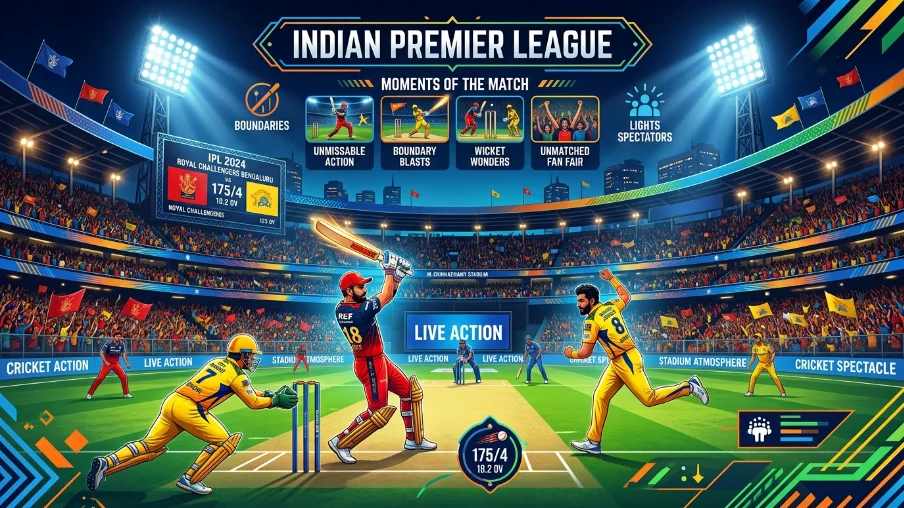

The Indian Premier League (IPL) is a professional T20 cricket league in India featuring franchise teams, global players, and fast-paced matches, making it one of the most popular and valuable cricket tournaments worldwide.
The Indian Premier League (IPL) has completely transformed the way cricket is played, watched, and experienced. What started as a domestic T20 tournament in India has now become a global sporting phenomenon.
Every year, millions of fans tune in to watch top international and local players compete in high-intensity matches. With big-money auctions, star-studded teams, and thrilling finishes, the IPL blends sports and entertainment like no other league.
Whether you’re new to cricket or a long-time fan, understanding how the IPL works will help you appreciate why it dominates the global cricket landscape.
What Is the Indian Premier League?
The Indian Premier League (IPL) is a professional Twenty20 (T20) cricket league organized by the Board of Control for Cricket in India.
- Launched in 2008
- Played annually
- Features franchise-based teams
- Combines sports, business, and entertainment
Each match lasts around 3 hours, making it fast-paced and highly engaging.
History and Evolution of IPL
The IPL was introduced to bring a shorter, more exciting format of cricket to a wider audience.
Key Milestones
| Year | Event |
| 2008 | First IPL season launched |
| 2010 | Became one of the most-watched leagues globally |
| 2016 | Expansion and new teams added |
| 2022 | Expanded to 10 teams |
Over time, IPL has become one of the richest sports leagues in the world.
IPL Teams (2026 Season)
Currently, the IPL features 10 franchise teams representing different cities.
Popular IPL Teams
- Mumbai Indians
- Chennai Super Kings
- Royal Challengers Bangalore
- Kolkata Knight Riders
- Delhi Capitals
- Rajasthan Royals
- Sunrisers Hyderabad
- Punjab Kings
- Lucknow Super Giants
- Gujarat Titans
IPL Format Explained
The IPL follows a structured and competitive format.
1. League Stage
- Each team plays multiple matches
- Points awarded:
- Win = 2 points
- Loss = 0 points
2. Points Table
Teams are ranked based on:
- Points
- Net Run Rate (NRR)
3. Playoffs
Top 4 teams qualify:
- Qualifier 1
- Eliminator
- Qualifier 2
- Final
IPL Auction System
One of the most exciting parts of IPL is the player auction.
How It Works
- Teams are given a budget
- Players are listed for bidding
- Franchises bid to buy players
- Highest bidder gets the player
Why It Matters
- Creates balanced teams
- Gives opportunities to young players
- Builds global competition
Top Players in IPL History
Some legendary cricketers have defined the IPL era.
Iconic Players
- Virat Kohli
- MS Dhoni
- Chris Gayle
- AB de Villiers
- Rohit Sharma
IPL Records and Statistics
Key Records Table
| Record | Player/Team | Achievement |
| Most Runs | Virat Kohli | 7000+ runs |
| Most Wickets | Lasith Malinga | 170+ wickets |
| Most Titles | Mumbai Indians | 5 titles |
| Fastest Century | Chris Gayle | 30 balls |
Why IPL Is So Popular
The IPL isn’t just cricket it’s a global entertainment product.
Reasons for Popularity
- Short and exciting matches
- Star international players
- Massive fan base
- Entertainment + sports combo
- High-quality broadcasting
IPL vs Other T20 Leagues
| League | Country | Popularity | Star Power |
| IPL | India | Very High | Global |
| BBL | Australia | High | Moderate |
| PSL | Pakistan | High | Growing |
The IPL remains the most valuable and watched T20 league worldwide.
Economic Impact of IPL
The IPL contributes significantly to the economy.
Key Impacts
- Boosts tourism
- Creates jobs
- Generates billions in revenue
- Attracts global sponsorships
FAQs
1. What is the Indian Premier League?
The Indian Premier League is a professional T20 cricket league in India where franchise teams compete annually. It features top international and domestic players, making it one of the most popular cricket tournaments worldwide.
2. How many teams are in IPL?
Currently, the IPL has 10 teams. Each team represents a different city and competes in a round-robin format followed by playoffs.
3. Who organizes the IPL?
The IPL is organized by the Board of Control for Cricket in India (BCCI), which manages cricket operations in India.
4. How does the IPL format work?
The IPL includes a league stage where teams earn points, followed by playoffs involving the top four teams, leading to the final match.
5. Which team has won the most IPL titles?
Mumbai Indians hold the record for the most IPL titles, making them one of the most successful franchises in the league.
6. What is the IPL auction?
The IPL auction is where teams bid for players to build their squads within a fixed budget before each season.
7. When does IPL usually start?
The IPL typically starts in March or April each year and runs for about two months.
8. Why is IPL so popular?
Its popularity comes from fast-paced matches, global players, entertainment elements, and strong fan engagement.
9. Can international players play in IPL?
Yes, international players from various countries participate in the IPL, adding global appeal to the tournament.
10. Is IPL bigger than other cricket leagues?
Yes, the IPL is considered the biggest and most valuable T20 cricket league globally in terms of viewership and revenue.
Conclusion
The Indian Premier League has redefined modern cricket by combining sport, entertainment, and business into a single powerful platform. From its launch in 2008 to its current global dominance, the IPL continues to grow in scale, popularity, and influence. It has provided a stage for young talent, brought international stars together, and created unforgettable cricketing moments.
What makes the IPL truly unique is its ability to connect with fans across the world. Whether it’s the excitement of last-over finishes, the thrill of auctions, or the loyalty fans show to their teams, the IPL delivers unmatched energy every season.
As cricket continues to evolve, the IPL remains at the center of that transformation. For fans, players, and stakeholders alike, it’s more than just a league it’s the future of cricket entertainment.