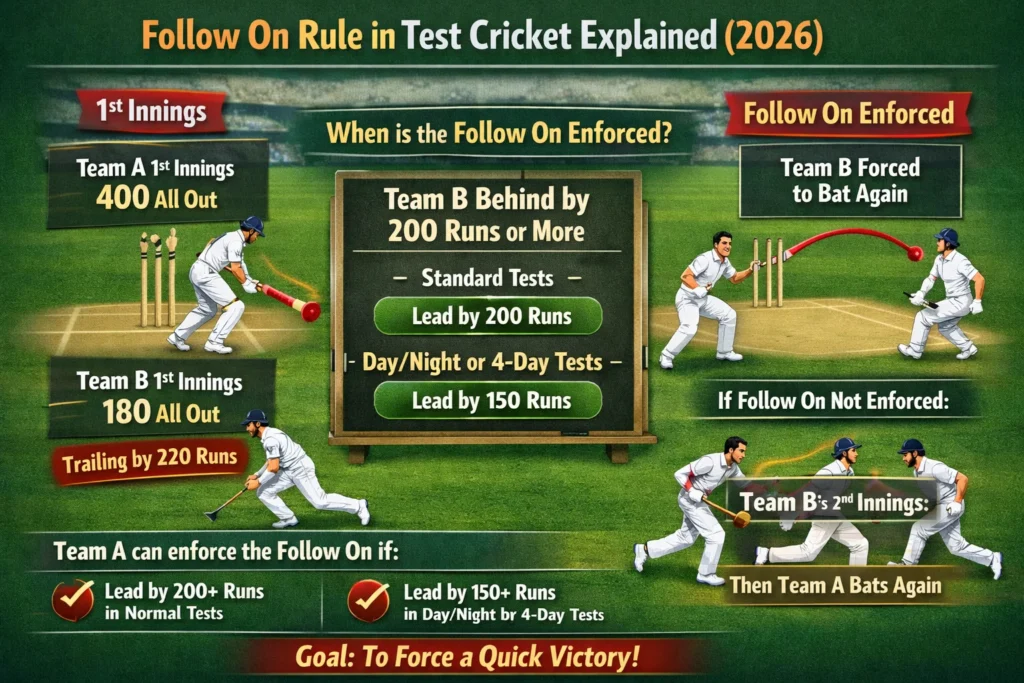

The follow-on rule allows a team to make their opponent bat again immediately after a first-innings lead of at least 200 runs (in a standard five-day Test match), instead of batting themselves. It’s a strategic tool used to try and force a result faster, but it comes with real risk if used incorrectly.
The follow-on is one of Test cricket’s most tactically fascinating rules it gives a dominant team the chance to press their advantage immediately, but history has shown it can also backfire spectacularly. This guide explains exactly how the rule works, the run thresholds involved, and why some of the most famous Test matches ever played have hinged on this single decision.
What Is the Follow-On in Test Cricket?
Normally, both teams in a Test match bat twice, alternating first and second innings. The follow-on is an exception to this pattern: if the team batting first builds a large enough lead after the first innings, they can force the opposition to bat again immediately, rather than batting a second time themselves right away.
If the follow-on is enforced and the opposition fails to overtake the leading team’s total in their second innings, the leading team wins without needing to bat again at all known as winning “by an innings.”
The Official Run-Difference Threshold
The exact run lead required to enforce the follow-on depends on the length of the match:
| Match Length | Minimum Lead Required |
|---|---|
| 5-day Test match | 200 runs |
| 3 or 4-day match | 150 runs |
| 2-day match | 100 runs |
| 1-day match | 75 runs |
Since almost all modern international Test matches are scheduled over five days, the 200-run threshold is the figure most commonly referenced by commentators and fans.
Who Decides Whether to Enforce the Follow-On?
The decision belongs entirely to the captain of the team with the lead even if they qualify for the follow-on based on the run difference, they are not obligated to enforce it. A captain can choose to bat again themselves instead, setting an even larger target and giving their bowlers more rest before bowling the opposition out a second time.
This decision is one of the most scrutinized calls in Test cricket, since getting it wrong has led to some of the sport’s most dramatic upsets.
Why Captains Sometimes Avoid Enforcing the Follow-On
Enforcing the follow-on might seem like the obvious choice when a team has a big lead, but there are real strategic risks:
- Bowler fatigue — Making the bowling attack bowl again immediately, without a batting rest in between, can lead to exhaustion, especially in hot conditions over a five-day match.
- Pitch deterioration in reverse — In some cases, batting again allows the leading team to set an even larger target while the pitch is deteriorating, making it even harder for the opposition in the final innings.
- The risk of a historic comeback — Test cricket has a small number of famous instances where a team enforced the follow-on, only for the following team to bat exceptionally well and turn the match around completely.
Famous Follow-On Turnarounds in Test History
The follow-on decision carries extra weight because of a small handful of historic matches where enforcing it backfired dramatically. The most famous example came during the 2001 Kolkata Test between India and Australia, where India, after being forced to follow on, batted so well in their second innings that they not only avoided defeat but went on to win the match outright one of the most celebrated comebacks in Test cricket history.
These rare but unforgettable results are a major reason captains today weigh the follow-on decision so carefully, even with a commanding first-innings lead.
Follow-On vs Normal Match Structure
| Feature | Normal Test Match | Follow-On Enforced |
|---|---|---|
| Batting order | Team A, Team B, Team A, Team B | Team A, Team B, Team B, Team A (if needed) |
| Requires lead? | No | Yes, minimum threshold based on match length |
| Can be declined? | Not applicable | Yes, captain’s choice |
| Possible outright win | Win by runs or wickets | Win by an innings, if opposition’s 2nd innings doesn’t overtake the lead |
Does the Follow-On Apply in ODI or T20 Cricket?
No. The follow-on is exclusive to Test cricket, since it depends on the two-innings-per-team structure unique to the longest format. ODI and T20 cricket, where each team bats only once, have no equivalent rule. To understand how these formats differ structurally, see our guides on Test Cricket, ODI Cricket and T20 Cricket.
How the Follow-On Connects to a Declaration
The follow-on is closely related to another Test-specific tactic: the declaration, where a captain voluntarily ends their own innings before being bowled out, usually to leave enough time to bowl the opposition out. While the follow-on forces the opposition to bat immediately after conceding a big first-innings lead, a declaration is a proactive choice made by the batting captain to control the match tempo. For the full breakdown, see our guide on Declaration Rule in Test Cricket Explained.
Interesting Facts About the Follow-On Rule
- The 2001 Kolkata Test between India and Australia remains the most iconic follow-on turnaround in cricket history, with India winning after being forced to bat again with a huge deficit.
- Only a handful of Test matches in over a century of international cricket have been won by a team after being asked to follow on making it one of the rarest comebacks in the sport.
- The follow-on rule has existed since the very early days of Test cricket, with the run-difference thresholds adjusted over time as match lengths and formats evolved.
- Some captains have been heavily criticized in hindsight for enforcing the follow-on, particularly when their bowlers looked visibly fatigued going into the third innings.
- Despite modern sports science and fitness improvements, the fatigue risk from enforcing the follow-on remains one of the most debated tactical considerations in Test captaincy.
- A team can qualify for the follow-on by exactly meeting the run threshold (for example, precisely 200 runs in a five-day Test) there’s no rounding or buffer involved.
Frequently Asked Questions
1. How many runs does a team need to enforce the follow-on? In a standard five-day Test match, a team needs a first-innings lead of at least 200 runs to enforce the follow-on.
2. Is a captain required to enforce the follow-on if they qualify? No, enforcing the follow-on is entirely optional, even if the run-difference threshold is met.
3. What happens if the follow-on is enforced and the opposition doesn’t overtake the lead? The leading team wins the match “by an innings,” without needing to bat again themselves.
4. Does the follow-on apply in ODI or T20 cricket? No, the follow-on only exists in Test cricket, due to its two-innings-per-team format.
5. What is the most famous follow-on comeback in cricket history? The 2001 Kolkata Test between India and Australia, where India was forced to follow on but went on to win the match after a historic second-innings performance.
Conclusion
The follow-on rule gives a dominant team in Test cricket the chance to press home their advantage immediately, but as history has shown, it’s a decision loaded with risk as much as opportunity. Understanding the run thresholds, the strategic trade-offs, and the rare but unforgettable turnarounds makes the follow-on one of the most fascinating tactical decisions in the entire sport.
For more on related Test cricket tactics, explore our guide on Declaration Rule in Test Cricket Explained or our Complete Cricket Rules Guide 2026.