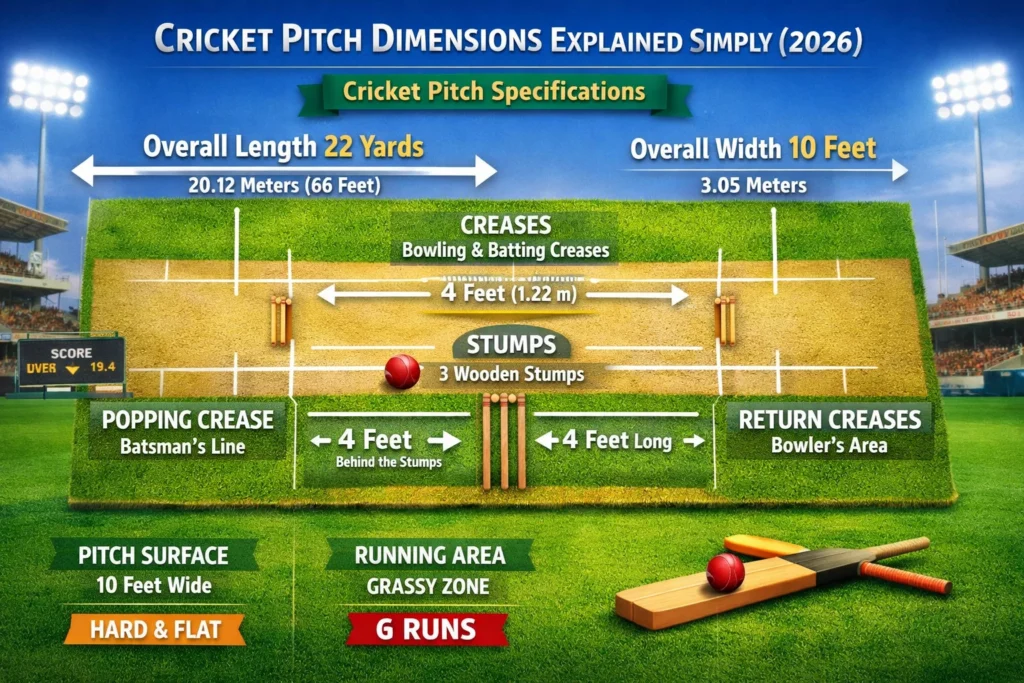

A cricket pitch is 22 yards (20.12 meters) long and 10 feet (3.05 meters) wide, marked with popping creases, bowling creases, and return creases at each end, with three stumps and two bails set up at both ends of the pitch.
The cricket pitch is the exact strip of ground where almost all the action of the game plays out where the bowler runs in, the ball bounces, and the batter defends their stumps. While the wider playing field can vary enormously in size from ground to ground, the pitch itself is precisely standardized. This guide breaks down every official measurement, marking, and structural detail of a cricket pitch.
The Basic Length and Width of a Cricket Pitch
The cricket pitch measures 22 yards (20.12 meters) from stump to stump a distance that has remained unchanged since the very early codification of cricket’s laws in the 18th century. The width of the pitch is 10 feet (3.05 meters), measured between the return creases on either side.
This 22-yard length is one of cricket’s most iconic and unchanging measurements, often referenced directly by commentators and used as a unit of distance within the sport itself.
Understanding the Crease Markings
Each end of the pitch has a specific set of markings that determine several key rules in the game, including run outs, stumpings, no-balls, and more.
1. Popping Crease
Located 4 feet (1.22 meters) in front of the stumps at each end, the popping crease is the line a batter must stay behind (or return their bat/body behind) to avoid being run out or stumped. It’s also the reference line for judging whether a batter is “in their ground.”
2. Bowling Crease
This line runs directly through the stumps, connecting the return creases on either side, and marks the width within which the stumps are positioned.
3. Return Crease
These are the two lines perpendicular to the bowling crease, marking the outer edges of where a bowler’s back foot must land during their delivery stride to avoid a no-ball. For more on how this connects to illegal deliveries, see our guide on No Ball and Wide Rules in Cricket.
Stump and Bail Dimensions
At each end of the pitch, three wooden stumps are placed upright, with two bails resting on top:
- Stump height: 28 inches (71.1 cm) above the playing surface.
- Total stump width (including bails): 9 inches (22.86 cm) across all three stumps combined.
- Bails: Small wooden pieces resting in grooves atop the stumps, designed to fall off easily when the stumps are struck, which is central to how run outs, stumpings, and bowled dismissals are judged.
Quick Reference: Cricket Pitch Measurements
| Element | Measurement |
|---|---|
| Pitch length (stump to stump) | 22 yards (20.12 m) |
| Pitch width | 10 feet (3.05 m) |
| Popping crease distance from stumps | 4 feet (1.22 m) |
| Stump height | 28 inches (71.1 cm) |
| Total stump width (3 stumps) | 9 inches (22.86 cm) |
Why the Pitch Length Matters for Bowling and Batting
The fixed 22-yard distance is central to almost every tactical decision in cricket. Fast bowlers rely on this exact distance to generate pace and bounce, while the ball’s behavior after pitching whether it seams, swings, or spins is judged by both bowler and batter based on this same unchanging length. Unlike the wider playing field, which varies from stadium to stadium, the pitch length staying constant means bowlers and batters can develop consistent techniques regardless of which ground they’re playing on.
How Pitch Dimensions Differ from Ground Dimensions
It’s a common point of confusion: the pitch (22 yards long, 10 feet wide) is completely different from the ground boundary, which can vary enormously between stadiums, from around 60 meters to over 90 meters from the center of the pitch. While the pitch dimensions are fixed by the laws of cricket, boundary distances are determined by each individual venue’s physical layout. For more on how boundaries work, see our guide on Boundary Rules: Four and Six Explained.
Do Pitch Dimensions Differ Between Formats?
No. The pitch dimensions themselves are identical across Test, ODI, and T20 cricket there’s no format-specific variation in the 22-yard length or 10-foot width. What differs between matches is the surface preparation and condition of the pitch (how much grass is left, how dry or worn it becomes), not its physical measurements. For more on how these surface differences affect play.
Interesting Facts About Cricket Pitch Dimensions
- The 22-yard pitch length is believed to originate from an old English unit of measurement called a “chain,” historically used in land surveying, long before cricket’s laws were formally written down.
- Despite massive changes to cricket over centuries new formats, new equipment, and new technology the core pitch dimensions have remained virtually unchanged since the sport’s earliest official laws.
- The distance between the popping crease and the stumps (4 feet) plays a direct role in stumping and run-out decisions, since it defines exactly how far a batter must be to be considered “safe.”
- Some historic pitches used slightly different stump heights and widths before standardization, though modern international cricket strictly follows the measurements outlined by the sport’s governing laws.
- While the pitch itself is fixed in size, the grass length and soil composition are adjusted by ground staff before each match, directly affecting bounce, pace, and spin despite the physical dimensions never changing.
- Cricket is one of the few major sports where the playing surface dimensions (the pitch) are fixed, while the outer field boundary is deliberately left variable from venue to venue.
Frequently Asked Questions
1. How long is a cricket pitch? A cricket pitch is 22 yards (20.12 meters) long, measured from stump to stump.
2. How wide is a cricket pitch? The pitch is 10 feet (3.05 meters) wide, measured between the return creases.
3. Does the pitch length change between Test, ODI, and T20 cricket? No, the pitch dimensions are identical across all formats only the ground boundary distance can vary by venue.
4. How tall are cricket stumps? Cricket stumps stand 28 inches (71.1 cm) above the ground, with two bails resting on top.
5. What is the difference between the popping crease and the bowling crease? The popping crease is the line batters must stay behind to avoid being run out or stumped, while the bowling crease runs directly through the stumps and defines their exact position on the pitch.
Conclusion
While cricket grounds vary enormously in shape and size from venue to venue, the pitch itself 22 yards long, 10 feet wide, with precisely measured creases and stumps has remained one of the most consistent elements of the sport for centuries. Understanding these exact dimensions makes it easier to appreciate how bowlers, batters, and umpires all rely on the very same fixed measurements, no matter where in the world a match is played.
For more on how pitch conditions (rather than dimensions) affect the game, explore our guide on Types of Cricket Pitches Explained or our Complete Cricket Rules Guide 2026.