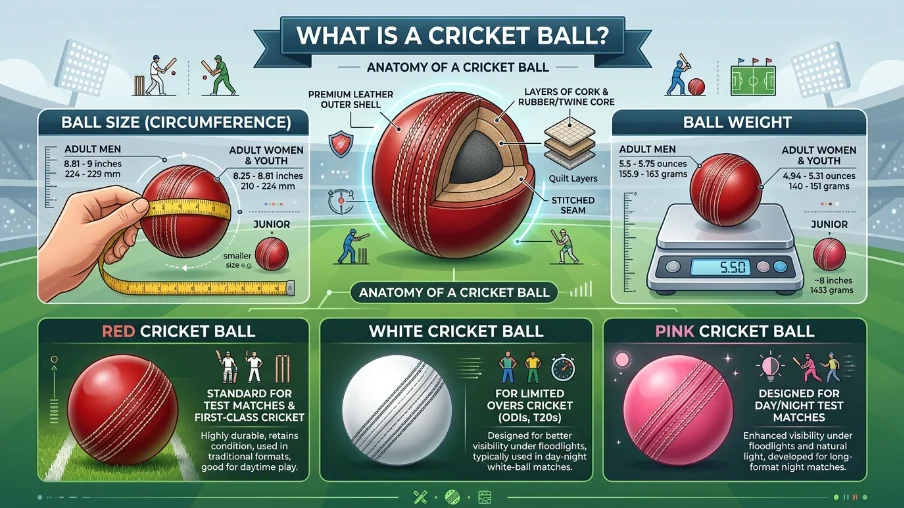

A cricket ball is a hard, leather-covered ball used in cricket, made with a cork core and tightly wound string. It weighs about 155–163 grams and features a stitched seam that helps bowlers generate swing and spin.
If you’re new to cricket, one of the first things you’ll notice is the ball it looks simple, but it plays a huge role in the game. Understanding what is cricket ball helps you grasp how cricket actually works, from fast bowling to spin and swing.
Unlike balls used in many other sports, a cricket ball is solid, durable, and carefully designed for performance. Its structure directly affects how the game is played, how bowlers attack, and how batters respond.
Let’s break it down step by step so you fully understand everything about it.
STEP 6 – ARTICLE STRUCTURE
What Is a Cricket Ball?
A cricket ball is the central piece of equipment used in cricket. It is a hard ball designed to be bowled toward a batter and hit using a bat.
Its unique design allows for:
- Bounce
- Swing in the air
- Spin off the pitch
These characteristics make cricket a skill-based sport rather than just power-based.
What Is a Cricket Ball Made Of?
A cricket ball has multiple layers, each serving a purpose.
Main Components
- Core: Cork (sometimes mixed with rubber)
- Inner Layer: Tightly wound string
- Outer Cover: Leather
- Seam: Raised stitched ridge
Structure Breakdown
| Layer | Material | Purpose |
| Core | Cork | Provides hardness and shape |
| Inner | String | Adds strength and durability |
| Outer | Leather | Protects and improves grip |
| Seam | Thread stitching | Helps bowlers control movement |
Size and Weight of a Cricket Ball
The size and weight are standardized to maintain fairness.
Official Specifications
| Category | Measurement |
| Weight | 155.9 – 163 grams |
| Circumference | 22.4 – 22.9 cm |
These standards are followed globally in professional cricket.
Why Is a Cricket Ball So Hard?
A cricket ball is intentionally hard for performance and durability.
Key Reasons
- To withstand repeated impact with bat and ground
- To maintain shape over long matches
- To allow bounce and speed
- To assist fast bowlers
However, this hardness also makes cricket a physically demanding sport, requiring protective gear.
Types of Cricket Balls
Different formats of cricket use different balls.
1. Red Ball
- Used in Test cricket
- Better visibility in daylight
- Lasts longer (up to 80 overs)
2. White Ball
- Used in ODIs and T20s
- Easier to see under lights
- Wears out faster
3. Pink Ball
- Used in day-night Test matches
- Designed for visibility in both light conditions
Comparison of Cricket Ball Types
| Type | Format | Visibility | Durability |
| Red | Test | Daylight | High |
| White | ODI/T20 | Night | Medium |
| Pink | Day-Night Test | Mixed | High |
Role of the Seam in Cricket Ball
The seam is one of the most important features.
What It Does
- Helps bowlers grip the ball
- Creates swing in the air
- Causes unpredictable movement after bounce
Fast bowlers use the seam for swing, while spinners use it for control.
How a Cricket Ball Affects Gameplay
The condition of the ball changes the game.
New Ball
- Hard and shiny
- Swings more
- Ideal for fast bowlers
Old Ball
- Rough surface
- Less swing
- Better for spin bowling
How Long Does a Cricket Ball Last?
The lifespan depends on the format.
| Format | Ball Usage |
| Test | Up to 80 overs |
| ODI | Two balls used (one per end) |
| T20 | Used for entire innings |
Basic Rules Related to Cricket Ball
- Players cannot damage the ball intentionally
- Ball tampering is illegal
- Only umpires can replace the ball
- Bowlers must deliver the ball fairly
Common Beginner Mistakes
- Thinking all cricket balls are the same
- Ignoring the importance of seam
- Not understanding ball wear
- Confusing red and white ball behavior
FAQs
1. What is a cricket ball made of?
A cricket ball is made from a cork core wrapped in tightly wound string and covered with leather. The outer seam is stitched to help bowlers grip and control the ball during play.
2. What is the weight of a cricket ball?
A standard cricket ball weighs between 155.9 and 163 grams. This weight ensures consistent performance across professional matches worldwide.
3. Why does a cricket ball have a seam?
The seam helps bowlers create movement in the air and off the pitch. It also provides grip, making it easier to control line and length.
4. What are the different types of cricket balls?
There are three main types: red, white, and pink. Each is used in different formats like Test matches, ODIs, and day-night games.
5. Why is a cricket ball so hard?
The ball is hard to maintain durability and allow proper bounce and speed. This design supports both fast bowling and long match durations.
6. How long does a cricket ball last?
In Test cricket, a ball can last up to 80 overs. In limited-overs formats, balls are replaced more frequently to maintain performance.
7. What is inside a cricket ball?
Inside the ball is a cork core, sometimes mixed with rubber, surrounded by tightly wound string layers that give it strength.
8. Why do cricket balls swing?
Swing occurs due to differences in airflow around the ball. The seam and surface condition help create this movement.
9. Is a cricket ball dangerous?
Yes, it can be dangerous due to its hardness and speed. Players wear protective gear like helmets and pads to stay safe.
10. What color cricket balls are used?
Cricket balls come in red, white, and pink. Each color is used depending on the format and lighting conditions.
CONCLUSION
Understanding what is cricket ball gives you a strong foundation in cricket. It’s not just a simple ball it’s a carefully designed piece of equipment that influences every aspect of the game. From its cork core to its leather surface and raised seam, every detail serves a purpose.
The type, condition, and behavior of the ball directly affect bowling strategies, batting techniques, and match outcomes. Whether it’s the swing of a new ball or the spin of an older one, the cricket ball shapes the rhythm of the game.
For beginners, learning about the cricket ball is the first step toward truly understanding cricket. Once you grasp how it works, the game becomes far more interesting and exciting to watch and play.