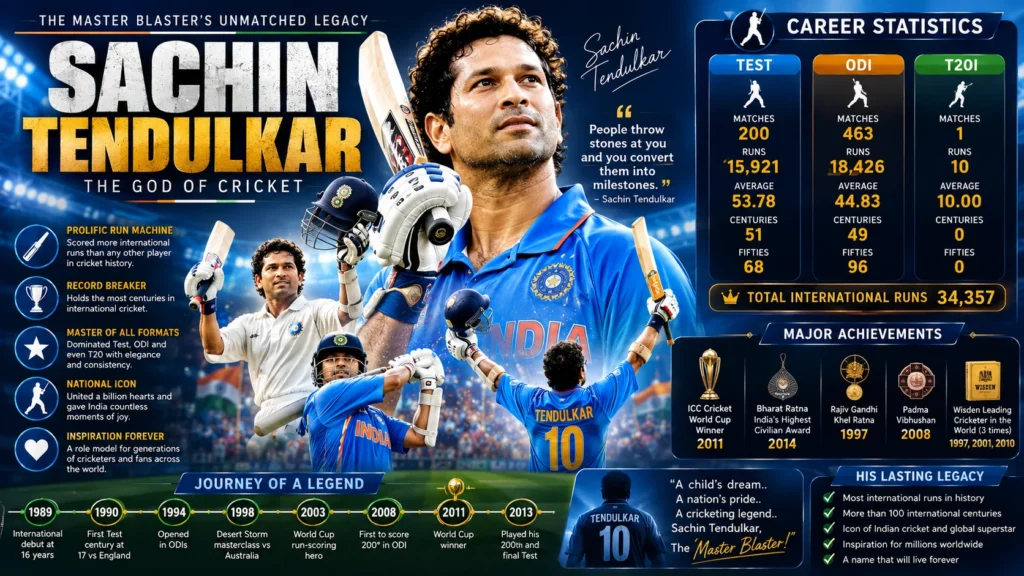

Sachin Tendulkar is widely regarded as one of the greatest cricketers in history. The Indian batting legend finished his 24-year international career with a record 34,357 runs across all formats, including 100 international centuries 51 in Tests and 49 in ODIs. He remains the highest run-scorer in both Test cricket (15,921 runs) and ODI cricket (18,426 runs).
Tendulkar played a record 200 Test matches and 463 ODIs, and was a key member of India’s 2011 ICC Cricket World Cup-winning team. His unmatched consistency, technical brilliance, and ability to carry the expectations of a billion fans cemented his status as cricket’s most iconic figure.
Few athletes have carried the weight of a nation’s hopes quite like Sachin Tendulkar. For 24 years, the man known as the “Master Blaster” and “Little Master” walked to the crease not just as a cricketer, but as the embodiment of India’s cricketing dreams. When he made his Test debut against Pakistan in 1989 at just 16 years old, no one could have predicted the seismic impact he would have on the sport.
Tendulkar’s journey from the cricket fields of Mumbai to becoming the most prolific run-scorer in international cricket is a story of extraordinary talent, relentless discipline, and remarkable longevity. His career coincided with India’s transformation into a cricketing superpower, and his influence extended far beyond the boundary ropes. Even years after his retirement in 2013, Sachin Tendulkar remains the benchmark against which every modern batter is measured a legacy that continues to tower over the game he graced for over two decades.
Biography
Early Life and Introduction to Cricket
Sachin Ramesh Tendulkar was born on April 24, 1973, in Bombay (now Mumbai), Maharashtra. He was the youngest of four children, with two elder brothers, Nitin and Ajit, and a sister, Savita. His father, Ramesh Tendulkar, was a noted Marathi novelist, while his mother, Rajni, managed the household.
Cricket entered Sachin’s life at age 11 when his elder brother Ajit, himself a cricketer, recognized the spark in the young boy and took him to the legendary coach Ramakant Achrekar at Shivaji Park in Dadar. Under Achrekar’s strict yet caring guidance, Tendulkar honed his skills on the dusty maidans of Mumbai. As a 14-year-old, he famously scored 329 runs in a record 664-run school partnership with Vinod Kambli a world record at the time.
At just 15, Tendulkar scored a century on his Ranji Trophy debut for Mumbai against Gujarat, finishing as his side’s leading run-scorer for the season.
International Debut (1989)
Sachin Tendulkar made his Test debut for India against Pakistan in Karachi on November 15, 1989, at the age of 16 years and 205 days making him the youngest Indian to play Test cricket. Facing a fearsome Pakistani pace attack featuring Imran Khan, Wasim Akram, and Abdul Qadir, the teenager showed remarkable composure.
In his second Test innings, he scored a gritty half-century, proving he belonged at the highest level. His first Test century came against England at Old Trafford in Manchester in August 1990, making him the youngest Indian to reach three figures in Test cricket. He followed this with centuries in Australia (148 at Sydney and 114 at Perth) during the 1991–92 tour, quickly adapting to fast, bouncy tracks.
The 1990s: Establishing Greatness
The 1990s saw Tendulkar transform from a promising teenager into the world’s most feared batter. In early 1994, he moved from the middle order to open the batting in ODIs a decision that revolutionized his career and the format itself.
His 1998 calendar year remains one of the greatest individual seasons in cricket history. He scored an astonishing 1,894 runs with nine ODI centuries both records that still stand today. That year, he also produced his famous “Desert Storm” innings against Australia in Sharjah, two back-to-back centuries that remain etched in cricketing folklore.
The 2000s: Records and Consistency
As Tendulkar entered his second decade of international cricket, he continued to shatter records. He surpassed Brian Lara’s tally of 11,953 Test runs in 2008, eventually finishing with 15,921 runs the highest in Test history. He became the fastest to 15,000 Test runs, achieving the milestone in just 300 innings.
He also became the first cricketer to score 30,000 international runs, a feat that remains unmatched. In February 2010, Tendulkar made history by scoring the first-ever double century in ODI cricket 200* against South Africa in Gwalior pioneering a feat that would inspire a generation of cricketers.
The World Cup Dream (2011)
After five fruitless World Cup campaigns, Tendulkar finally realized his ultimate dream on April 2, 2011. At his home ground, the Wankhede Stadium in Mumbai, India defeated Sri Lanka by six wickets to lift the ICC Cricket World Cup.
Though Tendulkar was dismissed early in the final, his contribution throughout the tournament was immense he finished as India’s leading run-scorer with 482 runs. The victory was deeply emotional, with teammates famously dedicating the win to the “God of Cricket”. Tendulkar himself called it the “best moment” of his cricketing career.
Farewell and Retirement
Tendulkar announced his retirement from ODIs in December 2012, having scored his long-awaited 100th international century in his penultimate ODI match against Bangladesh in the Asia Cup in March 2012.
His final Test appearance came against the West Indies at the Wankhede Stadium in November 2013 his 200th Test match. It was a fitting farewell for a player who “dealt in centuries,” and the emotional scenes at his home ground marked the end of an era.
Playing Style and Technique
Sachin Tendulkar possessed one of the most refined techniques in cricket history. His balance, footwork, and head position were exemplary. A product of the “Bombay school of batsmanship,” Tendulkar combined textbook technique with the ability to effortlessly switch from defence to attack.
His trademark back-foot square drive and punishing front-foot pull shot made him a complete player capable of dominating any bowling attack. Former West Indies pacer Ian Bishop described Tendulkar as “one of the most difficult batsmen I’ve ever bowled to,” praising his solid technique, strength off both front and back foot, and skill against both pace and spin.
Tendulkar’s innovative shot-making, including the upper cut against express pace bowlers like Brett Lee and Shoaib Akhtar, demonstrated his ability to turn pace into scoring opportunities. His longevity at the highest level spanning 24 years is a testament to his perfect technique and relentless work ethic.
Career Statistics
| Format | Matches | Runs | Highest Score | Centuries | Half-Centuries | Average | Fours |
| Test | 200 | 15,921 | 248* | 51 | 68 | 53.78 | 2,058 |
| ODI | 463 | 18,426 | 200* | 49 | 96 | 44.83 | 2,016 |
| T20I | 1 | 10 | 10* | 0 | 0 | — | — |
| IPL | 78 | 2,334 | 100* | 1 | 13 | 33.83 | — |
| Overall | 664 | 34,357 | — | 100 | 164 | 48.52 | 4,076 |
Sources: Cricbuzz, DNA India, Asianet News
Unbeaten Records That Still Stand
Even 13 years after his retirement, Sachin Tendulkar continues to hold several records that no active player has come close to surpassing:
| Record | Detail |
| Most international runs | 34,357 runs across all formats |
| Most international centuries | 100 (51 Tests + 49 ODIs) |
| Most Test runs | 15,921 runs |
| Most ODI runs | 18,426 runs |
| Most Test matches | 200 Test appearances |
| Most ODI matches | 463 ODIs |
| Most World Cup runs | 2,278 runs in ODI World Cups |
| Most Player of the Match awards | 76 awards |
| Fastest to 15,000 Test runs | 300 innings |
| Fastest to 18,000 ODI runs | 440 innings |
| Most runs in a calendar year (ODI) | 1,894 runs (1998) |
| Most centuries in a calendar year (ODI) | 9 centuries (1998) |
| Most fours in international cricket | 4,076 fours |
Awards and Honours
Sachin Tendulkar’s contributions to cricket have been recognized with numerous prestigious awards:
| Award | Year |
| Bharat Ratna (India’s highest civilian award) | 2014 |
| Padma Vibhushan (India’s second highest civilian award) | 2008 |
| Padma Shri (India’s fourth highest civilian award) | 1999 |
| ICC Hall of Fame | 2019 |
| Wisden Cricketer of the Year | 1997 |
| Col. C.K. Nayudu Lifetime Achievement Award (BCCI Naman Awards) | 2025 |
Tendulkar made history by becoming the first sportsperson and the youngest recipient (at age 40) to receive the Bharat Ratna. In February 2025, he was honoured with the BCCI’s prestigious Col. C.K. Nayudu Lifetime Achievement Award, celebrating his unparalleled contributions to Indian cricket over two decades.
Beyond Cricket: Post-Retirement Life
Since retiring from international cricket, Sachin Tendulkar has remained closely connected to the sport. He has served as an ICC event ambassador, including at the 2015 ICC Men’s Cricket World Cup and the 2017 ICC Women’s World Cup. He also mentored the Mumbai Indians in the Indian Premier League.
In the business world, Tendulkar has invested in various ventures. In March 2025, he invested in Purple Style through a preferential allotment, a company also backed by Shah Rukh Khan and Madhuri Dixit.
Tendulkar continues to engage with fans through social media. In June 2026, he delighted followers by sharing a video of himself playing cricket with his daughter Sara and daughter-in-law inside a private jet. He also actively supports grassroots cricket, visiting academies like the SRT10 Altevol Sports Academy in Ahmedabad to inspire young athletes.
FREQUENTLY ASKED QUESTIONS
1. How many runs did Sachin Tendulkar score in international cricket?
Sachin Tendulkar scored a record 34,357 international runs across all formats 15,921 in Tests, 18,426 in ODIs, and 10 in his sole T20I appearance. He remains the highest run-scorer in the history of international cricket, with his tally more than 6,000 runs ahead of the second-placed Kumar Sangakkara.
2. How many centuries did Sachin Tendulkar score?
Sachin Tendulkar scored 100 international centuries the only cricketer ever to reach three figures. This includes 51 centuries in Test cricket and 49 in One-Day Internationals. His 50th Test century, scored against South Africa in Centurion in 2010, made him the first player to score a half-century of Test tons.
3. When did Sachin Tendulkar retire from cricket?
Sachin Tendulkar retired from One-Day Internationals in December 2012. His final Test match was in November 2013 against the West Indies at the Wankhede Stadium in Mumbai his 200th Test appearance. He also retired from the Indian Premier League in 2013 after winning the IPL title with Mumbai Indians.
4. What is Sachin Tendulkar’s highest score in Test cricket?
Sachin Tendulkar’s highest Test score is 248 not out, achieved against Bangladesh in Dhaka in December 2004. Interestingly, he never scored a double century in Tests, with 248* remaining his best. His highest ODI score is 200* against South Africa in Gwalior in February 2010 the first double century in ODI cricket history.
5. Why is Sachin Tendulkar called the ‘God of Cricket’?
Sachin Tendulkar earned the title “God of Cricket” from fans and peers alike due to his extraordinary achievements, impeccable technique, and ability to carry the hopes of a billion people for over two decades. Despite being called by this title, Tendulkar himself has humbly stated, “I am not the god of cricket. I make mistakes”.
6. Did Sachin Tendulkar win the Cricket World Cup?
Yes, Sachin Tendulkar was a key member of the Indian team that won the ICC Cricket World Cup in 2011. India defeated Sri Lanka by six wickets in the final at the Wankhede Stadium in Mumbai. Tendulkar finished as India’s leading run-scorer in the tournament with 482 runs and called it the “best moment” of his cricketing career.
7. What awards has Sachin Tendulkar received?
Sachin Tendulkar has received numerous honours, including the Bharat Ratna (India’s highest civilian award) in 2014 he was the first sportsperson and youngest recipient. He also received the Padma Vibhushan (2008), Padma Shri (1999), and was inducted into the ICC Hall of Fame in 2019. In 2025, he received the BCCI’s Col. C.K. Nayudu Lifetime Achievement Award.
8. Who coached Sachin Tendulkar?
Sachin Tendulkar was coached by the legendary Ramakant Achrekar at Shivaji Park in Dadar, Mumbai. Achrekar, known for mentoring several Indian cricketers, was strict yet caring, and Tendulkar has often credited him for his development as a player. Tendulkar’s elder brother Ajit also played a crucial role in recognizing his talent and taking him to Achrekar.
9. How many Test matches did Sachin Tendulkar play?
Sachin Tendulkar played a record 200 Test matches the most by any cricketer in the history of the format. He amassed 15,921 runs at an average of 53.78, with 51 centuries and 68 half-centuries. He also holds the record for the most fours in Test cricket, with 2,058 boundaries.
10. What is Sachin Tendulkar doing now?
Sachin Tendulkar remains actively involved in cricket as an ICC ambassador and mentor to the Mumbai Indians in the IPL. He continues to engage with fans through social media and supports grassroots cricket development, recently visiting the SRT10 Altevol Sports Academy in Ahmedabad. He has also invested in business ventures.
CONCLUSION
Sachin Tendulkar’s journey from the maidans of Mumbai to becoming cricket’s most revered figure is more than a story of runs and records it is a testament to the power of dedication, humility, and an unyielding love for the game. His 34,357 international runs and 100 centuries are not just numbers; they represent two decades of carrying a nation’s dreams on his shoulders, of silencing critics with his bat, and of redefining what was thought possible in cricket.
What sets Tendulkar apart is not merely his statistical dominance but his ability to evolve across eras, adapting to different formats, conditions, and bowling attacks while maintaining the highest standards of excellence. He inspired a generation of cricketers in India and around the world, and his name remains the benchmark against which every modern batter is judged. Even as new stars emerge and records are challenged, the “Master Blaster’s” legacy endures not just in the record books, but in the hearts of millions who grew up watching him bat. Sachin Tendulkar didn’t just play cricket; he defined an era, united a nation, and gave the world a glimpse of sporting greatness that will be remembered for generations to come.