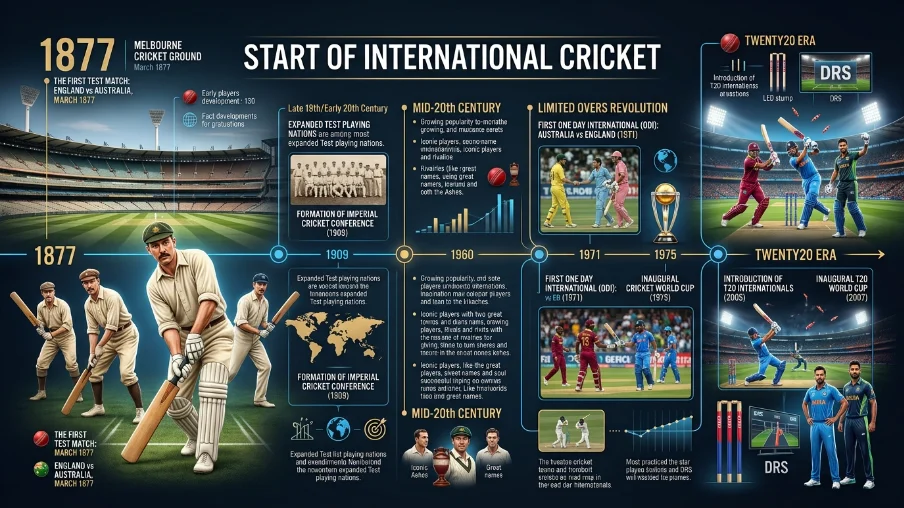

The start of international cricket dates back to 1877 when England and Australia played the first official Test match at the Melbourne Cricket Ground, marking the beginning of organized international competition in cricket.
Cricket today is a global sport followed by millions, but its journey began with a single historic moment. The start of international cricket traces back to the late 19th century, when nations first competed on an official stage. What began as a bilateral contest between two teams quickly evolved into a worldwide phenomenon. Understanding how international cricket started gives you a deeper appreciation of the sport’s traditions, rivalries, and modern formats.
What Is International Cricket?
International cricket refers to matches played between national teams that are officially recognized by the International Cricket Council.
These matches are played in three main formats:
- Test Cricket
- One Day Internationals (ODIs)
- Twenty20 Internationals (T20Is)
The True Start of International Cricket
The official beginning came in March 1877.
Key Event
- Match: England vs Australia
- Location: Melbourne Cricket Ground
- Result: Australia won by 45 runs
This match is now recognized as the first-ever Test match, marking the formal start of international cricket.
Early Unofficial International Matches
Before 1877, there were matches between teams from different countries, but they were not officially recognized.
Example:
- 1844 Match: USA vs Canada
Although historically significant, it is not considered the official start because it lacked formal structure and recognition.
Why 1877 Is Considered the Official Start
The 1877 match stands out because:
- It followed organized rules
- It involved national teams
- It was later recognized as a Test match
- It set a standard for future international games
Evolution of International Cricket Formats
International cricket didn’t stop at Test matches. It evolved over time.
Timeline of Formats
| Format | Year Introduced | Description |
| Test Cricket | 1877 | Long format (5 days) |
| ODI Cricket | 1971 | Limited overs (50 overs) |
| T20 Cricket | 2005 | Short format (20 overs) |
The Role of the ICC
The International Cricket Council plays a crucial role in:
- Governing international matches
- Setting rules and standards
- Organizing global tournaments
- Expanding cricket worldwide
The Birth of Iconic Rivalries
One of the biggest outcomes of early international cricket was legendary rivalries.
The Ashes
- Began in 1882
- Played between:
- England cricket team
- Australia cricket team
This rivalry remains one of the most prestigious in cricket history.
Growth of International Cricket Worldwide
After England and Australia, more nations joined.
Expansion Timeline
- South Africa – 1889
- West Indies – 1928
- India – 1932
- Pakistan – 1952
Cricket gradually became a global sport.
Key Milestones in International Cricket History
- 1877 – First Test match
- 1882 – Start of The Ashes
- 1971 – First ODI match
- 1975 – First Cricket World Cup
- 2007 – First T20 World Cup
Comparison: Early vs Modern International Cricket
| Feature | Early Cricket | Modern Cricket |
| Teams | Few (2–3) | 100+ nations |
| Format | Test only | Test, ODI, T20 |
| Audience | Local | Global |
| Technology | None | DRS, analytics |
| Coverage | Minimal | Live worldwide |
FAQs
1. When did international cricket officially start?
International cricket officially began in 1877 with the first Test match between England and Australia. This match is widely recognized as the foundation of organized international cricket and marked the beginning of global competition in the sport.
2. Where was the first international cricket match played?
The first official international cricket match was played at the Melbourne Cricket Ground in Australia. This iconic venue remains one of the most historic cricket stadiums in the world.
3. Who won the first international cricket match?
Australia won the first Test match against England by 45 runs in 1877. This victory marked a historic moment in cricket history and started one of the sport’s greatest rivalries.
4. Was there any international cricket before 1877?
Yes, there were matches like USA vs Canada in 1844, but they were not officially recognized as international cricket. The 1877 match is considered the true beginning due to its formal structure.
5. What is Test cricket?
Test cricket is the oldest format of international cricket. It is played over five days and is considered the most traditional and challenging form of the game.
6. When did ODI cricket start?
ODI cricket began in 1971 as a shorter format of the game. It introduced limited overs, making matches faster and more appealing to a broader audience.
7. When did T20 cricket start internationally?
T20 international cricket started in 2005. It quickly became popular due to its fast-paced nature and shorter match duration.
8. Why is The Ashes important?
The Ashes is one of cricket’s oldest and most prestigious series. It represents a historic rivalry between England and Australia dating back to 1882.
9. How did cricket become global?
Cricket spread through British influence and colonial expansion. Over time, more countries adopted the sport and joined international competitions.
10. What role does the ICC play in international cricket?
The ICC governs international cricket, sets rules, organizes tournaments, and ensures fair play among all participating nations worldwide.
Conclusion
The start of international cricket in 1877 marked the beginning of a sport that would grow into a global phenomenon. From a single Test match between England and Australia, cricket has evolved into a multi-format game played across continents. Over the years, new formats, advanced technology, and expanding participation have transformed the sport while preserving its rich traditions.
Understanding its origins helps you appreciate how far cricket has come and why it remains one of the most beloved sports worldwide. As the game continues to grow, its historic roots remain a foundation for its future.