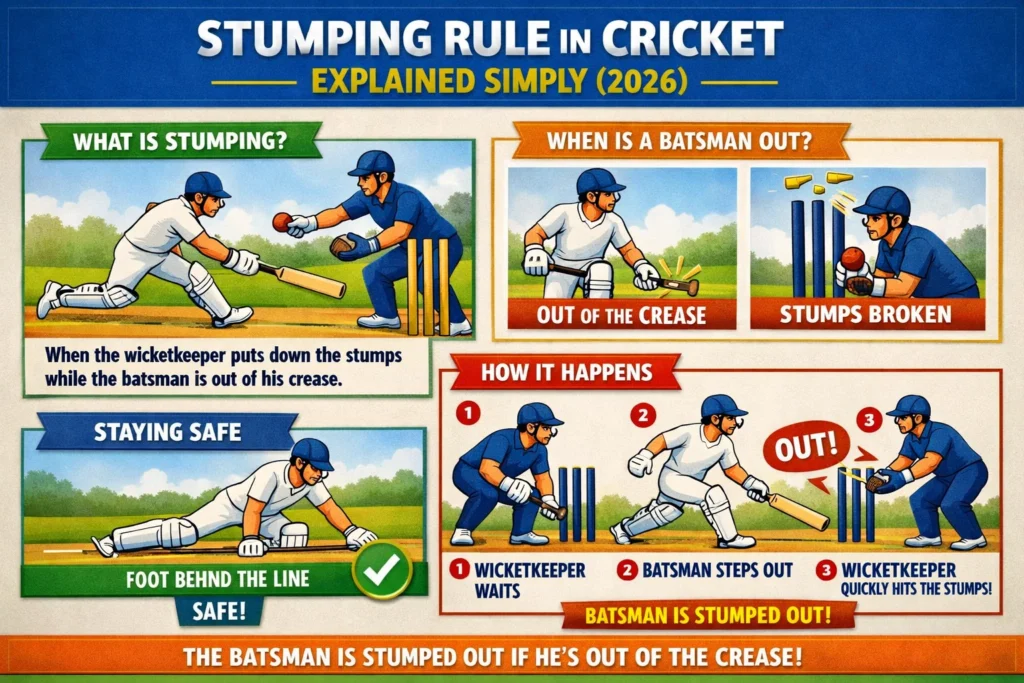

A stumping happens when the wicketkeeper breaks the stumps with the ball while the batter is out of their crease after missing or playing a shot but not while attempting a run. It’s one of the wicketkeeper’s signature dismissals and relies on lightning-fast hands behind the stumps.
Stumpings are among the quickest, most skillful dismissals in cricket a split-second gather and whip by the wicketkeeper that can end an innings in the blink of an eye. This guide explains exactly how the stumping rule works, what makes it different from a run out, and how DRS technology is used to review these tight calls.
What Is a Stumping in Cricket?
A stumping occurs when the batter steps or reaches out of their crease to play a delivery (or misses it entirely), and the wicketkeeper collects the ball cleanly and breaks the stumps before the batter can return their bat or body behind the popping crease.
Unlike most other dismissals, a stumping is credited to both the bowler and the wicketkeeper in the scorecard the bowler gets the wicket, and the wicketkeeper is credited with the stumping.
The Official Conditions for a Stumping
For a batter to be given out stumped, all of the following must be true:
- The batter must be out of their crease — no part of their bat or body grounded behind the popping crease at the moment the stumps are broken.
- The batter must not be attempting a run — if the batter is out of their crease while actually running between the wickets, the correct dismissal becomes a run out instead, not a stumping.
- The wicketkeeper must gather the ball themselves — the wicketkeeper has to collect the ball cleanly and break the stumps with the ball in hand (or the ball itself, if thrown directly at the stumps by the keeper).
- The ball must not have touched another fielder first — if another fielder deflects or touches the ball before the wicketkeeper uses it to break the stumps, the dismissal becomes a run out, not a stumping.
Stumping vs Run Out: The Key Difference
This is the single most important distinction to understand, since both dismissals involve breaking the stumps with the batter out of their crease:
| Feature | Stumping | Run Out |
|---|---|---|
| Who can execute it | Only the wicketkeeper | Any fielder |
| Batter’s action | Missed or played a shot, not running | Attempting a run between wickets |
| Ball handling | Must be gathered by keeper directly | Can be thrown from anywhere |
| Credited to bowler? | Yes | No |
| Applies to non-striker? | No, only the striker | Yes, either batter |
For the full breakdown of run outs, see our guide on Run Out Rule in Cricket Explained.
Why Stumpings Usually Happen Against Spin Bowling
Stumpings are far more common against slower, spin bowling than fast bowling, for a simple reason: batters often step down the pitch to attack spinners, trying to reach the ball before it turns or dips. This forward movement takes them out of their crease, and if they miss the ball, the wicketkeeper who stands much closer to the stumps against spin bowling than against pace has a realistic chance to gather the ball and break the stumps before the batter recovers their ground.
Against fast bowling, wicketkeepers typically stand much further back, making stumpings far rarer, though not impossible on rare quick deliveries where a batter overbalances.
Stumping and DRS Reviews
Stumpings are frequently referred to the third umpire, since the margin between the bails being broken and the batter’s bat reaching the crease is often a fraction of a second sometimes measured in single-digit milliseconds on slow-motion replay.
Technology like UltraEdge can also be used in these reviews, especially to check whether the batter edged the ball onto their pad or bat before missing it entirely, which could change the nature of the dismissal itself. For a full explanation of how DRS technology works across all types of decisions, read our guide on How Does DRS Work in Cricket.
Can a Stumping Be Overturned by a No-Ball?
Yes. If the delivery is later found to be a no-ball (for example, due to the bowler overstepping the crease), the stumping is automatically overturned, since dismissals other than run out cannot stand on an illegal delivery. This is one reason many cricket boards use automated front-foot no-ball checks before confirming a stumping on-field, to avoid needing to reverse a decision after it’s already been celebrated. For more on this, see our guide on No Ball and Wide Rules in Cricket.
Stumping Rules Across Formats
The core rule is identical across Test, ODI, and T20 cricket there is no format-specific variation in how a stumping is defined or executed. What does change is how often it occurs strategically:
- T20 cricket — Batters take more risks against spin, stepping out aggressively to hit boundaries, increasing stumping opportunities.
- Test cricket — Stumpings tend to happen later in an innings, often against spinners exploiting a worn pitch on days four or five.
- ODI cricket — A balance of both, particularly during the middle overs when spinners are typically introduced to control the run rate.
To understand these format differences more broadly, see our guides on T20 Cricket, Test Cricket, and ODI Cricket.
Interesting Facts About the Stumping Rule
- Some of the fastest stumpings in cricket history have been completed in under 0.1 seconds from ball-gather to bails-off, showcasing elite wicketkeeper reflexes.
- Wicketkeepers specializing against spin bowlers often stand within a meter of the stumps, compared to standing 15-20 meters back against fast bowlers.
- A stumping cannot occur if the ball has already become “dead” for example, if the batter has clearly finished their shot attempt and stepped back into their crease before any further action.
- Historically, some of cricket’s greatest stumping specialists built entire reputations around lightning-fast glovework specifically against spin bowling on turning pitches.
- A stumping can technically still happen even if the wicketkeeper fumbles the ball slightly, as long as they gather it cleanly before breaking the stumps there’s no rule requiring a “perfect” catch first.
- If the wicketkeeper breaks the stumps but the ball had already touched a fielder (like a diving slip catcher) beforehand, the dismissal automatically becomes a run out instead of a stumping.
Frequently Asked Questions
1. Can only the wicketkeeper complete a stumping? Yes, a stumping can only be credited if the wicketkeeper gathers the ball themselves and breaks the stumps any other fielder involvement changes it to a run out.
2. Is a stumping credited to the bowler? Yes, unlike a run out, a stumping is credited to both the bowler (as a wicket) and the wicketkeeper (as the stumping).
3. Why are stumpings more common against spin bowling? Batters often step out of their crease to attack spinners before the ball turns, and wicketkeepers stand much closer to the stumps against spin, making a quick stumping far more achievable.
4. What happens if a stumping occurs off a no-ball? The dismissal is automatically overturned, since no dismissal other than a run out can stand if the delivery is called a no-ball.
5. Can a batter be stumped while attempting a run? No if the batter is out of their crease while running between the wickets, the correct dismissal is a run out, not a stumping.
Conclusion
The stumping rule rewards split-second wicketkeeping skill gathering the ball cleanly and breaking the stumps before a batter, often caught out of position against spin, can recover their ground. While it shares surface similarities with a run out, the requirement that only the wicketkeeper can execute it, and that the batter must not be running, makes it a distinct and highly specialized dismissal in the game.
For more on related dismissals and fielding rules, explore our guides on Fielding Rules in Cricket and our Complete Cricket Rules Guide 2026.