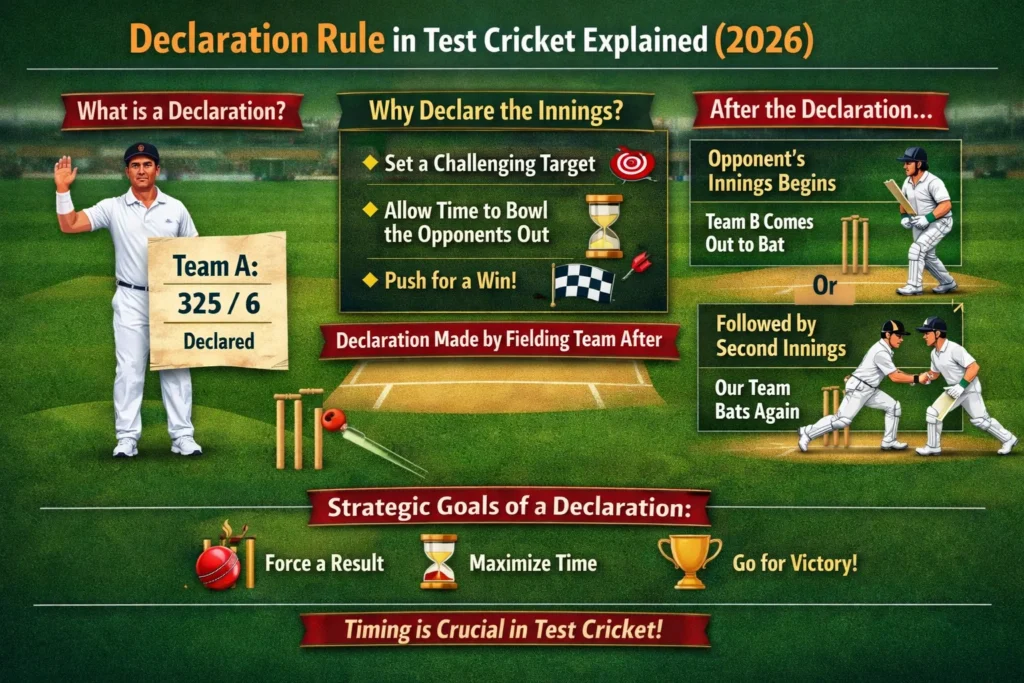

A declaration is when the batting captain voluntarily ends their team’s innings before all ten wickets have fallen, usually to leave enough time to bowl the opposition out and force a result. It’s one of Test cricket’s most important tactical tools, unique to the format’s time-based structure.
Unlike limited-overs cricket, where an innings always ends after a fixed number of overs, Test cricket gives captains the power to end their own innings whenever they choose. This single rule shapes some of the most tense finishes in the sport. This guide explains exactly how declarations work, when captains use them, and the risks involved in getting the timing wrong.
What Is a Declaration in Test Cricket?
A declaration occurs when the batting team’s captain chooses to close their innings voluntarily, even though they still have wickets in hand and haven’t been bowled out or reached a fixed over limit. Since Test matches are played over a maximum of five days rather than a fixed number of overs, declarations give captains full control over how much time remains to force a result.
Once a declaration is made, the innings ends immediately, and the opposition begins their next innings right away.
Why Do Captains Declare Early?
Declarations are almost always about managing time, not simply scoring runs. A captain might declare for several reasons:
- To leave enough time to bowl the opposition out — Since a Test match can end in a draw if neither team completes the required innings within five days, a captain may declare well before their team is bowled out, prioritizing bowling time over additional batting runs.
- Weather or bad light considerations — If rain or bad light is forecast, a captain might declare earlier than usual to guarantee enough playing time remains for a result.
- Setting a target under pressure — In the final innings of a match, teams often declare with a target designed to be challenging but theoretically chaseable, creating a tense finish rather than simply batting out the clock.
- Protecting player fitness — In rare cases, a captain may declare to rest key batters or bowlers ahead of the next stage of the innings, particularly during long tours with multiple matches.
When Can a Team Declare?
A captain can declare at any point during their team’s innings, including between overs, though not usually mid-over. There is no minimum number of overs or runs required before a declaration is allowed a captain could technically declare after just a handful of overs if the tactical situation called for it, though this is exceptionally rare in professional cricket.
The Risk of Declaring Too Early (or Too Late)
Timing a declaration correctly is one of Test cricket’s most difficult captaincy skills:
- Declaring too early risks giving the opposition a genuinely reachable target, potentially turning a near-certain win into a loss.
- Declaring too late risks running out of overs to bowl the opposition out, resulting in a draw despite a dominant position throughout the match.
This balancing act enough overs to bowl the opposition out, but not so many runs that the target becomes chaseable is why declarations are often debated intensely by commentators and fans in the closing stages of a Test match.
Declaration vs Follow-On: What’s the Difference?
These two Test-specific rules are sometimes confused, since both involve a captain making a proactive decision about the shape of the match:
| Feature | Declaration | Follow-On |
|---|---|---|
| Who decides | Batting captain | Captain with the first-innings lead |
| When it applies | Any point during an innings | Only after a lead of 200+ runs (5-day Test) |
| Purpose | Control time, set a target | Force the opposition to bat again immediately |
| Requires a run threshold? | No | Yes |
Can Both Teams Declare in the Same Match?
Yes. It’s common in a well-balanced Test match for both teams to declare at different points, particularly in matches where both sides are trying to force a result rather than settle for a draw. A well-known tactical pattern in some Tests involves both captains declaring across the third and fourth innings to set up a final-day run chase.
Declarations and the Final-Day Run Chase
Some of Test cricket’s most memorable finishes come from a declaration that sets up a final-day run chase a target designed to be tough but not impossible, encouraging the chasing team to go for the win rather than simply blocking out the remaining overs for a draw. These situations often produce dramatic, closely fought finishes, since both a win and a draw remain realistic outcomes deep into the last session.
Does the Declaration Rule Apply in ODI or T20 Cricket?
No. Declarations are exclusive to Test cricket, since ODI and T20 matches are governed by a fixed number of overs rather than time there’s no benefit to ending an innings early in a format where the over limit already determines when batting ends. To understand these format differences further, see our guides on Test Cricket, ODI Cricket and T20 Cricket.
Interesting Facts About the Declaration Rule
- A declaration can technically be made at any score, even 0 for 0, though this has almost never happened in serious professional cricket due to the obvious tactical disadvantage.
- Some of Test cricket’s most famous run chases have come directly from a well-timed declaration, creating tense final-session finishes watched by millions.
- Declarations are recorded in the scorebook with the notation “declared” next to the team’s final score, distinguishing it from being bowled out or reaching a set number of overs.
- Captains sometimes use declarations specifically to deny an individual opposition batter the chance to reach a personal milestone, a tactic that has occasionally sparked debate about sportsmanship.
- A team can, in rare circumstances, declare twice in the same match once in their first innings and again in their second, if the situation calls for it.
- Weather forecasts play a bigger role in declaration timing than many fans realize, with captains sometimes declaring earlier than statistically “ideal” simply to guarantee enough time against expected rain.
Frequently Asked Questions
1. Can a captain declare at any point in an innings? Yes, a captain can declare at almost any point during their team’s innings, typically between overs rather than mid-over.
2. Why do captains declare instead of batting until all-out? Declarations are used to manage time, ensuring enough overs remain to bowl the opposition out and force a result, rather than risk running out of time for a draw.
3. Is there a minimum score required before a team can declare? No, there’s no minimum run requirement a captain can technically declare at any score, though doing so at a very low score would be extremely unusual tactically.
4. What’s the difference between a declaration and a follow-on? A declaration is a voluntary choice by the batting captain to end their innings early, while a follow-on is enforced by the team with a first-innings lead of at least 200 runs, forcing the opposition to bat again immediately.
5. Does the declaration rule apply in ODI or T20 cricket? No, declarations are exclusive to Test cricket, since limited-overs formats are already governed by a fixed number of overs rather than time.
Conclusion
The declaration rule is one of the clearest examples of Test cricket’s unique, time-based strategy giving captains the power to sacrifice potential runs in exchange for enough time to force a genuine result. Whether it’s setting up a nail-biting final-day run chase or simply managing the clock against the weather, a well-timed declaration remains one of the most fascinating tactical decisions in the entire sport.
For more on related Test cricket tactics, explore our guide on Complete Cricket Rules Guide 2026.