
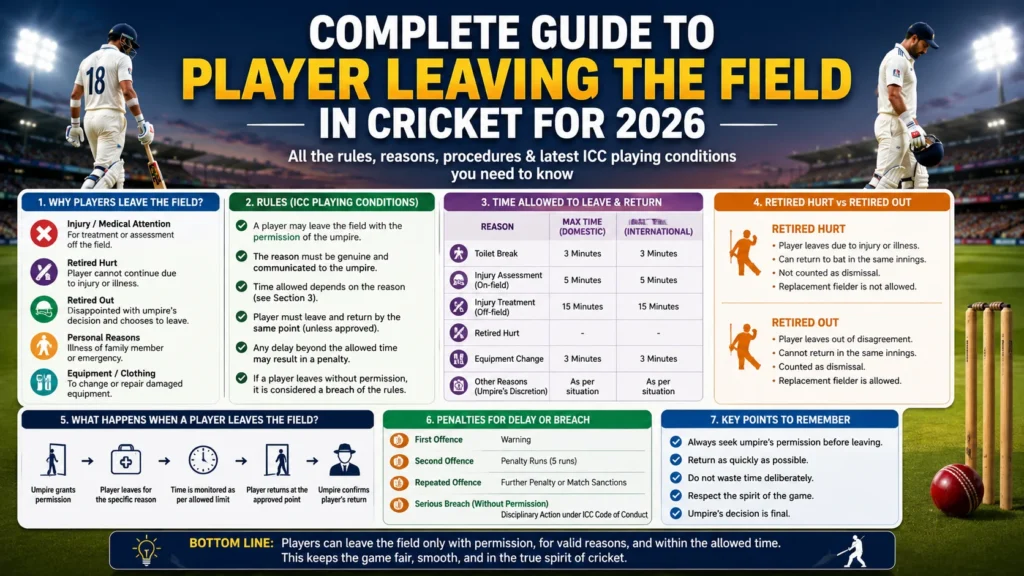

A player leaving the field in cricket occurs for various reasons including injury, illness, or personal emergencies. When a player exits, the rules permit a substitute fielder to take their place, though substitutes cannot bat, bowl, or act as wicketkeeper. The departing player may return to the field with umpire approval, subject to time restrictions that impact their eligibility to bowl or bat later in the innings. Under ICC regulations, specific provisions exist for concussed players, allowing permanent replacements with umpire and match referee approval.
If a player leaves without permission or for non-medical reasons, they face penalties including fines and match bans. Concussion substitutes are a modern addition where a like-for-like replacement can bat and bowl, ensuring fair competition. The injured player’s recovery timeline determines their return, making this rule vital for team strategies.
Cricket is a sport built on precision, teamwork, and adherence to complex regulations. One scenario that often leaves fans and new players confused is when a cricketer suddenly walks off the field mid-match. Whether due to a hamstring tweak, dizziness, or a collision on the boundary, a player leaving the field in cricket triggers a specific set of rules designed to balance fairness, safety, and competitive integrity.
Understanding these regulations is crucial for players, coaches, and fans who want to follow the game intelligently. From temporary departures to permanent substitutions, the cricketing laws have evolved to protect athletes while ensuring no team gains an unfair advantage. With the introduction of concussion substitutes and strict medical protocols, modern cricket prioritizes player welfare without compromising the game’s spirit.
Overview
1. Definition
A player leaving the field in cricket simply means any cricketer who exits the playing area during an active match. This could happen when the team is batting, bowling, or fielding. The reasons vary from physical injuries to tactical decisions or personal emergencies.
Cricket has unique regulations to handle these situations. Unlike many other sports where substitutions are routine, cricket strictly controls player exits and replacements. The rules ensure that teams maintain competitive balance while prioritizing athlete safety. Understanding these laws helps everyone from casual viewers to dedicated players appreciate the game’s complexity.
2. Official Rules and Laws
The Marylebone Cricket Club (MCC) oversees the Laws of Cricket, while the International Cricket Council (ICC) publishes detailed Playing Conditions for international matches. Law 24 addresses substitute fielders, and Law 25 covers batsman retiring. These fundamental rules apply across all formats.
ICC Playing Conditions add further clarity for professional matches. They specify time limits, medical protocols, and approval procedures. For instance, a player who leaves due to injury must receive clearance from the match officials before returning. The ICC also mandates that any substitute fielder cannot bowl or bat, preserving the original squad’s integrity.
Additionally, the Decision Review System (DRS) procedures include provisions for injured players. If a batsman leaves the field mid-review, specific protocols determine how the review proceeds. These comprehensive guidelines ensure consistency across all international fixtures.
Table: Key Laws Governing Player Departures
| Law/Provision | Source | Key Rule |
| Law 24 | MCC Laws | Substitute fielders allowed but cannot bat/bowl |
| Law 25 | MCC Laws | Batsman retiring (hurt/out) |
| ICC Concussion Rule | ICC Playing Conditions | Like-for-like permanent replacement |
| Law 31 | MCC Laws | Unfair play and penalties |
| Law 42 | MCC Laws | Player conduct and discipline |
3. Types of Departures
Temporary Departures: Most players leave temporarily for medical treatment or equipment adjustments. For example, a bowler might exit after feeling a twinge, get treatment, and return later. These departures, when approved by the umpire, allow the player to resume participation.
Permanent Departures: Serious injuries or emergencies force permanent departures. In such cases, the team relies on substitutes for fielding. However, no permanent replacement can bat or bowl. Unless the player is replaced via the concussion substitute rule, the team continues with one less active participant.
Injury-Related: The most common reason is injury. Muscle pulls, fractures, dehydration, and collisions happen frequently. Medical teams assess the player, and if safe to return, the umpire permits it. Otherwise, the player stays off for the remainder.
Non-Injury: Rarely, a player might leave for tactical reasons or personal matters. A batsman retiring “out” when not injured is considered retired out. The captain can also withdraw a player as a strategic move, though this is uncommon.
4. The Concussion Substitute Rule
Introduced in 2019, the concussion substitute rule revolutionized how cricket handles head injuries. When a player suffers a concussion or suspected concussion, the team can request a like-for-like replacement. This means the substitute can bat, bowl, and field as if they were the original player.
The process begins when the team physio suspects a concussion. The match referee then reviews medical evidence. If approved, a nominated replacement takes the injured player’s place permanently. The original player cannot return. This ensures teams aren’t severely disadvantaged while prioritizing player health.
The rule has sparked debate about fairness and misuse. Some worry teams might use it tactically. However, independent doctors and strict protocols prevent abuse. The ICC continues refining the rules as medical understanding evolves. Cases like Marnus Labuschagne replacing Steve Smith in the 2019 Ashes brought global attention to this progressive rule.
Table: Concussion Substitute Comparison
| Aspect | Concussion Substitute | Regular Substitute |
| Can Bat | ✅ Yes | ❌ No |
| Can Bowl | ✅ Yes | ❌ No |
| Can Wicketkeep | ✅ Yes | ❌ No |
| Permanent | ✅ Yes | ❌ No (Fielding only) |
| Medical Approval | ✅ Yes | ❌ Not required |
| Like-for-Like | ✅ Yes | ❌ No |
5. Retired Hurt vs Retired Out
Retired Hurt: When a batsman leaves due to injury, illness, or any other cause, they are “retired hurt.” The umpire records this and the player’s score remains. If the player recovers, they can resume batting later in the innings with the umpire’s permission. Their retirement doesn’t count as a dismissal, and they can return at the fall of a wicket or when a partner retires.
Retired Out: This occurs when a batsman retires for non-medical reasons. Once retired out, the player cannot return and the innings is considered complete for them. This is rare and usually happens in extreme circumstances, like a player needing to leave for an emergency. It counts as a dismissal against the batsman.
The distinction is crucial for team strategy. A team might encourage a hurt player to retire temporarily rather than risk further injury. If the batsman is struggling, they can leave and return later. Conversely, retired out is irreversible and often viewed unfavorably.
6. Substitute Fielders
The substitute fielder, traditionally known as the “12th man,” plays a vital role when a player leaves the field. Under Law 24, the substitute can field in place of the absent player. However, they cannot bat, bowl, or act as wicketkeeper. This limits their impact but maintains game balance.
The captain, with umpire approval, nominates the substitute. They must be a player not already in the starting XI. In international cricket, teams typically list substitutes before the match. The substitute can enter the field immediately upon the player’s departure.
Substitute fielders can also assist with carrying equipment, delivering messages, and providing drinks. Their presence is essential for teams managing player absences. However, any breach of substitute rules can lead to penalties, including fines or match bans.
7. Time Penalties and Restrictions
Time plays a critical role when players leave the field. ICC regulations impose time penalties to prevent teams from gaining tactical advantages. For instance, if a fielder leaves the field for more than 8 minutes (or 15 minutes in Test cricket), they cannot bowl for a specified period.
Bowling Restrictions: In limited-overs cricket, a fielder absent for more than 8 minutes cannot bowl for the equivalent time they were off. This applies cumulatively. In Test matches, the time out is 15 minutes before restrictions apply. These rules discourage players from faking injuries to manipulate field placements.
Batting Restrictions: Batsmen who leave and return may face delayed entry. The umpire decides on the appropriate point for resumption. Usually, they return when a wicket falls or at the end of the over. This ensures the batting order remains fair.
Fielding Limitations: The absent player’s fielding time must match their bowling restrictions. If a player cannot bowl, they can still field, but teams risk strategic disadvantages. Captains must carefully manage player rotations to avoid penalties.
Table: Time Restrictions by Format
| Format | Maximum Leave Time | Bowling Restriction |
| Test Cricket | 15 minutes | Equivalent time off |
| ODI | 8 minutes | Equivalent time off |
| T20I | 8 minutes | Equivalent time off |
| Domestic Variations | Varies | Varies |
8. Player Return Procedures
Returning to the field after leaving requires several steps. First, the player must seek the umpire’s permission. The umpire checks if the player is fit to play and ensures no tactical manipulation. Medical clearance is mandatory for injury departures.
For batsmen who retired hurt, the return timing matters. They can resume batting only at the fall of a wicket or when their partner retires. They cannot simply walk back in mid-over. The new batsman may be promoted or demoted depending on the circumstances.
Fielders must also wait for the umpire’s nod. If they leave for equipment changes, they may return quickly. For medical reasons, the physio usually accompanies them to confirm safety. Umpires have the final say, prioritizing fairness above all.
9. Penalties for Unauthorized Departure
Leaving the field without umpire approval violates cricket’s code of conduct. The penalties range from warnings to severe sanctions. Under the ICC Code of Conduct, players can face fines, demerit points, or even match bans.
Level 1 Offenses: Minor violations, such as leaving without informing the umpire, incur a fine of up to 50% of the match fee. These are considered breaches of the spirit of cricket.
Level 2 or 3 Offenses: Serious misconduct, like deliberately leaving to manipulate play, leads to harsher penalties. Match bans of 1-4 matches are possible, along with heavy fines. Demerit points can accumulate, triggering automatic suspensions.
Retired Out Considerations: If a player retires out without permission, the team may suffer strategic losses. The batsman cannot return, and it counts as a dismissal. Teams rarely risk this except in extreme circumstances.
10. Strategic Implications
A player leaving the field can disrupt team balance. Captains must quickly adjust field placements, bowling rotations, and batting orders. The absence of a key player whether a strike bowler or an aggressive batsman forces tactical shifts.
Batting Teams: If a top-order batsman leaves, the middle order adapts. Partnerships change, and run-scoring rates may slow. The team might promote a nightwatchman or adjust aggression levels.
Bowling Teams: Losing a bowler limits options. The captain might rely on part-timers or adjust overs to cover the deficit. Substitute fielders rarely fill bowling gaps, so teams lose strategic depth.
Advantage Considerations: Some critics argue players could fake injuries to slow momentum. However, strict medical checks and time penalties minimize this risk. Teams understand that violations bring severe consequences.
11. Notable Incidents
Steve Smith’s Concussion (2019 Ashes): Smith was hit on the neck by Jofra Archer. He left the field and was later replaced by Marnus Labuschagne. It was one of the first major concussion substitute uses, setting a precedent for the rule.
Shane Warne’s Retirement (2007 World Cup): The legendary leg-spinner retired hurt after an injury, never to return. His departure shifted Australia’s bowling strategies significantly.
Virat Kohli’s Shoulder Injury (2017): Kohli left the field during a Test match due to a shoulder issue. He returned later to bat, highlighting the temporary nature of many departures.
Hashim Amla’s Dehydration (2015): Amla left during a tense ODI due to severe dehydration. He returned after treatment, demonstrating the importance of medical protocols.
12. Medical Team Protocols
Medical teams are central to managing player departures. Physiotherapists and doctors assess injuries, provide treatment, and make return decisions. Their protocols follow strict guidelines to protect players and ensure fair play.
Assessment: The medical team conducts immediate checks. They test mobility, pain levels, and cognitive function. For head injuries, concussion protocols are mandatory. If any doubt exists, the player stays off.
Treatment: On-field treatment is brief, and players may need further off-field care. The physio can administer pain relief, strapping, or hydration. The goal is to enable safe return if possible.
Return Clearance: The medical team must clear the player before umpire approval. They communicate with match officials, confirming fitness. Without clearance, the player cannot return.
13. Key Differences by Format
Test Cricket: More lenient time allowances exist. Players can leave for 15 minutes without penalty. The longer format allows players more recovery time, reflecting the five-day nature. Substitute fielders are less common, and teams rely on specialist players.
One-Day Internationals: Faster pace demands stricter rules. The 8-minute threshold applies, and bowling restrictions are strictly enforced. Teams often manage departures carefully to avoid penalties.
T20 Cricket: The shortest format sees frequent substitutions. Fielding restrictions are tight, and teams frequently rotate players. The concussion substitute rule is crucial here, as head injuries carry higher risks.
Domestic Cricket: Variations exist in domestic competitions. Some adopt ICC rules, while others have unique provisions. Players should consult local regulations for specific details.
Table: Summary of Player Departure Rules
| Scenario | Rule | Consequences |
| Injury Departure | Temporary or permanent | Substitute fielder allowed |
| Concussion | Permanent replacement allowed | Like-for-like replacement |
| Retired Hurt | Can return later | Resume at fall of wicket |
| Retired Out | Cannot return | Counts as dismissal |
| Unauthorized Leave | Code of conduct violation | Fines and/or bans |
| Time Penalty | Bowling restriction | Equivalent off-time |
Table: Comparison of Substitute Roles
| Role | Can Bat | Can Bowl | Can Field | Can Wicketkeep |
| Concussion Substitute | ✅ | ✅ | ✅ | ✅ |
| Regular Substitute | ❌ | ❌ | ✅ | ❌ |
| 12th Man | ❌ | ❌ | ✅ | ❌ |
| Temporary Replacement | ❌ | ❌ | ✅ | ❌ |
FAQs
1. What happens when a batsman leaves the field due to injury?
The batsman is recorded as “retired hurt.” They can return to bat later with the umpire’s permission. If they cannot return, their innings ends, but it doesn’t count as a dismissal. The team continues with their remaining batsmen.
2. Can a cricket player leave the field and come back?
Yes, players can return after leaving if they receive umpire approval and medical clearance. However, time restrictions may apply. If a player exceeds the allowed time off field, they face bowling restrictions or other penalties.
3. What is a concussion substitute in cricket?
A concussion substitute is a like-for-like replacement for a player diagnosed with a concussion. Unlike regular substitutes, the replacement can bat, bowl, and field. The rule, introduced in 2019, ensures teams aren’t disadvantaged while prioritizing player safety.
4. Can a substitute fielder bowl in cricket?
No, substitute fielders cannot bowl, bat, or act as wicketkeeper. Only the original 11 players can participate in these roles. The substitute’s sole purpose is to field for an absent player, maintaining numbers on the field.
5. What is the difference between retired hurt and retired out?
Retired hurt occurs when a batsman leaves due to injury or illness. They can return later. Retired out is when a batsman retires for non-medical reasons. This is irreversible and counts as a dismissal. Retired out is extremely rare in professional cricket.
6. What happens if a player leaves the field without permission?
Leaving without umpire approval is a violation. The player faces penalties under the ICC Code of Conduct, including fines, demerit points, or match bans. The umpire may also impose time restrictions affecting the player’s ability to bowl.
7. How long can a fielder be off the field in cricket?
In limited-overs cricket, a fielder can be off for up to 8 minutes without penalty. In Test matches, the limit is 15 minutes. If they exceed this, they can’t bowl for the equivalent time they were off.
8. Can a player retire hurt and return in the same innings?
Yes, a batsman who retires hurt can resume their innings later. They can return when a wicket falls or when their batting partner retires. The umpire must approve the return, ensuring it’s fair to the opposition.
9. Does a concussion substitute count as a substitution?
Yes, but it’s a special case. The concussion substitute permanently replaces the injured player. The original player cannot return. This rule is designed for serious head injuries and requires strict medical and match referee approval.
10. What penalties apply for faking an injury in cricket?
Faking an injury is considered a serious offense. Under the ICC Code of Conduct, offenders face significant fines, demerit points, and potential match bans. Match officials and medical teams are trained to detect fraudulent behavior, maintaining the sport’s integrity.
CONCLUSION
Understanding the rules surrounding a player leaving the field in cricket is essential for anyone who loves the sport. From temporary injury breaks to permanent concussion replacements, these regulations reflect the game’s commitment to player welfare and fair competition. They’ve evolved over time to address medical advancements, tactical challenges, and the growing pace of modern cricket.
For players, knowing the rules helps them manage their physical limits and avoid penalties. Coaches use these rules strategically, deciding when to encourage a hurt player to return or when to accept a permanent loss. Fans gain a deeper appreciation of match dynamics, understanding why certain decisions are made and how teams adapt to unexpected circumstances.
Cricket’s governing bodies continue to refine these laws, balancing tradition with modern needs. The introduction of concussion substitutes marked a significant step forward, showing the sport’s willingness to prioritize health. As technology and medical knowledge advance, these rules will likely evolve further.
Ultimately, the player leaving the field rules exemplify cricket’s unique character a sport that values individual contribution while ensuring collective fairness. Whether you’re a spectator or a participant, understanding these regulations enriches your cricketing experience. So next time you see a player walk off, you’ll know exactly what’s happening behind the scenes.