
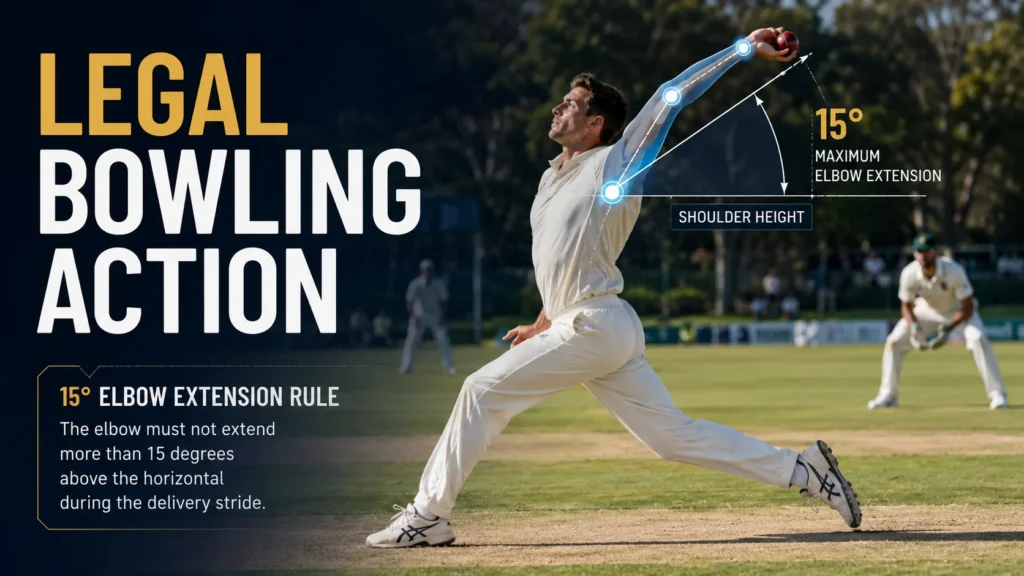

A legal bowling action in cricket is one where the bowler delivers the ball without straightening their elbow beyond 15 degrees after the arm reaches shoulder height. Under ICC regulations introduced in 2018, any elbow extension exceeding 15 degrees between the arm reaching horizontal and ball release constitutes an illegal bowling action commonly known as chucking.
Bowlers reported for suspect actions undergo biomechanical testing at ICC-accredited centres. If found illegal, they are suspended until they modify their action and pass reassessment.
Cricket is a game of fine margins, and few aspects are as scrutinised as a bowler’s action. The line between a legal delivery and an illegal throw often called “chucking” has sparked debates that have shaped the sport’s history. At the heart of this lies the concept of a legal bowling action, a term that carries immense weight for any bowler aspiring to compete at the highest level.
The International Cricket Council (ICC) has established clear rules to determine what constitutes a legal bowling action. These regulations, refined over decades, balance the need for fairness with an understanding of human biomechanics. Whether you’re a budding cricketer, a curious fan, or a coach looking to understand the rules, knowing what makes a bowling action legal is essential to appreciating the game’s integrity.
Definition of a Legal Bowling Action
A legal bowling action refers to a delivery where the bowler does not throw the ball but bowls it with a straight or near-straight arm. The ICC defines an illegal bowling action as one where “the player’s elbow extends by an amount of more than 15 degrees between their arm reaching the horizontal and the ball being released”.
This means the critical measurement is not the starting position of the arm, but the change in elbow angle during the delivery swing. If a bowler’s arm bends naturally and then straightens within the 15-degree tolerance, the action remains legal.
The Official ICC Rule
Under ICC protocols introduced in September 2018, a delivery is considered fair if:
“Once the bowler’s arm reaches shoulder height in the delivery swing, there is no partial or complete straightening of the elbow until the ball is released.”
However, scientific studies have shown that all bowlers exhibit some degree of elbow straightening naturally. To account for this, the ICC permits up to 15 degrees of elbow extension. Anything beyond this threshold is deemed illegal.
The rule applies between two specific points:
- Point 1: When the bowling arm reaches the horizontal (shoulder height)
- Point 2: When the ball is released from the hand
Any elbow hyperextension (bending backward beyond straight) is discounted when determining an illegal bowling action.
Why the Rule Exists
The 15-degree rule exists to protect the spirit of cricket. Bowling requires the ball to be delivered with a straight arm, while throwing (chucking) gives the bowler an unfair advantage by allowing greater speed, spin, or deception.
Before biomechanical testing, umpires judged legality by naked eye alone. But research in the 1990s revealed that every bowler flexes their arm to some degree. The ICC responded by introducing graduated limits (5 degrees for spinners, 7.5 for medium pacers, 10 for fast bowlers) before standardising at 15 degrees for all bowlers in 2005.
How Bowling Actions Are Tested
When a match official suspects an illegal bowling action, they submit an ICC Bowling Action Report Form. The process then unfolds as follows:
| Step | Action |
| 1 | Umpire or match referee reports suspect action |
| 2 | Player and home board notified within 24 hours |
| 3 | Player undergoes independent biomechanical assessment at an ICC-accredited testing centre |
| 4 | Assessment must occur within 14 days of the report |
| 5 | Experts in human movement supervise the testing |
| 6 | Results determine if action is legal or illegal |
If found illegal, the bowler is suspended from bowling in international cricket until they modify their action and pass a subsequent assessment.
ICC-Accredited Testing Centres
The ICC has accredited biomechanics laboratories around the world to test bowling actions:
- National Cricket Centre — Brisbane, Australia
- Sri Ramachandra University — Chennai, India
- Cardiff Metropolitan University — Cardiff, Wales
- Loughborough University — Loughborough, England
- University of Pretoria — Pretoria, South Africa
- LUMS — Lahore, Pakistan (accredited 2019)
These centres use state-of-the-art motion-capture technology to measure elbow extension with precision.
Comparison: Legal vs Illegal Bowling Action
| Aspect | Legal Bowling Action | Illegal Bowling Action |
| Elbow Extension | 15 degrees or less | More than 15 degrees |
| Common Term | Bowling | Throwing / Chucking |
| Umpire Call | Fair delivery | No-ball |
| Consequence | Continues bowling | Reported; suspension if confirmed |
| Testing Required | No (unless reported) | Mandatory biomechanical assessment |
Famous Cases and Controversies
Muttiah Muralitharan The Sri Lankan spin legend was repeatedly called for throwing, most famously by umpire Darrell Hair in 1995. Biomechanical testing later revealed Muralitharan had a congenital deformity that prevented him from fully straightening his arm. His action was eventually cleared, though debates continued throughout his career.
Saeed Ajmal The Pakistani off-spinner was suspended in 2014 after testing revealed his elbow extension exceeded 40 degrees more than double the legal limit. He modified his action and returned to cricket.
Matthew Kuhnemann The Australian left-arm spinner was reported during the 2025 Sri Lanka Test series. After testing at Brisbane’s National Cricket Centre, his action was cleared as all deliveries fell within the 15-degree tolerance.
Prenelan Subrayen The South African spinner was reported during an ODI against Australia in August 2025. Testing confirmed his elbow extension was within legal limits, and he was cleared to continue bowling.
Usman Tariq The Pakistan spinner’s unusual pause-and-sling action has drawn frequent scrutiny. However, ICC testing has repeatedly cleared his action as legal.
The MCC Law 21 Connection
The ICC’s regulations work alongside the MCC Laws of Cricket. Law 21.2 states:
“A ball is fairly delivered in respect of the arm if, once the bowler’s arm has reached the level of the shoulder in the delivery swing, the elbow joint is not straightened partially or completely from that point until the ball has left the hand.”
The ICC’s 15-degree regulation provides the quantifiable threshold that allows this law to be enforced consistently using modern technology.
Common Misconceptions
| Misconception | Reality |
| A bent arm at the start means illegal action | The change in angle matters, not the starting position |
| Only spinners get reported | Fast bowlers are also regularly reported |
| Umpires can judge legality accurately | Naked-eye judgement is unreliable; biomechanical testing is required |
| 15 degrees is a large allowance | It’s a small tolerance roughly the angle of a clock’s minute hand moving 2.5 minutes |
FAQs
1. What is a legal bowling action in cricket?
A legal bowling action is one where the bowler’s elbow does not extend by more than 15 degrees between the arm reaching shoulder height and the ball being released. The ICC defines any extension beyond this limit as an illegal bowling action, commonly called chucking.
2. What is the 15-degree rule in cricket?
The 15-degree rule is the ICC’s tolerance limit for elbow straightening during a delivery. All bowlers naturally flex their arms to some degree. The ICC allows up to 15 degrees of elbow extension anything more is deemed an illegal bowling action.
3. How does ICC test a bowler’s action?
Bowlers reported for suspect actions undergo biomechanical testing at ICC-accredited centres. Motion-capture technology measures elbow extension from the point the arm reaches horizontal until ball release. Experts analyse the data to determine if the action exceeds the 15-degree limit.
4. What happens if a bowler is reported for an illegal action?
The bowler must undergo an independent assessment at an ICC-accredited testing centre within 14 days. If the action is found illegal, the bowler is suspended from bowling in international cricket until they modify their action and pass a subsequent test.
5. Can a bowler continue playing while under investigation?
Yes, a reported bowler can continue playing in domestic cricket but is not allowed to bowl at the international level until cleared. If the action is found legal, they can resume bowling immediately.
6. Who decides if a bowling action is illegal?
Match officials (umpires and match referees) use their experience to identify suspect actions and submit reports. However, the final determination is made through biomechanical testing at ICC-accredited centres, not by umpires alone.
7. Has any bowler been banned permanently for an illegal action?
No bowler has received a permanent ban. Suspensions are temporary bowlers can return once they modify their action and pass reassessment. Some bowlers, like Saeed Ajmal, successfully returned after remedial work.
8. Why was Muttiah Muralitharan’s action considered legal?
Muralitharan had a congenital elbow deformity that prevented him from fully straightening his arm. Biomechanical testing showed his action was within legal limits, and he was cleared by the ICC in 1998.
9. Does the 15-degree rule apply to all bowlers equally?
Yes. The ICC standardised the limit at 15 degrees for all bowlers in 2005. Previously, different limits applied based on bowling style 5 degrees for spinners, 7.5 for medium pacers, and 10 for fast bowlers.
10. What is the difference between bowling and throwing?
Bowling involves delivering the ball with a straight or near-straight arm, while throwing (chucking) involves significantly straightening the elbow to propel the ball. The ICC defines the legal threshold as 15 degrees of elbow extension.
CONCLUSION
Understanding what constitutes a legal bowling action is fundamental to appreciating cricket at every level. The ICC’s 15-degree rule, refined through decades of research and debate, provides a clear, measurable standard that balances fairness with the natural biomechanics of human movement.
From the controversy surrounding Muralitharan to the recent clearance of Matthew Kuhnemann, the testing process ensures that bowlers are judged by objective science rather than subjective opinion. ICC-accredited centres around the world use cutting-edge technology to protect the integrity of the game while giving bowlers a fair opportunity to prove their actions are legal.
For aspiring cricketers, the message is clear: focus on developing a smooth, repeatable action. If doubts arise, the testing process exists to provide clarity. The rules are strict but fair designed to preserve cricket’s unique character while embracing the technological advances that make the game more transparent than ever.