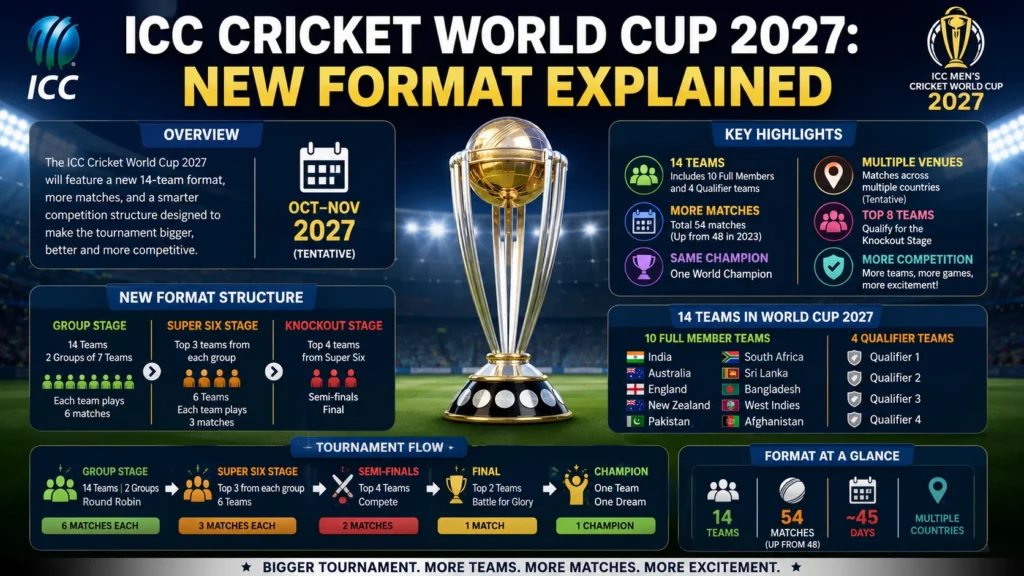

The ICC Cricket World Cup 2027 will expand to 14 teams and introduce a new three-stage format a Super Series, a 12-team group stage, and a new “Super 7” round before the semi-finals and final. The tournament will be jointly hosted by South Africa, Zimbabwe, and Namibia between October and November 2027.
The 2027 ICC Men’s Cricket World Cup will look noticeably different from the 10-team editions fans watched in 2019 and 2023. The ICC has confirmed a bigger tournament with an entirely new qualification-to-knockout structure. This guide breaks down exactly how the new format works, who qualifies automatically, and everything confirmed so far about hosting and scheduling.
Quick Facts: ICC Cricket World Cup 2027
| Detail | Information |
|---|---|
| Edition | 14th ICC Men’s Cricket World Cup |
| Hosts | South Africa, Zimbabwe, and Namibia (co-hosted) |
| Dates | October 4 – November 21, 2027 (provisional) |
| Number of teams | 14 (expanded from 10 in 2019 and 2023) |
| Total matches | 54 |
| Cricket format | One Day International (ODI), 50 overs per side |
| Defending champions | Australia (2023 winners) |
Why Is the Format Changing?
Since 2019, the ICC Cricket World Cup had been played with a compact 10-team, single round-robin format. For 2027, the ICC confirmed it would return to a larger 14-team tournament a size the event hadn’t featured since earlier editions as part of a broader plan to expand global participation in the 50-over format. According to the ICC, the new multi-stage structure was designed specifically to add more competitive stakes to the early rounds, rather than simply expanding the group stage in a straightforward way.
The New Three-Stage Format Explained
Stage 1: The Super Series
The tournament will open with a Super Series involving the three lowest-ranked teams among the 14 qualified sides. These three teams will play a round-robin series against each other, and only the team that finishes on top will advance to the next stage of the tournament. The other two teams are eliminated at this point.
This stage effectively acts as a play-in round, ensuring that even the lowest-seeded qualifiers get real matches on the world stage, while still keeping the main group stage more competitive by filtering out two of the weakest sides beforehand.
Stage 2: The Group Stage (12 Teams, 30 Matches)
Once the Super Series winner joins the tournament, 12 teams move into the main group stage. These teams will be divided into two groups of six, each playing a round-robin format against the other teams in their group. This stage will produce 30 matches in total.
From each group, the top three teams advance, along with one additional “next-best-placed” team taken from across both groups combined meaning seven teams total qualify from this stage rather than a clean six.
Stage 3: The Super 7
The seven qualifying teams then enter a new round called the Super 7 a round-robin stage involving all seven sides, producing 21 matches. From this stage, the top four teams advance to the semi-finals.
This “Super 7” concept is new to the ICC Cricket World Cup and has not been used in this exact form in previous editions of the tournament.
Semi-Finals and Final
The top four teams from the Super 7 proceed to the semi-finals, with the two winners advancing to the final, which will decide the champion of the 2027 tournament.
Quick Reference: Tournament Stages at a Glance
| Stage | Teams Involved | Format | Matches | Teams Advancing |
|---|---|---|---|---|
| Super Series | 3 (lowest-ranked qualifiers) | Round-robin | Small series | 1 |
| Group Stage | 12 | Two groups of 6, round-robin | 30 | 7 (3 from each group + 1 next-best) |
| Super 7 | 7 | Round-robin | 21 | 4 |
| Semi-Finals | 4 | Knockout | 2 | 2 |
| Final | 2 | Single match | 1 | 1 (Champion) |
How Do Teams Qualify for the 2027 World Cup?
Qualification for the expanded 14-team tournament works as follows:
- 10 automatic qualifiers: This includes the two Full Member co-hosts South Africa and Zimbabwe along with the eight highest-ranked teams in the ICC ODI rankings, based on a cutoff around September 2026.
- 4 remaining spots via a global qualifier event: These are expected to be decided through a qualifying tournament involving the next-highest-ranked teams alongside sides progressing through the ICC’s World Cup Cricket League structure and a separate qualifier playoff.
Namibia, as a co-host but not a Full Member nation in the same category as South Africa and Zimbabwe, is understood to go through the standard qualification process rather than receiving an automatic host spot, based on ICC reporting at the time of the announcement.
Where Will the Matches Be Played?
Hosting duties will be split unevenly across the three co-host nations, reflecting their differing stadium infrastructure:
- South Africa is expected to host the majority of matches reportedly at least 41 of the 54 total games across eight venues.
- Zimbabwe is set to host between 8 and 10 matches, using three venues: Harare Sports Club, Queens Sports Club in Bulawayo, and a newly built venue in Victoria Falls.
- Namibia is expected to host a smaller share, around 3 matches.
These figures were reported ahead of the ICC’s formal confirmation of the tournament’s complete fixture list and venues, which was expected to follow at a later ICC meeting.
Why This Format Is Historically Significant
This will be the first ICC Men’s Cricket World Cup hosted entirely within Africa, and the first time South Africa and Zimbabwe have co-hosted the tournament since the 2003 edition. Namibia will be hosting the men’s ODI World Cup for the first time in the country’s history.
For more on that earlier African-hosted tournament and the tournament’s full history, see our guide on ICC Cricket World Cup Winners List (1975-2026).
How This Format Differs From 2019 and 2023
The 2019 and 2023 editions were both played as a single 10-team round-robin group stage, with every team playing every other team once, followed directly by semi-finals and a final. The 2027 format is considerably more layered:
- It expands the field from 10 to 14 teams.
- It introduces a play-in round (the Super Series) that didn’t exist in the previous two editions.
- It adds an extra qualifying round (the Super 7) between the group stage and the semi-finals, rather than moving straight from groups to knockouts.
This makes 2027 a structurally different tournament from anything fans have seen in the most recent editions, even though the core 50-overs-per-side format of each individual match remains unchanged. For more on how the 50-over format itself works, see our guide on ODI Cricket Explained.
What’s Still to Be Confirmed
At the time of the ICC’s format announcement, a few specific details remained subject to further confirmation at later ICC meetings, including:
- The exact fixture list and full match schedule
- The complete qualification pathway and playoff structure for the four non-automatic qualifying spots
- Final confirmation of venue allocations, beyond the reported estimates above
Fans should expect these specifics to be finalized closer to the tournament, with the ICC having indicated further updates would follow its Annual Conference discussions.
Frequently Asked Questions
1. How many teams will play in the 2027 ICC Cricket World Cup? The tournament will feature 14 teams, expanded from the 10-team format used in 2019 and 2023.
2. What is the Super Series in the 2027 World Cup format? It’s a new opening round-robin stage involving the three lowest-ranked qualified teams, with only the top-placed team advancing to the main group stage.
3. What is the Super 7 stage? It’s a new round-robin stage involving seven teams the top three from each of the two main groups, plus one additional next-best-placed team with the top four advancing to the semi-finals.
4. Who is hosting the 2027 ICC Cricket World Cup? South Africa, Zimbabwe, and Namibia will co-host the tournament, marking the first World Cup held entirely in Africa.
5. How many teams qualify automatically for the 2027 World Cup? Ten teams qualify automatically South Africa and Zimbabwe as host nations, along with the eight highest-ranked teams in the ICC ODI rankings as of the September 2026 cutoff.
Conclusion
The 2027 ICC Cricket World Cup marks one of the most significant format changes in the tournament’s history expanding to 14 teams and introducing an entirely new multi-stage qualification path through the Super Series and Super 7 rounds. Combined with its historic status as the first World Cup hosted entirely in Africa, the 2027 tournament promises to be one of the most structurally unique editions since the event began in 1975.
For the complete history of past champions and tournament editions, explore our guide on ICC Cricket World Cup Winners List (1975-2026) or our Complete Cricket Rules Guide 2026.
This article will be updated as the ICC confirms further details, including the final fixture list and complete qualification pathway.