
ODI One Day International is a 50-over cricket format where each team bats once, aiming to score the highest runs. It’s a limited-overs international match governed by ICC rules and typically completed in one day.
Cricket has evolved into multiple formats, but ODI One Day International remains one of the most balanced and exciting. It combines strategy, endurance, and explosive gameplay within a single day.
Unlike Test cricket, which can last five days, or T20 matches that are fast and short, ODI cricket sits right in the middle. It offers enough time for teams to build innings while still maintaining high intensity.
Whether you’re new to cricket or just want a clearer understanding, this guide breaks down everything about ODI One Day International in simple, practical terms.
WHAT IS ODI ONE DAY INTERNATIONAL?
ODI stands for One Day International, a format of cricket played between two international teams.
Key Characteristics:
- Each team plays one innings
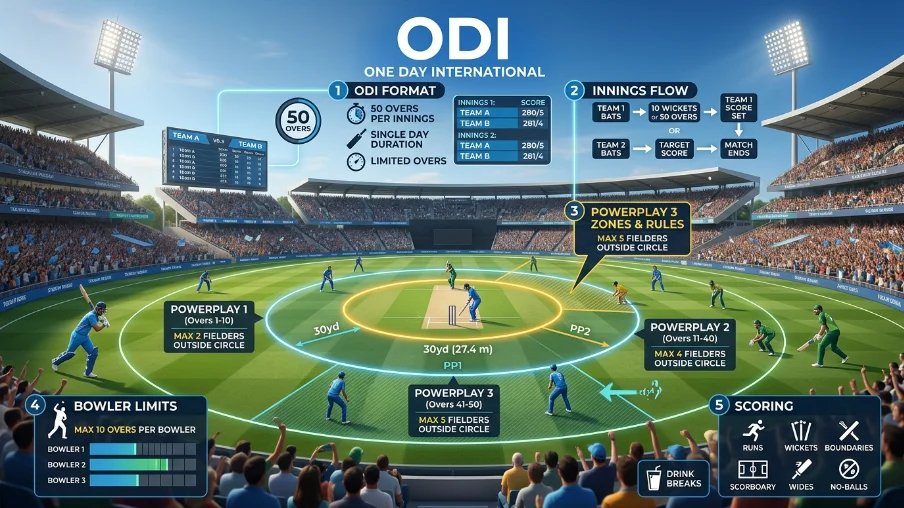
- Maximum 50 overs per team
- Played with a white ball
- Usually completed in one day
ODIs are officially recognized and regulated by the International Cricket Council (ICC).
HISTORY OF ODI CRICKET
ODI cricket began in 1971 as an alternative to Test matches.
Important Milestones:
- 1971: First ODI played (Australia vs England)
- 1975: First Cricket World Cup
- 1992: Introduction of colored kits and white ball
- 2005+: Powerplay rules introduced
ODIs quickly became popular due to their shorter duration and spectator-friendly format.
ODI MATCH FORMAT EXPLAINED
Basic Structure
| Feature | Details |
| Overs per team | 50 |
| Innings | 1 per team |
| Players | 11 per side |
| Match duration | 7–8 hours |
Flow of the Game
- Toss decides batting or bowling
- First team bats (50 overs max)
- Second team chases target
- Winner = highest runs
POWERPLAY AND FIELDING RULES
Powerplays are critical in ODI strategy.
Powerplay Breakdown
| Phase | Overs | Fielding Restrictions |
| Powerplay 1 | 1–10 | Only 2 fielders outside circle |
| Powerplay 2 | 11–40 | 4 fielders outside |
| Powerplay 3 | 41–50 | 5 fielders outside |
These rules influence aggressive batting early and controlled gameplay later.
BATTING AND BOWLING RULES
Batting Rules
- Players bat in a fixed order
- Team loses innings after 10 wickets
- Score as many runs as possible
Bowling Rules
- Each bowler can bowl maximum 10 overs
- No bowler can dominate the entire innings
- Variety in bowling is required
HOW LONG DOES AN ODI MATCH LAST?
An ODI typically lasts:
- 7 to 8 hours total
- Includes breaks (innings break ~45 minutes)
Time Breakdown
| Activity | Approx Time |
| First innings | 3.5 hours |
| Break | 45 minutes |
| Second innings | 3.5 hours |
ODI VS T20 VS TEST CRICKET
| Feature | ODI | T20 | Test Cricket |
| Overs | 50 | 20 | Unlimited |
| Duration | 1 day | 3–4 hours | 5 days |
| Strategy | Balanced | Aggressive | Defensive & long-term |
| Popularity | High | Very high | Traditional |
WHY ODI CRICKET IS IMPORTANT
ODIs remain crucial because they:
- Offer a balanced format
- Showcase both skill and endurance
- Host major tournaments like the World Cup
- Provide fair competition between teams
MAJOR ODI TOURNAMENTS
Top Events:
- ICC Cricket World Cup
- ICC Champions Trophy
- Bilateral ODI series
These tournaments define international rankings and cricket history.
COMMON TERMS IN ODI CRICKET
- Run Rate: Runs scored per over
- Strike Rate: Batting speed
- Economy Rate: Runs conceded by bowler
- Duck: Scoring zero runs
COMMON MISTAKES BEGINNERS MAKE
- Confusing ODI with T20
- Not understanding powerplays
- Ignoring bowling limits
- Misjudging match duration
FAQs
1. What does ODI mean in cricket?
ODI means One Day International, a limited-overs format where each team plays 50 overs. It’s played between international teams and usually finishes within a single day.
2. How many overs are in an ODI match?
Each team gets 50 overs in an ODI. This means a total of 100 overs can be bowled in a full match, split equally between both teams.
3. How long does an ODI match take?
An ODI typically lasts around 7 to 8 hours, including innings breaks and short interruptions. Weather or delays can extend the total time.
4. What is the difference between ODI and T20?
ODI has 50 overs per team, while T20 has only 20. ODI is longer and more strategic, while T20 focuses on aggressive, fast-paced gameplay.
5. Who controls ODI cricket rules?
ODI rules are governed by the International Cricket Council, which sets regulations for all international cricket formats.
6. Why is it called One Day International?
It’s called One Day International because the entire match is designed to be completed in a single day between international teams.
7. What happens if an ODI match is tied?
If scores are equal, the match is declared a tie. In tournaments, a Super Over may be used to determine the winner.
8. Can a bowler bowl all 50 overs?
No, each bowler can bowl a maximum of 10 overs. This ensures fair distribution among bowlers.
9. What is a powerplay in ODI cricket?
Powerplay is a phase with fielding restrictions that limit the number of players outside the inner circle, encouraging attacking play.
10. Which tournament is the biggest in ODI cricket?
The ICC Cricket World Cup is the biggest ODI tournament, held every four years and featuring top international teams.
CONCLUSION
ODI One Day International cricket continues to hold a special place in the sport. It strikes a perfect balance between the endurance of Test matches and the explosive nature of T20 cricket. With 50 overs per side, it allows teams to build strategies, recover from setbacks, and showcase complete cricketing skills.
From its historic beginnings in 1971 to becoming the backbone of global tournaments like the World Cup, ODI cricket has evolved significantly. Rules like powerplays and bowling limits have made it more competitive and engaging.
For fans and beginners alike, understanding ODIs gives you a deeper appreciation of cricket as a whole. It’s not just about scoring runs it’s about timing, planning, and execution across an entire day of play.