
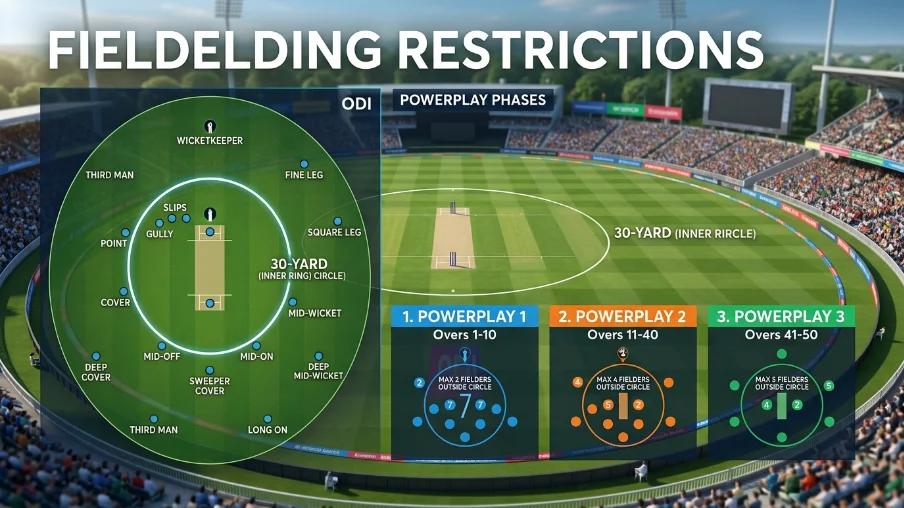

Fielding restrictions in cricket limit how many fielders can stand outside the 30-yard circle during specific overs, known as powerplays, to encourage attacking play and higher scoring in limited-overs formats.
Fielding restrictions are one of the most important rules in modern cricket, especially in fast-paced formats like ODIs and T20s. They directly shape how teams bat, bowl, and defend runs.
If you’ve ever wondered why fielders suddenly move closer to the pitch at the start of an innings, or why boundaries flow more easily early on, fielding restrictions are the reason. These rules create a balance between bat and ball while making the game more exciting for fans around the world.
WHAT ARE FIELDING RESTRICTIONS?
Fielding restrictions are rules that control how many fielders a team can place outside a marked 30-yard circle during certain overs.
Key Idea:
- Fewer fielders outside = more scoring opportunities
- More fielders outside = better defense
These rules mainly apply in limited-overs cricket, not Test matches.
WHY FIELDING RESTRICTIONS EXIST
Fielding restrictions were introduced to make cricket:
- More entertaining
- More aggressive
- More balanced between bat and ball
Main Purposes
- Encourage attacking batting early
- Prevent overly defensive field setups
- Increase scoring rates
- Create strategic phases in a match
THE 30-YARD CIRCLE RULE
At the center of fielding restrictions is the 30-yard circle.
Inside the Circle
- Fielders positioned close to the batter
- Helps stop singles and quick runs
Outside the Circle
- Fielders near the boundary
- Used to prevent fours and sixes
FIELDING RESTRICTIONS IN ODI CRICKET
In One Day Internationals (50 overs), fielding restrictions are divided into three phases.
ODI Powerplay Breakdown
| Phase | Overs | Fielders Outside Circle |
| Powerplay 1 | 1–10 | Maximum 2 |
| Powerplay 2 | 11–40 | Maximum 4 |
| Powerplay 3 | 41–50 | Maximum 5 |
Key Insights
- First 10 overs are highly aggressive
- Middle overs balance attack and defense
- Final overs allow maximum boundary protection
FIELDING RESTRICTIONS IN T20 CRICKET
T20 cricket has simpler and faster rules.
T20 Powerplay Breakdown
| Phase | Overs | Fielders Outside Circle |
| Powerplay | 1–6 | Maximum 2 |
| Remaining Overs | 7–20 | Maximum 5 |
Why It Matters
- Early overs = big hitting opportunities
- Later overs = controlled scoring + death bowling
ROLE OF POWERPLAY IN FIELDING RESTRICTIONS
Powerplay is the period when fielding restrictions are the strictest.
Characteristics of Powerplay
- Only 2 fielders allowed outside
- Batters take more risks
- Bowlers focus on accuracy
Strategy Impact
- Teams often score fastest during powerplay
- Losing wickets early can be costly
HOW FIELDING RESTRICTIONS IMPACT STRATEGY
For Batters
- Attack early overs
- Target gaps in the field
- Take advantage of fewer boundary fielders
For Bowlers
- Focus on line and length
- Use swing and seam early
- Avoid giving width
For Captains
- Plan field placements carefully
- Adjust strategy per phase
- Balance aggression and defense
COMMON FIELDING POSITIONS DURING RESTRICTIONS
Inside Circle Positions
- Slip
- Point
- Cover
- Mid-off
- Mid-on
Outside Circle Positions
- Deep square leg
- Long-off
- Long-on
- Deep cover
COMMON MISTAKES RELATED TO FIELDING RESTRICTIONS
- Placing too many fielders outside the circle
- Miscounting fielders during pressure situations
- Poor field positioning during powerplay
- Defensive mindset in early overs
DIFFERENCE BETWEEN ODI AND T20 FIELDING RESTRICTIONS
| Feature | ODI | T20 |
| Total Overs | 50 | 20 |
| Powerplay Overs | 10 | 6 |
| Complexity | More phases | Simpler |
| Strategy Depth | High | Fast-paced |
EVOLUTION OF FIELDING RESTRICTIONS
Fielding rules have changed over time, mainly by the International Cricket Council.
Key Changes
- Introduction of powerplays
- Reduction of defensive fields
- Standardization across formats
FAQs
1. What are fielding restrictions in cricket?
Fielding restrictions limit how many fielders can be placed outside the 30-yard circle during certain overs. These rules mainly apply in ODI and T20 formats to promote attacking cricket and higher scoring rates.
2. What is a powerplay in cricket?
A powerplay is a set of overs where strict fielding restrictions apply. During this time, only two fielders are allowed outside the circle, encouraging aggressive batting and exciting gameplay.
3. How many fielders are allowed outside the circle in T20?
In T20 cricket, only 2 fielders are allowed outside the circle during the first 6 overs. After that, up to 5 fielders can be positioned outside the circle.
4. Why are fielding restrictions important?
They ensure a balance between batting and bowling. Without them, teams could use overly defensive fields, making matches less exciting and lowering scoring rates.
5. Do fielding restrictions apply in Test cricket?
No, fielding restrictions do not apply in Test matches. Teams can place fielders anywhere they want based on strategy.
6. What happens if a team breaks fielding restrictions?
If a team places too many fielders outside the circle, it results in a no-ball penalty, giving the batting team an extra run and a free hit in limited-overs cricket.
7. Who enforces fielding restrictions?
On-field umpires monitor and enforce fielding restrictions according to rules set by the International Cricket Council.
8. What is the 30-yard circle?
It is a marked circle on the field used to determine fielding restrictions. It helps umpires ensure the correct number of fielders are placed inside or outside.
9. Are fielding restrictions the same in all leagues?
Most leagues, including the Indian Premier League, follow similar ICC rules, though minor variations can exist.
10. How do captains use fielding restrictions strategically?
Captains adjust field placements depending on match situations, overs, and batters. During powerplay, they focus on attacking fields, while later overs prioritize boundary protection.
CONCLUSION
Fielding restrictions have transformed modern cricket into a faster, more exciting sport. By controlling how many fielders can patrol the boundary, these rules create natural phases in a match, each with its own rhythm and strategy. From explosive powerplays to tactical death overs, every moment is shaped by these regulations.
Understanding fielding restrictions not only helps you follow the game better but also reveals the deeper strategies teams use to win. Whether you’re watching a high-stakes match like the ICC Cricket World Cup or a T20 league clash, these rules are always in play behind the scenes.