
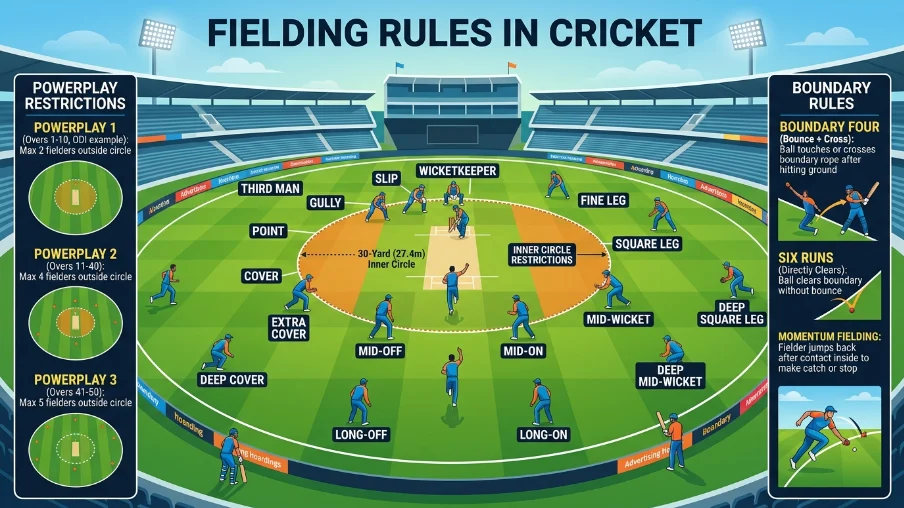

Fielding rules in cricket define how the fielding team positions players during a match. These include limits on the number of fielders outside the 30-yard circle, powerplay restrictions, and rules about boundary contact. In limited-overs formats, only a certain number of fielders can stand outside the circle, while Test cricket has fewer restrictions but still follows basic fielding laws.
Cricket is not just about batting and bowling. Fielding plays a massive role in controlling the game, saving runs, and taking crucial wickets. Understanding fielding rules in cricket helps you see why teams place players in specific positions and how strategies change during different match formats.
Whether you’re a beginner or a fan looking to deepen your knowledge, these rules explain the structure behind every field setup you see on the ground.
What Are Fielding Rules in Cricket?
Fielding rules govern how the fielding team can position its 11 players during a match.
These rules ensure:
- Fair play between bat and ball
- Balanced competition
- Strategic gameplay
They vary depending on the format:
- Test Cricket (least restrictions)
- ODI (moderate restrictions)
- T20 (strict restrictions)
Basic Fielding Rules Every Player Must Follow
1. Number of Fielders
- A team can have 11 fielders on the ground
- One of them is the bowler, one is the wicketkeeper
2. Wicketkeeper Position
- Must stay behind the stumps
- Cannot move ahead before the ball is bowled
3. Fielders’ Movement
- Fielders can move only after the ball is delivered
- Early movement can result in a no-ball
4. Boundary Rule
- Fielders must not touch the boundary rope while holding the ball
- If they do → counts as a boundary (4 or 6)
Fielding Positions Explained
Fielding positions are divided into two main areas:
Infield (Inside 30-yard Circle)
- Slip
- Gully
- Point
- Cover
- Mid-off / Mid-on
Outfield (Outside Circle)
- Deep cover
- Long-on
- Long-off
- Deep square leg
Fielding Restrictions in Limited Overs Cricket
Fielding restrictions are what make ODI and T20 cricket exciting.
Powerplay Rules (ODI & T20)
| Phase | Overs | Fielders Outside Circle |
|---|---|---|
| Powerplay 1 | 1–10 (ODI) / 1–6 (T20) | 2 |
| Middle Overs | 11–40 (ODI) | 4 |
| Death Overs | 41–50 (ODI) / Final Overs T20 | 5 |
👉 This forces aggressive batting early in the innings.
Why Fielding Restrictions Exist
Fielding rules are not random. They serve key purposes:
- Encourage attacking cricket
- Prevent overly defensive setups
- Create scoring opportunities
- Maintain entertainment value
Without restrictions, teams could place all fielders on the boundary and make scoring extremely difficult.
Fielding Rules in Test Cricket
Test cricket is more flexible.
- No strict powerplays
- Captain can set fields freely
- Still must follow general rules (boundary, movement, etc.)
This allows:
- Defensive fields
- Tactical traps (like slip cordon)
Catching Rules in Cricket
Catching is a core part of fielding.
Valid Catch Conditions
- Ball must not touch the ground
- Fielder must be inside the boundary
- Complete control is required
Boundary Catch Rule
- Fielder can jump outside but must release the ball before touching the ground outside
Important Fielding Violations
Illegal Fielding Actions
| Violation | Result |
|---|---|
| Too many fielders outside circle | No-ball |
| Fielder moves early | Warning / No-ball |
| Boundary contact while catching | Boundary |
| Wicketkeeper moves early | No-ball |
Common Fielding Mistakes
- Misjudging boundary line
- Poor communication between fielders
- Incorrect positioning
- Slow reaction time
Even professional players make these mistakes under pressure.
Fielding Strategy in Cricket
Field placement is a tactical decision.
Defensive Strategy
- More fielders on boundary
- Focus on saving runs
Attacking Strategy
- Close-in fielders (slips, short leg)
- Focus on taking wickets
Comparison: Fielding Rules by Format
| Format | Restrictions | Strategy Style |
|---|---|---|
| Test | Minimal | Tactical & flexible |
| ODI | Moderate | Balanced |
| T20 | Strict | Aggressive |
Why Fielding Is Crucial in Cricket
Fielding can:
- Save 20–30 runs per match
- Create run-out chances
- Build pressure on batters
Modern cricket places huge importance on athletic fielding.
FAQs
1. What are fielding rules in cricket?
Fielding rules in cricket define how players position themselves, including restrictions on fielders outside the circle, movement rules, and boundary conditions. These rules vary by format and are designed to maintain fairness and excitement in the game.
2. How many fielders can stand outside the circle?
In limited-overs cricket, only 2 fielders are allowed outside the circle during powerplay, while later phases allow 4–5 depending on the format. These restrictions ensure aggressive gameplay.
3. Are there fielding restrictions in Test cricket?
Test cricket has minimal fielding restrictions. Captains can place fielders freely, but they must still follow basic rules like boundary restrictions and fair play conditions.
4. What happens if a fielder touches the boundary?
If a fielder touches the boundary rope while in contact with the ball, it is counted as a boundary (4 or 6). Proper body control is essential to avoid this mistake.
5. Can fielders move before the ball is bowled?
No, fielders must remain still until the ball is delivered. Early movement can lead to penalties like a no-ball.
6. What is the 30-yard circle in cricket?
The 30-yard circle is an inner fielding ring used in limited-overs cricket to enforce fielding restrictions, especially during powerplays.
7. What are powerplay rules in cricket?
Powerplay rules limit the number of fielders outside the circle during specific overs. This creates scoring opportunities and adds excitement.
8. What is an illegal field setup?
An illegal setup occurs when too many fielders are outside the allowed area or rules are violated, resulting in penalties like no-balls.
9. Why are fielding rules important?
They ensure fair competition, prevent defensive gameplay, and make matches more exciting for players and viewers.
10. Can a fielder catch the ball outside the boundary?
A fielder can jump from inside the boundary and catch the ball, but must not touch the ground outside while holding it, or it will count as a boundary.
Conclusion
Fielding rules in cricket shape how the game is played, balancing fairness with excitement. From basic positioning to powerplay restrictions, these rules ensure that neither the batting nor fielding side gains an unfair advantage.
Once you understand these rules, the game becomes much clearer. You’ll start noticing strategies behind every field placement, every boundary save, and every catch. In modern cricket, strong fielding isn’t just support it’s often the difference between winning and losing.