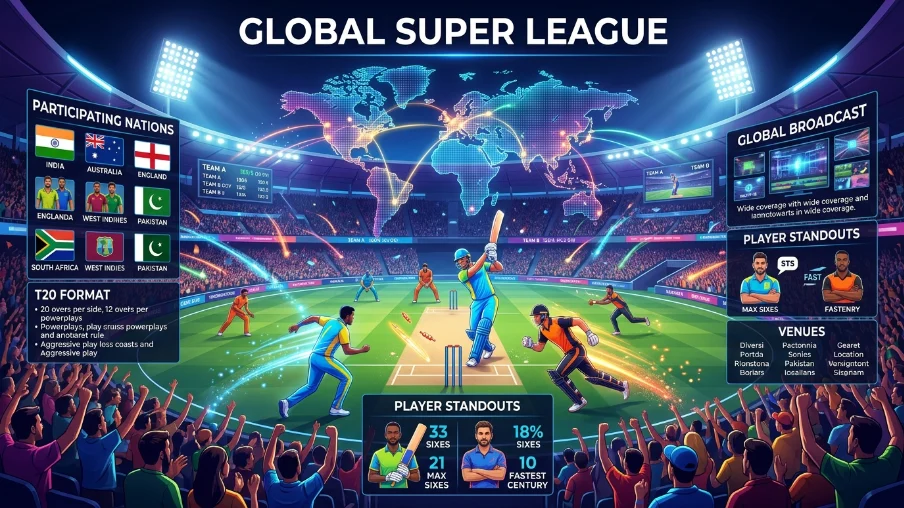

The Global Super League is an international franchise-style cricket tournament featuring top teams from different domestic leagues, designed to create a global competition with elite players and a unified T20 format.
Cricket is evolving fast, and new tournaments are reshaping how fans experience the game. One of the most exciting developments is the Global Super League, a concept designed to bring the best franchise teams from around the world into one competitive stage.
Unlike traditional leagues limited to one country, this format aims to create a truly global contest. It connects different cricket ecosystems and gives fans a chance to see dream matchups that were never possible before.
So, what exactly is the GLOBAL Super League, and why is it generating so much buzz in 2026? Let’s break it down.
WHAT IS THE GLOBAL SUPER LEAGUE?
The GLOBAL Super League (GSL) is a cross-league cricket tournament where champion teams (or top franchises) from various domestic T20 leagues compete against each other.
Think of it as:
“A Champions League for cricket franchises.”
It brings together top-performing teams from leagues like IPL, PSL, BBL, and others into one global showdown.
PURPOSE OF THE GLOBAL SUPER LEAGUE
The tournament was introduced to solve a major gap in cricket:
- No global competition between franchise teams
- Limited interaction between players from different leagues
- Missed opportunity for worldwide fan engagement
Key Objectives
- Create a global cricket ecosystem
- Increase competitive standards
- Boost commercial value of franchise cricket
- Expand cricket’s global audience
GLOBAL SUPER LEAGUE FORMAT
The structure is designed to be simple yet competitive.
Tournament Structure
| Stage | Description |
| League Stage | Teams play round-robin matches |
| Points Table | Top teams qualify |
| Semi-Finals | Knockout matches |
| Final | Winner crowned champion |
Match Format
- T20 format (fast-paced and viewer-friendly)
- Standard ICC playing conditions
- Day and night matches
TEAMS IN GLOBAL SUPER LEAGUE
Teams are usually selected based on performance in their domestic leagues.
Possible Team Sources
- IPL Champions (India)
- PSL Champions (Pakistan)
- BBL Champions (Australia)
- CPL Champions (Caribbean)
- SA20 Winners (South Africa)
- The Hundred Winners (England)
Team Selection Model
| Criteria | Details |
| Qualification | League winners or top teams |
| Representation | Global diversity |
| Squad Composition | Mix of local + international players |
PLAYER PARTICIPATION
One of the biggest attractions of the GLOBAL Super League is player diversity.
How Players Join
- Existing franchise contracts
- Temporary tournament agreements
- Player draft or loan system
Key Benefits
- Star vs star matchups
- Exposure for young talent
- Increased player earnings
RULES AND PLAYING CONDITIONS
The tournament largely follows ICC T20 rules with slight league-specific adjustments.
Core Rules
- 20 overs per side
- Powerplay restrictions
- DRS (Decision Review System)
- Super Over in case of tie
Unique Features
- Flexible squad changes
- Cross-league player eligibility
- Short tournament window
GLOBAL SUPER LEAGUE VS IPL
| Feature | GLOBAL Super League | IPL |
| Scope | International | Domestic (India) |
| Teams | Multiple leagues | Indian franchises |
| Player Pool | Global | Auction-based |
| Objective | Global champion | National league winner |
WHY GLOBAL SUPER LEAGUE MATTERS
This tournament could change cricket forever.
Key Impacts
- Globalization of cricket
- Higher competition level
- More revenue streams
- Fan engagement across borders
Industry Perspective
Experts believe this league could:
- Rival football-style global tournaments
- Increase ICC influence
- Standardize franchise cricket globally
CHALLENGES AND CRITICISM
Not everything is smooth.
Major Concerns
- Scheduling conflicts
- Player workload
- Clash with international cricket
- Franchise ownership disputes
FUTURE OF GLOBAL SUPER LEAGUE
The future looks promising but depends on execution.
Expected Developments
- Expansion of teams
- Women’s Global Super League
- Longer tournament windows
- Integration with ICC calendar
FREQUENTLY ASKED QUESTIONS
1. What is the GLOBAL Super League in cricket?
The GLOBAL Super League is an international franchise cricket tournament featuring top teams from various domestic leagues competing in a unified T20 format. It aims to create a global championship among franchise teams.
2. Is GLOBAL Super League an ICC event?
Not fully, but it may operate under ICC guidelines or partial approval. It is primarily a franchise-based competition, though governing bodies may influence scheduling and rules.
3. How are teams selected for GLOBAL Super League?
Teams usually qualify by winning or performing well in domestic leagues like IPL, PSL, or BBL. Selection ensures global representation and competitive balance.
4. What format does GLOBAL Super League follow?
It follows a T20 format with a league stage, followed by semi-finals and a final. The structure is similar to most modern cricket tournaments.
5. When does GLOBAL Super League take place?
The schedule depends on the international calendar, but it is typically planned in a window that avoids clashes with major ICC events and domestic leagues.
6. How is it different from IPL?
The IPL is a domestic Indian league, while the GLOBAL Super League features teams from multiple countries competing at an international level.
7. Will international players participate?
Yes, top international players are expected to participate through franchise contracts or special agreements for the tournament.
8. Is GLOBAL Super League a permanent tournament?
It is still evolving, but organizers aim to make it a recurring annual or biennial event.
9. Where are matches played?
Matches may be hosted in one country or multiple venues depending on logistics and agreements between cricket boards.
10. Why is GLOBAL Super League important?
It brings together the best franchise teams globally, increasing competition, fan engagement, and the commercial value of cricket worldwide.
CONCLUSION
The Global Super League represents a bold step toward unifying franchise cricket across the world. It fills a long-standing gap by creating a platform where top teams from different leagues compete for global supremacy. This isn’t just another tournament it’s a shift in how cricket is structured and consumed.
By combining elite talent, high-intensity matches, and global reach, the league has the potential to redefine modern cricket. However, its success depends on balancing player workload, scheduling, and cooperation between cricket boards.
If executed properly, the GLOBAL Super League could become cricket’s ultimate franchise competition something fans have been waiting for. As the game continues to evolve, this league might just be the future of international franchise cricket.