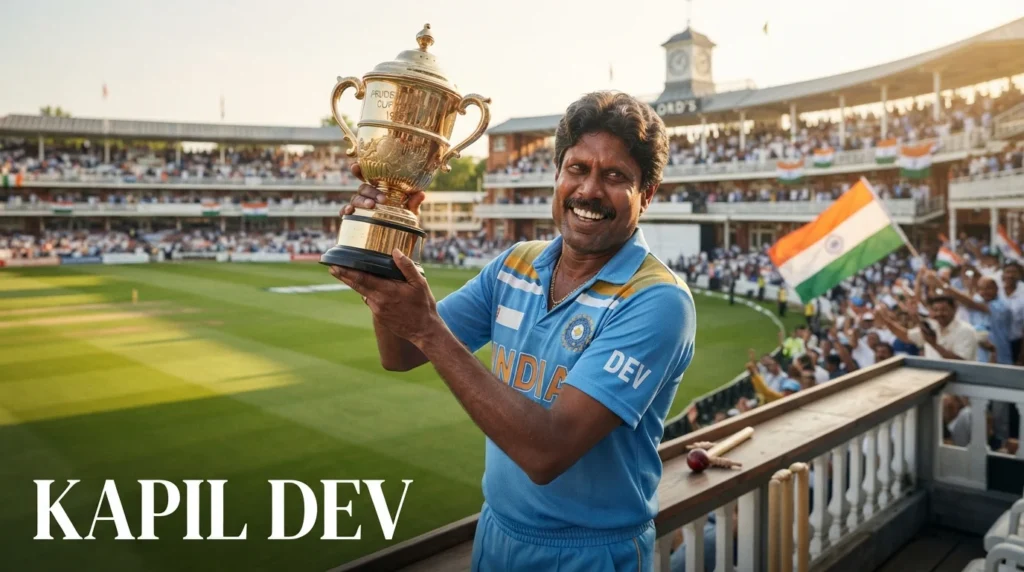

Kapil Dev is an Indian former cricketer and one of the greatest all-rounders in cricket history. He captained India to its first-ever Cricket World Cup victory in 1983, defeating the mighty West Indies in the final at Lord’s.
Kapil Dev remains the only player in Test cricket history to have taken more than 400 wickets (434) and scored over 5,000 runs (5,248). His international career spanned 16 years, during which he played 131 Tests and 225 ODIs.
Kapil Dev Nikhanj the name alone evokes memories of a golden era in Indian cricket. Born on January 6, 1959, in Chandigarh, this right-arm fast-medium bowler and hard-hitting middle-order batsman would go on to become one of the sport’s most celebrated figures. Affectionately nicknamed the “Haryana Hurricane”, Kapil Dev redefined what it meant to be an all-rounder. He was India’s pace spearhead for nearly 15 years, their most reliable wicket-taker, and a captain who inspired a nation to believe in the impossible. His crowning achievement leading a underdog Indian team to World Cup glory in 1983 changed the landscape of cricket in India forever. Today, his legacy continues to inspire generations of cricketers around the world.
Early Life and Background
Kapil Dev Ramlal Nikhanj was born to Ram Lal Nikhanj, a prominent timber merchant, and Raj Kumari in Chandigarh. He grew up alongside six siblings in a household that valued hard work and discipline. His cricketing journey began under the guidance of his childhood coach, Desh Prem Azad, who shaped the careers of several Test cricketers including Kapil Dev, Yograj Singh, and Chetan Sharma. Azad was not just a coach but a lifelong mentor and friend to the young Kapil. Kapil made his first-class debut for Haryana in 1975 and quickly caught the attention of selectors with his raw pace and batting ability.
International Debut
Kapil Dev made his One-Day International debut on October 1, 1978, against Pakistan in Quetta. Just two weeks later, on October 16, 1978, he made his Test debut against the same opposition in Faisalabad. It was the beginning of a remarkable 16-year international career that would see him play 131 Test matches and 225 ODIs. His full name, Kapildev Ramlal Nikhanj, reflects his Punjabi heritage, and his height of 183 cm (6 ft) gave him the leverage to generate significant pace and bounce.
Playing Style and Role
Kapil Dev was a bowling all-rounder who batted right-handed and bowled right-arm fast-medium. His bowling action was smooth and rhythmic, generating consistent pace with the ability to swing the ball both ways. As a batsman, he was aggressive and powerful, known for his ability to clear the boundary with ease. His 61 sixes and 587 fours in Test cricket demonstrate his attacking approach. He was India’s strike bowler for close to 15 years, leading the attack with distinction. Alongside Imran Khan, Ian Botham, and Richard Hadlee, Kapil Dev was considered one of the greatest all-rounders of his era.
Test Cricket Career
Kapil Dev’s Test career is defined by extraordinary numbers. In 131 matches and 227 innings, he took 434 wickets at an average of 29.64, with best bowling figures of 9/83. He achieved 23 five-wicket hauls and two 10-wicket match hauls. With the bat, he scored 5,248 runs at an average of 31.05, including eight centuries and 27 half-centuries. His highest Test score was 163.
Record-Breaking Feat: On February 8, 1994, Kapil Dev surpassed Richard Hadlee’s world record of 431 Test wickets, becoming the highest wicket-taker in Test cricket history. He held this record until Courtney Walsh surpassed him in 2000.
Remarkable Achievement: At just 21 years and 25 days old, Kapil Dev became the youngest cricketer to reach 100 Test wickets a record that still stands.
One-Day International Career
In 225 ODIs, Kapil Dev scored 3,783 runs at an average of 23.79, including one century and 14 half-centuries. He took 253 wickets at an average of 27.45, with best bowling figures of 5/43. He was the first player to take 200 ODI wickets and remains one of only seven players and the only Indian with 2,500 runs and 250 wickets in ODI cricket.
The 1983 World Cup Triumph
This is the defining moment of Kapil Dev’s career. At just 24 years old, he became the youngest captain to win a Cricket World Cup. India entered the tournament as massive underdogs. Under Kapil Dev’s inspiring leadership, the team defied all odds.
The 175 Innings:* Against Zimbabwe at Tunbridge Wells, India were reeling at 17 for 5. Kapil Dev walked in and played what many consider the greatest ODI innings ever an unbeaten 175 off just 138 balls, featuring 16 boundaries and 6 sixes. This remains the highest individual score by a batsman batting at number 5 or lower in ODIs, a record that stood until 2023 when Glenn Maxwell surpassed it. No video footage exists of this innings as the broadcasters were on strike that day.
The Final: In the final at Lord’s, India defeated the two-time defending champions West Indies. Kapil Dev’s captaincy was described as “dynamic” by Sunil Gavaskar, who called him “the original captain cool”. The victory at Lord’s inspired a generation, including a 10-year-old Sachin Tendulkar who dreamt of holding the trophy himself.
Captaincy and Leadership
Kapil Dev captained India from 1982 to 1987. His leadership style was marked by calmness under pressure, a ready smile even when things went wrong, and an unshakeable belief in his team. He once admitted, “When they made me captain, I don’t think I deserved it” a statement that reflects his humility.
He holds the record for the best bowling figures by a captain in Test cricket 9 for 83 against the West Indies in Ahmedabad during the 1983 home series. This remains unmatched after 37 years.
Career Statistics Summary
| Format | Matches | Runs | Batting Avg | 100s/50s | Wickets | Bowling Avg | 5w Hauls |
| Tests | 131 | 5,248 | 31.05 | 8/27 | 434 | 29.64 | 23 |
| ODIs | 225 | 3,783 | 23.79 | 1/14 | 253 | 27.45 | 1 |
| First-Class | 275 | 11,356 | 32.91 | 18/56 | 835 | 27.09 | 39 |
(Source: ESPNcricinfo)
County Cricket and Domestic Career
Kapil Dev had successful stints in English county cricket, representing Northamptonshire (1981–1983) and Worcestershire (1984–1985). He also played for Haryana in domestic cricket throughout his career. In first-class cricket, he amassed 11,356 runs and took 835 wickets across 275 matches.
Coaching Career
After retiring, Kapil Dev served as the head coach of the Indian national team from September 1999 to September 2000. He was appointed coach following Sachin Tendulkar’s appointment as captain, replacing Anshuman Gaekwad. He beat competition from Sunil Gavaskar, Ravi Shastri, and Mohinder Amarnath for the role. He later described his role as “a guide, not coach”. He also mentored players like Rahul Dravid, guiding him into coaching roles after retirement.
Awards and Honors
| Year | Award/Honor |
| 1975 | Arjuna Award |
| 1982 | Padma Shri |
| 1983 | Wisden Cricketer of the Year |
| 1991 | Padma Bhushan |
| 2002 | Wisden Indian Cricketer of the Century |
| 2010 | ICC Cricket Hall of Fame induction |
| 2013 | BCCI Col. CK Nayudu Lifetime Achievement Award |
Personal Life
Kapil Dev married Romi Bhatia in 1980. They have a daughter, Amiya Dev, born on January 16, 1996. In 1993, Kapil took up golf. He was the only Asian founding member of the Laureus Foundation in 2000. In 2008, he was commissioned as a Lieutenant Colonel in the Indian Territorial Army.
His mother, Raj Kumari, was born in Pakpattan (now in Pakistan), and one of his uncles remained in Pakistan after Partition.
Legacy and Impact
Kapil Dev’s impact on Indian cricket cannot be overstated. Before 1983, cricket in India was popular but lacked the cult following it enjoys today. The World Cup victory changed everything. It gave India the belief that they could compete with and defeat the best teams in the world. His all-round performances with both bat and ball set a benchmark that few have matched. He remains India’s third-highest wicket-taker in Test cricket after Anil Kumble (619) and Ravichandran Ashwin (537).
He is the only player in the history of Test cricket to achieve the unique double of 5,000-plus runs and 400-plus wickets a record that still stands.
Interesting Facts
- Kapil Dev is the first player to play 100 Test matches without being run out.
- He was the first Indian to score a century in ODIs, achieving this against Zimbabwe during the 1983 World Cup.
- He was the first Indian to take a five-wicket haul in ODIs, against Australia.
- No video footage exists of his famous 175* against Zimbabwe due to a broadcaster strike.
- He has authored multiple autobiographies, including “Cricket My Style,” “By God’s Decree,” and “Straight from the Heart”.
- He almost married a Bollywood actress before reconciling with Romi Bhatia.
FAQs
1. How many wickets did Kapil Dev take in Test cricket?
Kapil Dev took 434 wickets in 131 Test matches at an average of 29.64. He held the world record for most Test wickets until Courtney Walsh surpassed him in 2000. He remains India’s third-highest wicket-taker in Test cricket.2. How many runs did Kapil Dev score in Test cricket?
Kapil Dev scored 5,248 runs in Test cricket at an average of 31.05. He hit eight centuries and 27 half-centuries in his Test career. His highest Test score was 163.3. When did Kapil Dev become captain of the Indian cricket team?
Kapil Dev was appointed captain of the Indian cricket team in 1982. At 24 years old, he became the youngest captain to win a Cricket World Cup when India triumphed in 1983.4. What is Kapil Dev’s most famous innings?
Kapil Dev’s most famous innings is his unbeaten 175 against Zimbabwe during the 1983 World Cup at Tunbridge Wells. India were 17 for 5 when he walked in, and he rescued the innings with 16 fours and 6 sixes off 138 balls.5. Is there video footage of Kapil Dev’s 175 against Zimbabwe?
No, there is no video footage of Kapil Dev’s 175 against Zimbabwe. The broadcasters were on strike that day, and only BBC radio commentary and some images exist of the innings.6. What awards has Kapil Dev received?
Kapil Dev has received the Arjuna Award (1975), Padma Shri (1982), Padma Bhushan (1991), Wisden Cricketer of the Year (1983), Wisden Indian Cricketer of the Century (2002), and was inducted into the ICC Cricket Hall of Fame in 2010. He also received the BCCI Lifetime Achievement Award.7. Was Kapil Dev the coach of the Indian cricket team?
Yes, Kapil Dev served as the head coach of the Indian national team from September 1999 to September 2000. He was appointed after Sachin Tendulkar became captain, replacing Anshuman Gaekwad.8. What is Kapil Dev’s full name?
Kapil Dev’s full name is Kapildev Ramlal Nikhanj. He is often referred to simply as Kapil Dev, and his nickname is the “Haryana Hurricane”.9. When did Kapil Dev retire from international cricket?
Kapil Dev retired from international cricket in 1994. His last Test match was against New Zealand in Hamilton in March 1994, and his last ODI was against West Indies in Faridabad in October 1994.10. Is Kapil Dev married and does he have children?
Yes, Kapil Dev is married to Romi Bhatia. They got married in 1980 and have one daughter, Amiya Dev, who was born on January 16, 1996.
CONCLUSION
Kapil Dev is more than just a cricket legend he is a symbol of Indian resilience and sporting excellence. From his humble beginnings in Chandigarh to lifting the World Cup at Lord’s, his journey embodies the spirit of never giving up. He redefined the role of an all-rounder, setting records that still stand today the only player with 5,000 runs and 400 wickets in Test cricket. His 1983 World Cup victory transformed Indian cricket, turning a nation of cricket lovers into cricket believers.
Beyond the statistics and records, Kapil Dev’s legacy lies in the inspiration he provided. A 10-year-old Sachin Tendulkar watching the 1983 win dreamed of emulating his hero and went on to become the greatest batsman of all time. That is the true measure of Kapil Dev’s impact. He didn’t just win matches; he changed the course of Indian cricket history. Today, at 67 years old, the Haryana Hurricane remains one of the most respected figures in world cricket a true giant of the game whose influence will be felt for generations to come.