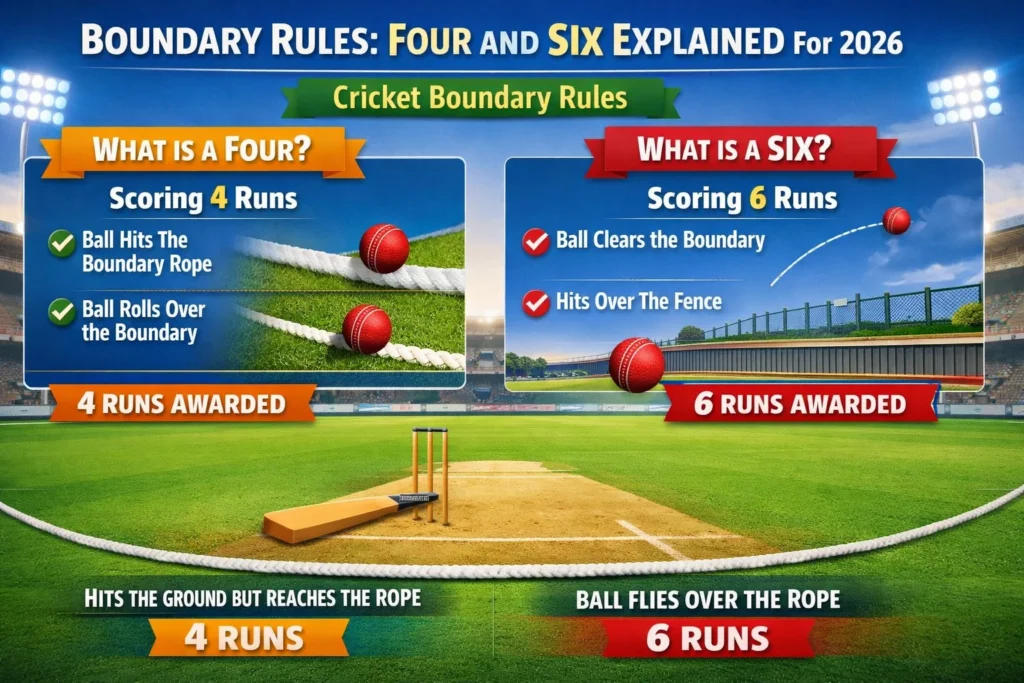

A four is awarded when the ball touches or crosses the boundary line after bouncing at least once, while a six is awarded when the ball clears the boundary without touching the ground. Both automatically add runs to the batting team’s total without the batters needing to physically run.
Boundaries are cricket’s most exciting scoring moments the crowd roar, the ball sailing over the rope, or a perfectly timed shot racing across the turf. But the exact rules behind fours and sixes involve a few technical details that even regular viewers sometimes get wrong. This guide breaks down exactly how boundaries are judged, including rare edge cases like overthrows and boundary-line catches.
What Is a Boundary in Cricket?
The boundary refers to the marked edge of the playing field, usually indicated by a rope or painted line. When the ball reaches this boundary after being hit by the batter, the batting team is awarded either four or six runs automatically, depending on how the ball crossed it.
What Counts as a Four?
A four is awarded when the ball touches the ground (bounces) at least once inside the field of play before touching or crossing the boundary line. The batting team receives four runs added directly to their total, and the batters do not need to run between the wickets for these runs to count.
Key Conditions for a Four:
- The ball must have been hit by the bat (or, in some cases, deflected off the batter’s body while attempting a shot).
- The ball must bounce at least once inside the boundary.
- The ball must then touch or fully cross the boundary rope or line.
What Counts as a Six?
A six is awarded when the ball clears the boundary without touching the ground at any point after being hit. This means the ball must sail through the air, over the boundary rope, without bouncing first a much harder shot to execute, which is why sixes are generally considered more impressive than fours.
Key Conditions for a Six:
- The ball must be hit by the bat.
- The ball must not touch the ground at any point before crossing the boundary.
- The ball must fully clear the boundary line or rope while still in the air.
Four vs Six: Key Differences
| Feature | Four | Six |
|---|---|---|
| Ground contact before boundary | Ball bounces at least once | Ball does not touch the ground |
| Runs awarded | 4 | 6 |
| Difficulty | Requires timing and placement | Requires power and elevation |
| Batters need to run? | No | No |
What Happens If a Fielder Touches the Ball Near the Boundary?
This is one of the most debated situations in modern cricket. If a fielder touches the ball while it’s still in the air near the boundary, but their feet or body touch or cross the boundary line at the moment of contact, it is still counted as a six or four, depending on the ball’s trajectory before the touch.
However, if the fielder is fully inside the boundary when they make contact, and they can then throw or parry the ball back into the field of play before it crosses the line, the ball remains live, and no boundary is awarded this is often referred to as a boundary save, and has become one of the most athletic and celebrated fielding skills in the modern game.
What Are Overthrows?
An overthrow occurs when a fielder’s throw toward the stumps misses and continues on to the boundary, or when the ball deflects off a fielder, umpire, or the stumps and reaches the boundary unintentionally. In this case, the batting team is awarded the runs the batters had already completed plus four additional runs if the ball reaches the boundary after the overthrow.
Overthrows can occasionally lead to unusual run totals on a single delivery for example, batters completing two runs before an overthrow reaches the boundary would result in six total runs added to the team’s score from that one ball.
Can a Boundary Be Scored Without the Bat Touching the Ball?
Yes, in certain situations. If the ball deflects off the batter’s body or helmet (while not being a deliberate action considered “obstructing the field”) and still reaches the boundary, it can be counted as byes rather than runs off the bat, but it still awards four (or, in rare cases, six) runs to the batting team’s total. These runs are recorded separately in the scorebook as extras, rather than being credited to the batter personally.
Boundary Rules Across Formats
The core boundary rules are identical across Test, ODI, and T20 cricket a four and six are defined exactly the same way regardless of format. What differs is the boundary distance, which can vary between grounds and is often set shorter in T20 leagues to encourage more aggressive, high-scoring cricket. There’s no universal fixed distance required by law; it depends on the dimensions of each specific ground.
For more on how these formats structurally differ, see our guides on T20 Cricket, ODI Cricket, and Test Cricket.
Boundary Rules and DRS
Close boundary decisions particularly whether a fielder’s foot touched the rope while catching or saving a ball are frequently reviewed using slow-motion replays by the third umpire, even without a player-initiated review in many competitions. For more on how technology supports these close calls, read our guide on How Does DRS Work in Cricket.
Interesting Facts About Boundary Rules
- The exact distance of the boundary rope is not fixed by a single universal law it varies by ground, though most modern venues aim for boundaries between roughly 60 to 90 meters from the pitch.
- Some of the longest sixes ever recorded in professional cricket have traveled well over 100 meters, based on ball-tracking data used by broadcasters.
- The “boundary save,” where a fielder leaps to keep the ball in play before touching the rope themselves, has become a highlight-reel staple in modern T20 cricket.
- Overthrow boundaries have decided extremely tense finishes in international cricket, including a widely discussed incident during the 2019 ICC Cricket World Cup Final involving a deflection off a diving batter’s bat.
- Historically, boundary ropes weren’t always used older cricket grounds sometimes marked the boundary with a simple painted line or fence, before ropes became the modern standard.
- A six hit high enough to clear a stadium roof or structure entirely, in grounds with such features, is still simply scored as six runs, regardless of how far it travels afterward.
Frequently Asked Questions
1. What is the difference between a four and a six? A four is scored when the ball bounces at least once before reaching the boundary, while a six is scored when the ball clears the boundary without touching the ground.
2. Do batters need to run for a boundary to count? No, both fours and sixes are awarded automatically once the ball crosses the boundary, regardless of whether the batters have run.
3. What happens if a fielder saves a certain boundary? If a fielder can control the ball and either touch it back into play or throw it back before their body crosses the boundary themselves, no boundary is awarded, and the ball remains live.
4. Are overthrows counted as boundaries? Yes, if a misfielded throw reaches the boundary, the batting team is awarded the completed runs plus four additional runs for the overthrow.
5. Is the boundary distance the same on every cricket ground? No, boundary distances vary by venue, since there’s no single fixed universal distance required grounds differ based on their physical dimensions.
Conclusion
Fours and sixes might look like straightforward scoring shots, but the rules behind them from boundary saves to overthrows to close boundary-line reviews add real tactical depth to the game. Understanding these details makes it much easier to appreciate the split-second athleticism fielders show while defending the rope, and why some boundaries generate far more debate than others.
For more on related scoring and fielding rules, explore our guide on Fielding Rules in Cricket or our Complete Cricket Rules Guide 2026.