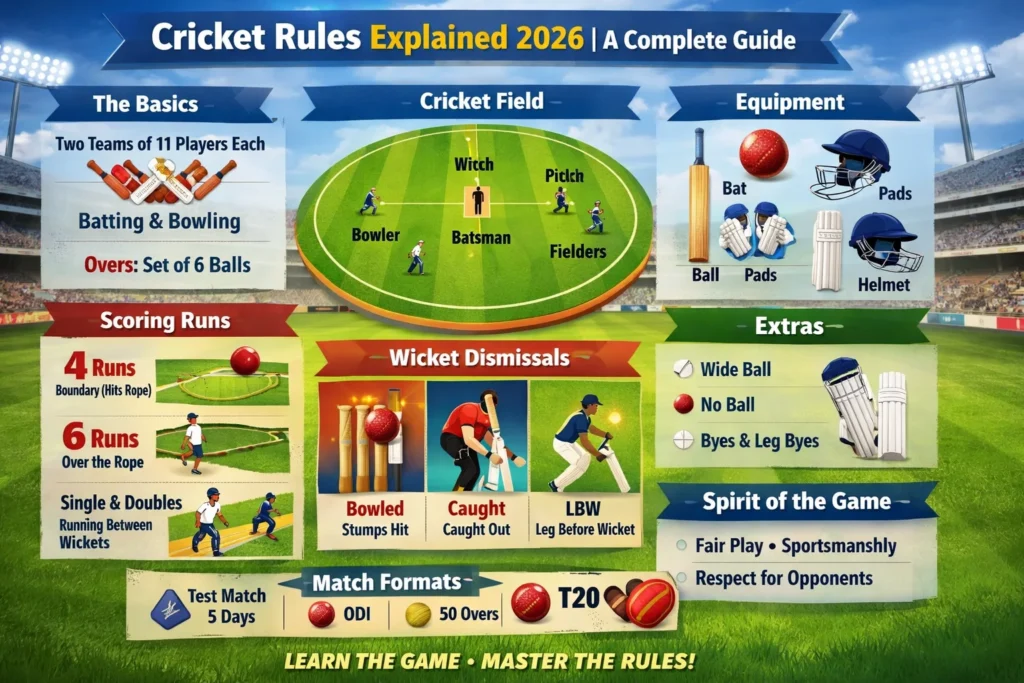

Cricket rules cover how a match is played starting with a toss to decide batting order, followed by overs, batting, bowling, and fielding restrictions, all governed by umpires across three formats: Test, ODI, and T20 cricket.
Cricket is one of the most-loved sports in the world, but for beginners, its rules can feel overwhelming overs, fielding restrictions, toss decisions, formats, umpiring calls, and more. This guide brings every core rule of cricket together in one place, so you can understand the full picture of the game before diving into the details.
Whether you’re new to cricket or want a refresher on the fundamentals, this is your starting point and every section links to a full, in-depth article if you want to go deeper.
How a Cricket Match Begins: The Toss
Every cricket match starts with a coin toss, which decides who bats or bowls first. The outcome of the toss can shape a team’s entire strategy, especially depending on pitch and weather conditions.
👉 Read the full breakdown: Toss Rule in Cricket Explained
Understanding Overs in Cricket
An over consists of six legal deliveries bowled by one bowler from one end. The number of overs in a match depends on the format being played this is one of the first things beginners should understand before anything else.
👉 Full guide: Overs in Cricket Explained
Batting Rules in Cricket
Batting rules cover how runs are scored, how a batter gets out, and the responsibilities of both batters at the crease. Understanding dismissals, running between wickets, and scoring shots is essential to following any match.
👉 Full guide: Batting Rules in Cricket
Bowling Rules in Cricket
Bowling rules define what counts as a fair delivery, what results in a no-ball or wide, and the restrictions placed on bowlers during a match. These rules keep the contest between bat and ball fair.
👉 Full guide: Bowling Rules in Cricket
Fielding Rules, Positions, and Restrictions
Fielding is often the most visually complex part of cricket for new fans — knowing where fielders stand and why teams set specific fields can make the game far easier to follow.
- Fielding Rules — the do’s and don’ts for fielders during play 👉 Fielding Rules in Cricket
- Fielding Positions — where each fielder stands and their role (slip, gully, cover, mid-on, and more) 👉 Fielding Positions in Cricket
- Fielding Restrictions — powerplay rules that limit how many fielders can be outside the inner circle 👉 Fielding Restrictions in Cricket Explained
- Powerplay Rules — how fielding restrictions change across the phases of a match 👉 Powerplay Rules Explained
Cricket Formats: Test, ODI and T20
Cricket is played in three major formats, each with its own pace, rules, and strategy:
- Test Cricket — the oldest and longest format, played over five days 👉 Test Cricket Explained
- ODI (One Day International) — a 50-over format that balances patience and aggression 👉 ODI Cricket Explained
- T20 Cricket — the shortest and most explosive format, built for entertainment 👉 T20 Cricket Explained
Each format has different fielding restrictions, over limits, and strategic approaches which is why the same rule (like powerplays) can look different depending on which format you’re watching.
The Role of Umpires and Decision-Making
Umpires are responsible for enforcing the rules of the game, from judging dismissals to calling no-balls and overseeing the use of technology like DRS. Modern cricket has evolved significantly in how decisions are reviewed and made.
👉 Full guide: Umpires and Decision Making Explained
The Indian Premier League (IPL)
No modern cricket guide is complete without covering the IPL the world’s biggest T20 league, known for its franchise teams, player auctions, and massive global following.
👉 Full guide: Indian Premier League (IPL) Guide 2026
The History of International Cricket
To understand modern cricket, it helps to know where it all began from the very first international match to how the game has evolved into the sport we watch today.
👉 Full guide: Start of International Cricket: History & First Match
FAQs
1. What are the three main formats of cricket? Test cricket, ODI (One Day International), and T20 cricket each differing in match length, overs, and strategy.
2. What decides who bats first in a cricket match? A coin toss before the match determines which team bats or bowls first.
3. What is a fielding restriction? A rule limiting how many fielders can be positioned outside a marked circle during specific phases (overs) of a match, most notably the powerplay.
4. Who enforces the rules during a match? On-field umpires, supported by a third umpire and technology like DRS (Decision Review System), enforce all playing rules.
5. Why do fielding positions matter? Fielding positions are set strategically based on the bowler, batter, and match situation to maximize chances of dismissals or run-saving.
Conclusion
Cricket’s rules may seem complex at first, but they build on each other logically from the toss, to overs, to batting and bowling, to the fielding restrictions that shape each format. Once you understand these fundamentals, watching any format of the game Test, ODI, or T20 becomes far more rewarding.
Explore each linked guide above to go deeper into any specific rule, and bookmark this page as your one-stop reference for everything cricket rules in 2026.