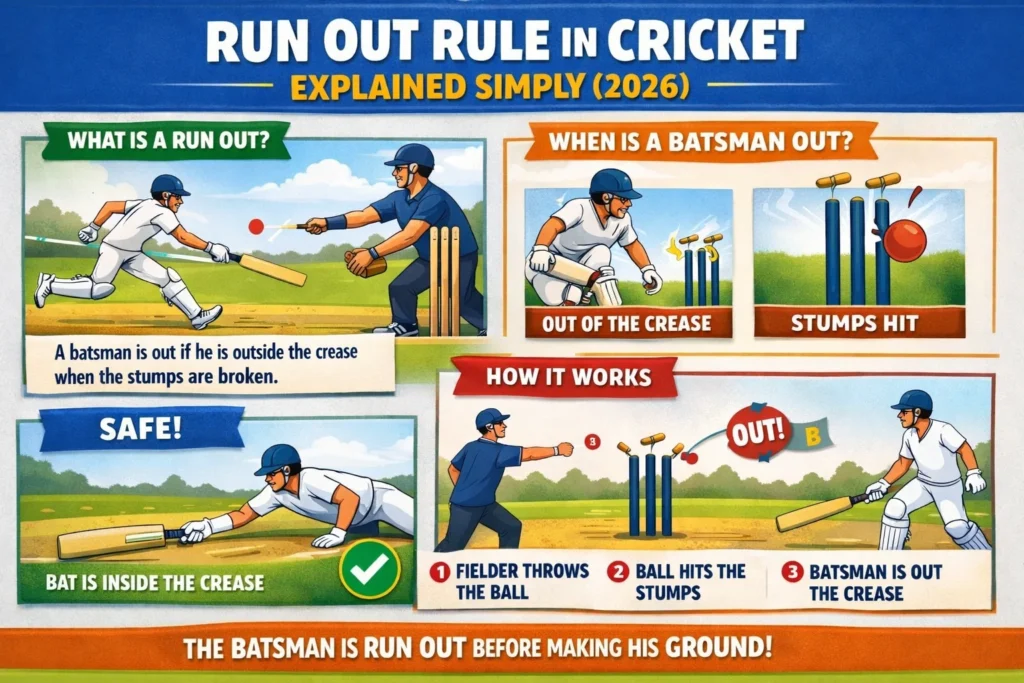

A run out happens when a fielder breaks the stumps with the ball (or their hand holding the ball) while a batter is outside their crease attempting a run. It’s one of the few dismissals that can happen to either batter on the pitch, regardless of who is on strike.
Run outs are some of the most dramatic moments in cricket a mix-up between batters, a direct hit from the boundary, or a diving dash to make the crease in time. Unlike LBW or caught decisions, a run out can happen to either batter, and doesn’t depend on the bowler at all. This guide explains exactly how the rule works, the technology used to review it, and some of the rarer scenarios that confuse even experienced fans.
What Is a Run Out in Cricket?
A run out occurs when a batter, while attempting to take a run (or attempting to return to their crease), fails to ground their bat or body behind the popping crease before the fielding side breaks the stumps with the ball in hand.
Unlike most dismissals, a run out is not credited to the bowler in the scorebook it’s recorded as a fielding-side dismissal, crediting the fielder(s) involved instead.
The Official Conditions for a Run Out
For a batter to be given run out, the following must happen:
- The batter must be out of their ground — meaning no part of their bat or body is grounded behind the popping crease at the moment the stumps are broken.
- The stumps must be broken correctly — either by the ball itself, or by a fielder’s hand or arm while holding the ball (not the ball alone in the fielder’s other hand while a different hand touches the stumps).
- The ball must be in play — meaning the delivery has been legally bowled and the ball hasn’t already become dead (for example, after the previous ball’s action has fully finished).
If any of these conditions aren’t met, the batter is not out, even if they appear to be short of the crease on replay.
Which Batter Can Be Run Out?
This is one of the most common points of confusion for new fans: either batter can be run out, not just the one who was facing the delivery. Since both batters are running between the wickets, a mix-up, a misjudged call, or a direct hit at either end can result in a run out for the batter closer to that end regardless of who was originally on strike.
For more on how batters interact during an innings, see our guide on Batting Rules in Cricket.
Can a Bowler Run Out the Non-Striker? (The “Mankad” Rule)
Yes and this is one of cricket’s most debated dismissals. If the non-striking batter leaves their crease early (before the bowler releases the ball) in an attempt to gain a head start on a run, the bowler is allowed to break the stumps at the non-striker’s end and appeal for a run out.
This dismissal is commonly nicknamed a “Mankad”, after Indian cricketer Vinoo Mankad, who famously ran out a batter this way in 1947. For decades, the dismissal was considered against the “spirit of the game” by some traditionalists, even though it was always legal. In recent years, the ICC has officially reclassified it as a standard run out in the laws of cricket, removing it from the “unfair play” section entirely reflecting a shift toward treating it as a legitimate part of the game rather than a controversial loophole.
Run Outs and DRS Reviews
Run outs are almost always checked by the third umpire using slow-motion replays, since the margin between “in” and “out” can be a fraction of a second. Unlike LBW or caught decisions, run-out reviews typically do not use up a team’s DRS review count they’re automatically referred by the on-field umpire whenever the decision is close.
For more on how DRS technology supports these close calls, read our full guide on How Does DRS Work in Cricket.
Common Run Out Scenarios
1. Simple Misfield or Direct Hit
The most common scenario a fielder throws directly at the stumps while a batter is still running, and the throw beats the batter to the crease.
2. Mix-Up Between Batters
Both batters call for a run, then change their mind midway, leaving one batter stranded well short of their ground.
3. Collision or Obstruction
If a fielder’s throw is deflected by a batter obstructing the field deliberately, the decision can shift to a separate dismissal entirely (obstructing the field), rather than a standard run out.
4. Non-Striker Backing Up Too Far (Mankad)
As explained above, if the non-striker leaves the crease before the ball is released, they can be run out at the bowler’s end.
Run Out vs Stumping: What’s the Difference?
These two dismissals are often confused since both involve breaking the stumps, but they’re fundamentally different:
| Feature | Run Out | Stumping |
|---|---|---|
| Who breaks the stumps | Any fielder | Only the wicketkeeper |
| When it happens | While batters are running between wickets | While the batter is out of their crease attempting (or missing) a shot, not running |
| Ball requirement | Ball can be thrown from anywhere on the field | Wicketkeeper must gather the ball themselves |
| Non-striker included? | Yes, either batter can be run out | No, only applies to the striker |
For the full breakdown of stumpings specifically, see our guide on Stumping Rule in Cricket Explained.
Interesting Facts About the Run Out Rule
- The “Mankad” dismissal is named after Vinoo Mankad, who ran out Australia’s Bill Brown in 1947 a moment still referenced in cricket nearly 80 years later.
- In 2022, the MCC (Marylebone Cricket Club), which maintains the official Laws of Cricket, moved the Mankad dismissal from the “unfair play” section into the standard “run out” law, formally ending decades of debate about its legality.
- A batter can be run out even if they’ve already crossed the striker’s end, if they turn back for another run and fail to make their ground in time.
- Run outs are one of the few dismissals where both batters are technically at risk on the very same delivery, depending on where the ball is thrown.
- Some of the most iconic run outs in cricket history have come from direct hits from the boundary, covering over 70 meters in the air before removing the stumps.
- Unlike caught or LBW dismissals, a run out does not require any fielder to appeal loudly in many competitions sometimes it’s given simply because the stumps are visibly broken with the batter out of their ground.
Frequently Asked Questions
1. Can both batters be run out on the same ball? No, only one batter can be dismissed per delivery, but the fielding side can choose which end to target if both batters are out of their ground.
2. Is the Mankad dismissal legal in cricket? Yes, it has always been legal, and since 2022, it has officially been classified as a standard run out in the Laws of Cricket rather than a separate “unfair play” rule.
3. Does a run out count against the bowler’s figures? No, a run out is recorded as a fielding dismissal and does not count toward the bowler’s wicket tally.
4. Do run-out reviews use up a team’s DRS count? No, run outs are typically reviewed automatically by the third umpire and don’t count against a team’s limited DRS reviews.
5. What is the difference between a run out and a stumping? A run out can happen to either batter while running between the wickets and can be executed by any fielder, while a stumping only applies to the striker and must be completed by the wicketkeeper.
Conclusion
The run out rule might seem simple on the surface beat the batter to the crease but it includes some fascinating nuances, from the historic and once-controversial Mankad dismissal to the technical requirements around how the stumps must be broken. Understanding these details makes it much easier to follow the drama of a tight run-out review during a live match.
For more on related dismissals and fielding rules, explore our guides on Fielding Rules in Cricket and our Complete Cricket Rules Guide 2026.