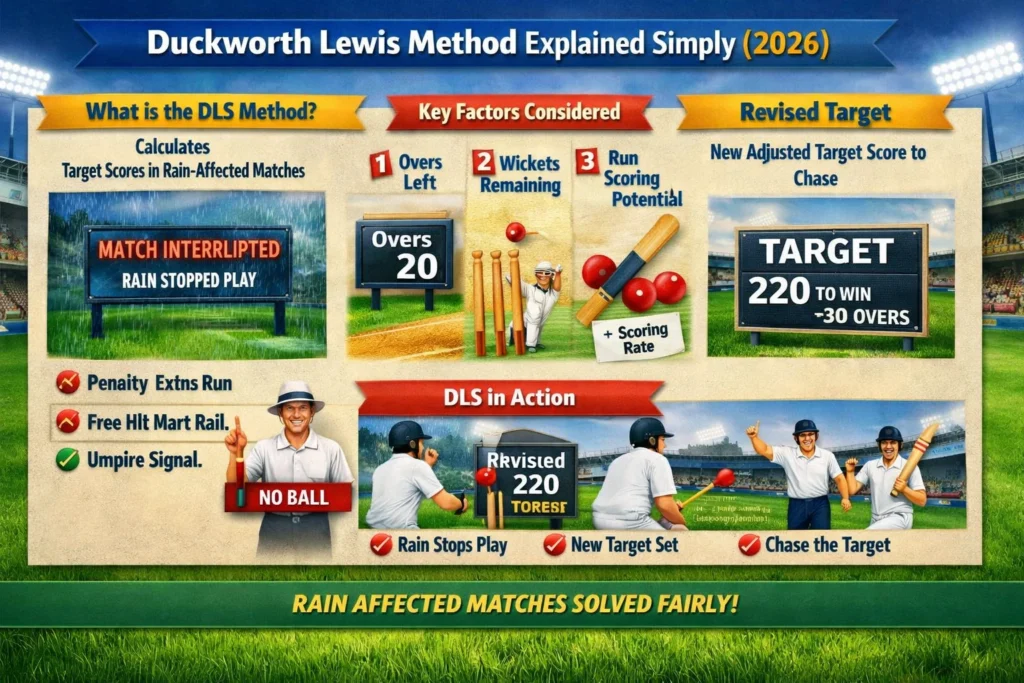

The Duckworth Lewis Stern (DLS) method is a mathematical formula used to set fair, adjusted targets in limited-overs cricket matches interrupted by rain or other delays. It calculates a team’s “resources” overs and wickets remaining to decide what score would have been fair if the match had continued uninterrupted.
If you’ve ever watched an ODI or T20 match get interrupted by rain and wondered how commentators suddenly announce a completely new target score, the answer is the Duckworth Lewis Stern method usually just called DLS. It’s one of the most talked-about, and most misunderstood, concepts in limited-overs cricket. This guide explains exactly how it works, why it exists, and why it sometimes sparks controversy among fans.
Why Does Cricket Need the Duckworth Lewis Method?
In a rain-affected cricket match, one team may not get to bat for as many overs as the other. Simply comparing raw scores wouldn’t be fair a team batting only 30 overs cannot reasonably be expected to match a target set over a full 50 overs.
Before DLS existed, cricket used cruder methods, like Run Rate and later the Average Run Rate method, which often produced unfair results. For example, a team could lose a match simply because the required run rate spiked after a rain delay, even if they were well-placed before the interruption. Cricket needed a system that accounted for both overs remaining and wickets in hand since both factors affect how many runs a team can realistically score.
Who Invented the Duckworth Lewis Method?
The method was developed by two British statisticians, Frank Duckworth and Tony Lewis, in the mid-1990s. Their system was first used officially in international cricket in 1997 and was adopted as the standard method by the ICC in 1999 after the 1992 World Cup semi-final controversy (South Africa’s target famously dropped to an impossible “22 runs off 1 ball” under the old rain-rule system).
In 2014, statistician Steven Stern updated the model with improved data, and it was renamed the Duckworth-Lewis-Stern (DLS) method the version still used in international and domestic cricket today.
How Does the Duckworth Lewis Method Actually Work?
At its core, DLS is built around one key concept: resources. A team’s ability to score runs depends on two things:
- Overs remaining
- Wickets remaining
The DLS method assigns a combined “resource percentage” based on both factors, using pre-calculated statistical tables (or now, computer software) built from decades of historical scoring data across formats.
Simplified Step-by-Step Example
Let’s say:
- Team A bats first and scores 250 runs in a full 50 overs.
- Rain interrupts the match before Team B bats, reducing their innings to 30 overs.
- Team B has 100% of their wickets available but only a percentage of their overs.
The DLS formula calculates what percentage of “resources” Team B has compared to a full innings, then adjusts Team A’s score proportionally to set a fair target for Team B’s reduced overs.
This means the revised target is not just a simple percentage cut of the original score it factors in exactly how batting resources scale as overs are lost, which is why DLS targets can sometimes look unusual to fans expecting straightforward math.
DLS in Different Match Situations
When Only the Chasing Team’s Overs Are Reduced
This is the most common scenario rain interrupts only the second innings. DLS recalculates a new target based on the resources the chasing team has left.
When Both Teams’ Overs Are Reduced
If rain interrupts the match before it starts or between innings, both teams may play a reduced number of overs. DLS still applies, comparing resource percentages for both sides.
The “Par Score” Concept
During a rain delay, broadcasters often show a “DLS par score” the score the chasing team would need to be considered “level” with the target if the match were abandoned at that exact moment. This number updates constantly as the innings progresses.
Why Fans Often Find DLS Confusing
DLS is a computer-calculated system, and its exact resource tables aren’t publicly memorized by fans or commentators in real time. This creates a few common frustrations:
- Targets can jump unexpectedly after a delay, since resource percentages don’t scale in a straight line.
- Wickets in hand matter enormously a team 2 wickets down can have a very different target than a team 6 wickets down, even with identical overs remaining.
- The system assumes “normal” scoring patterns, which can feel unfair in matches with unusually high or low scoring rates (like today’s high-scoring T20 leagues).
These are legitimate critiques, and DLS has been refined multiple times (hence the “Stern” update in 2014) specifically to address scoring-pattern issues in modern limited-overs cricket.
DLS vs Older Rain Rules
| Method | Key Factor Considered | Fairness Issue |
|---|---|---|
| Run Rate Method (pre-1990s) | Only overs faced | Ignored wickets in hand entirely |
| Average Run Rate Method | Slightly better than run rate | Still didn’t scale properly for reduced overs |
| Duckworth Lewis (1997) | Overs + wickets combined | Improved fairness significantly |
| Duckworth Lewis Stern (2014–present) | Overs + wickets + modern scoring data | Most accurate version to date |
Interesting Facts About the Duckworth Lewis Method
- The method was born out of controversy the infamous 1992 World Cup semi-final between England and South Africa, where a rain delay left South Africa needing 22 runs off 1 ball, a mathematically impossible target under the old rules.
- Frank Duckworth and Tony Lewis first published their idea as an academic paper in a statistics journal before it was ever used in professional cricket.
- The full DLS calculation is too complex to do by hand during a live match modern matches use dedicated DLS software operated by match officials.
- DLS has been adapted for T20 cricket specifically, since T20’s shorter format and different scoring patterns required separate resource tables from ODI cricket.
- Some fans and commentators have proposed newer alternatives, but as of 2026, DLS remains the ICC’s official method for all rain-affected limited-overs matches.
- The method doesn’t just apply to rain it can be used for any stoppage that reduces available overs, including bad light, crowd interference, or other unexpected delays.
Does DLS Apply to Test Cricket?
No. Test cricket is not run-rate dependent in the same way, since it’s played over five days with a fixed number of overs per day rather than a fixed total. Lost time in Test matches is typically handled through extended playing hours or, in rare cases, a draw not a recalculated target. DLS is exclusively used in limited-overs formats: ODI and T20 cricket.
For more on how these formats differ structurally, see our guides on ODI Cricket, T20 Cricket, and Test Cricket.
Frequently Asked Questions
1. What does DLS stand for in cricket? DLS stands for Duckworth-Lewis-Stern, a formula used to set fair targets in rain-affected limited-overs cricket matches.
2. Why was the Duckworth Lewis method created? It was created to fairly adjust targets when overs are lost to rain or other delays, replacing older methods that ignored wickets remaining and produced unfair results.
3. Does DLS apply to Test cricket? No, DLS is only used in ODI and T20 cricket. Test matches handle lost playing time differently, usually through extended hours or a draw.
4. What is a DLS par score? It’s the live target a chasing team needs to reach at any given moment for the match to be considered level if play were abandoned right then.
5. Who created the Duckworth Lewis method? Statisticians Frank Duckworth and Tony Lewis created the original method in the 1990s; Steven Stern updated it in 2014, leading to its current name, DLS.
Conclusion
The Duckworth Lewis Stern method may look like a confusing black box during a rain delay, but it’s built on a simple principle: fairly measuring how many “resources” overs and wickets each team has left to score runs. It replaced deeply flawed older systems and remains, even with its critics, the most statistically sound way to handle interrupted limited-overs cricket matches today.
To understand how DLS interacts with other match rules, explore our Complete Cricket Rules Guide 2026 or our guide on ODI Cricket.