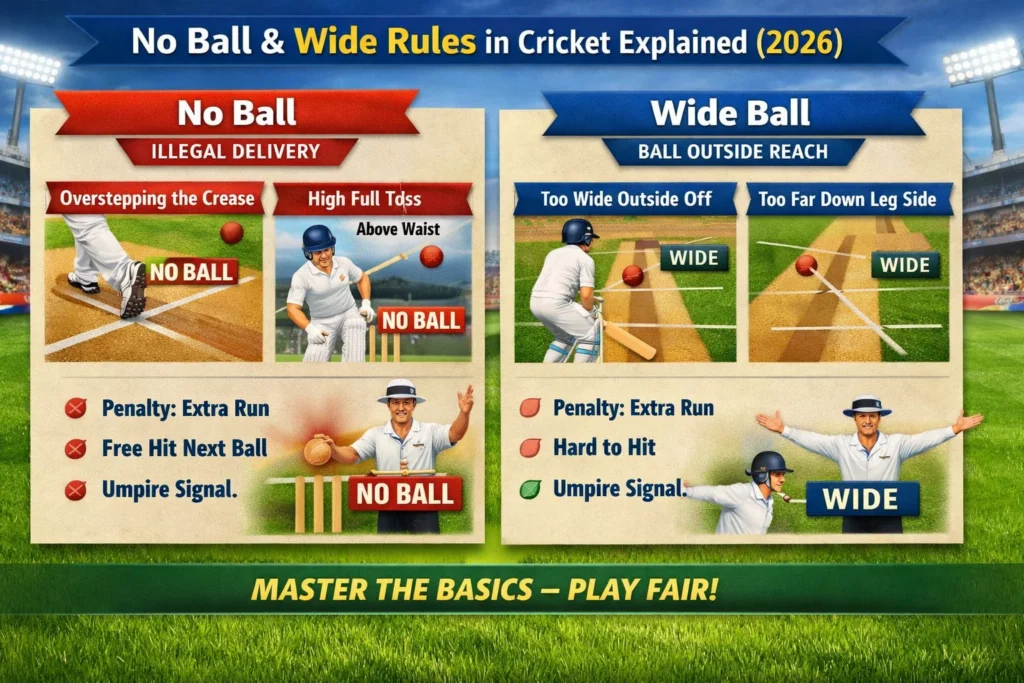

A no-ball is an illegal delivery by the bowler (usually due to overstepping the crease), giving the batting team an extra run and often a free hit. A wide is a delivery too far from the batter to reasonably play, also awarding an extra run. Both rules keep bowling fair and give batters a genuine chance to score.
No-balls and wides are two of the most common and most misunderstood extras in cricket. A single no-ball can shift momentum entirely, especially in T20 cricket where a free hit often results in a boundary. This guide breaks down exactly what counts as a no-ball or a wide, how the rules differ across formats, and why these small details matter so much in modern cricket.
What Is a No-Ball in Cricket?
A no-ball is called when the bowler breaks a rule while delivering the ball, making it an “illegal” delivery. The batting team is awarded one extra run and importantly the delivery must be re-bowled, meaning it doesn’t count toward the over’s six legal balls.
Common Reasons a No-Ball Is Called
- Front-foot overstepping — The most frequent reason. If the bowler’s front foot lands completely over the popping crease (the line in front of the stumps) at the point of delivery, it’s called a no-ball.
- Back-foot fault — If the bowler’s back foot doesn’t land within the return crease (the side lines), it’s also a no-ball.
- High full toss — A delivery that reaches the batter above waist height without bouncing (called a “beamer”) is an automatic no-ball, and considered dangerous bowling if above shoulder height.
- Fielding violations — If a fielder is standing illegally (for example, too many fielders behind square on the leg side, or outside the fielding circle during a powerplay), the delivery can also be called a no-ball.
- Underarm bowling — Illegal in modern cricket except in extremely rare, pre-agreed circumstances; bowling underarm without notice results in a no-ball.
For a full breakdown of fielding-related restrictions that can trigger a no-ball, see our guide on Fielding Restrictions in Cricket.
What Happens After a No-Ball?
Once a no-ball is called, three things happen:
- The batting team gets 1 extra run added to their total immediately.
- The ball is re-bowled, meaning the over is not shortened.
- In limited-overs cricket (ODI and T20), the next delivery is a free hit the batter cannot be dismissed on that ball except by run-out, hit the ball twice, or obstructing the field.
The free hit rule is one of the biggest strategic factors in modern white-ball cricket, since batters can play aggressive shots with almost no risk of losing their wicket.
What Is a Wide in Cricket?
A wide is called when the bowler delivers the ball too far away from the batter either too wide down the leg side, too wide outside off stump, or too high such that the batter cannot reasonably reach it with a normal cricket shot.
Like a no-ball, a wide results in:
- 1 extra run awarded to the batting team
- The delivery must be re-bowled
- The batter cannot be out off a wide, except by run-out, stumping, or hitting their own wicket
Key Difference: Wide Lines Vary by Format
The exact distance that counts as “wide” is often stricter in white-ball cricket (ODI/T20) than in Test cricket, since limited-overs cricket demands a tighter contest between bat and ball. Umpires generally allow bowlers more room down the leg side in Test matches, where defensive bowling is more common.
No-Ball vs Wide: Key Differences
| Feature | No-Ball | Wide |
|---|---|---|
| Cause | Illegal delivery (overstepping, height, fielding) | Ball out of batter’s reach |
| Extra runs | 1 run | 1 run |
| Ball re-bowled? | Yes | Yes |
| Free hit (limited overs)? | Yes | No |
| Can batter be dismissed? | Only run-out (and a few exceptions) | Only run-out, stumping, hit wicket |
Why the Free Hit Rule Was Introduced
The free hit rule was introduced specifically to discourage bowlers from overstepping deliberately to slow down aggressive batters or disrupt scoring momentum. Before its introduction, a no-ball only cost a bowler one run and one extra delivery a small price compared to stopping a dangerous batter. Now, the risk of a free hit (and a probable boundary) makes bowlers far more careful with their front-foot discipline.
This is one of the clearest examples of a rule change directly shaping how the modern game is played bowlers in T20 cricket, in particular, now practice their run-up and delivery stride specifically to avoid no-balls under pressure.
To see how these rules apply differently depending on match format, check our guides on T20 Cricket, ODI Cricket, and Test Cricket.
The Role of Umpires and Technology
Historically, no-ball and wide calls were made entirely by the on-field umpire’s eye, especially for front-foot overstepping a decision that had to be made in a split second. In recent years, many leagues and international matches have introduced front-foot no-ball technology, where a separate video official checks every delivery for overstepping, reducing human error significantly.
Wide calls, on the other hand, still rely largely on the umpire’s judgment, since they involve interpreting the batter’s reach and stance something technology hasn’t fully automated.
For more on how umpires make decisions and where technology like DRS fits in, read our guide on Umpires and Decision Making Explained.
Common Myths About No-Balls and Wides
Myth: “A no-ball always means a free hit.” False free hits only apply in limited-overs cricket (ODI and T20). In Test cricket, a no-ball adds a run and is re-bowled, but there’s no free hit.
Myth: “You can never get out on a wide.” Not entirely true a batter can still be out by run-out, stumping, or hitting their own wicket, even off a wide delivery.
Myth: “No-balls are only about overstepping.” Overstepping is the most common cause, but height violations and illegal fielding positions can also result in a no-ball.
Frequently Asked Questions
1. How many runs does a no-ball give the batting team? A no-ball gives one extra run to the batting team, and the delivery must be bowled again.
2. Is there a free hit after a wide? No the free hit rule only applies after a no-ball, not after a wide.
3. Can a batter be dismissed off a no-ball? Yes, but only by run-out (and in rare cases, obstructing the field or hitting the ball twice). All other dismissals are cancelled on a no-ball.
4. What is a beamer in cricket? A beamer is a delivery that reaches the batter above waist height without bouncing, and it is automatically called a no-ball due to the safety risk.
5. Do no-ball and wide rules differ between formats? The core rules are the same, but wide lines are often interpreted more strictly in ODI and T20 cricket compared to Test cricket, and free hits only apply in limited-overs formats.
Conclusion
No-balls and wides may look like small technical calls, but they carry real strategic weight especially with the free hit rule turning a single mistake into a scoring opportunity. Understanding these rules helps explain why bowlers are so cautious with their run-up in tense moments, and why a “simple” extra run can sometimes change the entire momentum of a match.
For the full picture of how these rules fit into the game, explore our Bowling Rules in Cricket guide or our Complete Cricket Rules Guide 2026.