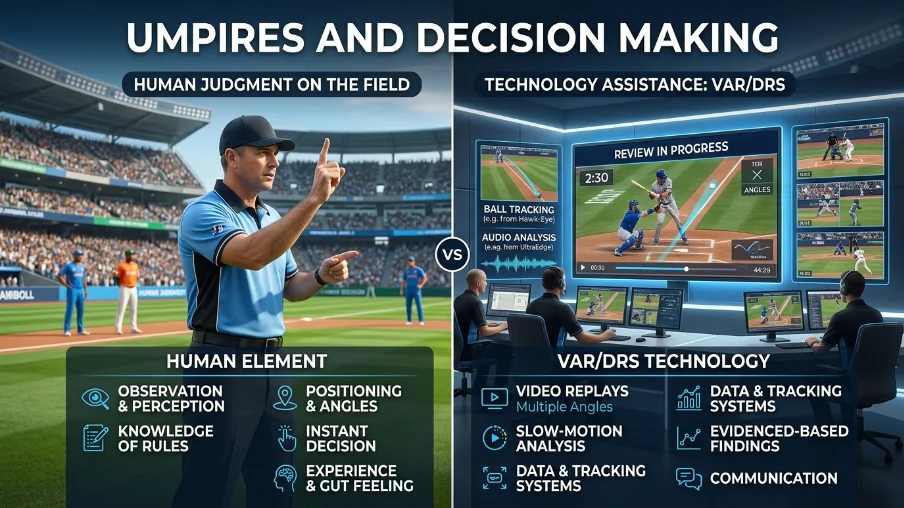

Umpires and decision making involve applying game rules, observing play in real time, and using technology like VAR or DRS to ensure accurate, fair outcomes during matches.
In every sport, fairness depends on one critical factor accurate decisions. That’s where umpires and decision making come into play. Whether it’s a close LBW call in cricket or an offside decision in football, umpires are responsible for interpreting the rules and ensuring the game runs smoothly.
But decision making today isn’t just about human judgment. With the rise of advanced technology, modern officiating has become faster, more precise, and more transparent than ever before.
So how exactly do umpires make decisions? What tools do they use? And why do controversies still happen? Let’s break it all down.
How Umpires Make Decisions
Umpires rely on a combination of:
- Visual observation
- Rule knowledge
- Positioning on the field
- Experience and instincts
Key Decision Factors
| Factor | Explanation |
| Positioning | Being in the right place for clear visibility |
| Timing | Making quick judgments under pressure |
| Rule Knowledge | Understanding detailed regulations |
| Communication | Coordinating with other officials |
Umpires must process information instantly. In high-speed sports, decisions are often made in less than a second.
Types of Decisions Umpires Make
Different sports require different types of decisions.
Common Decision Categories
- Fouls and violations
- Scoring decisions
- Out or not out calls
- Boundary or line judgments
- Time-related decisions
Example Across Sports
| Sport | Example Decision |
| Cricket | LBW, caught behind |
| Football | Offside, foul |
| Tennis | Line calls |
| Baseball | Strike or ball |
Role of Technology in Umpires and Decision Making
Technology has transformed officiating.
Major Technologies Used
- Hawk-Eye – Tracks ball trajectory
- DRS (Decision Review System) – Used in cricket
- VAR (Video Assistant Referee) – Used in football
- Instant Replay – Used in multiple sports
Impact of Technology
| Benefit | Description |
| Accuracy | Reduces human error |
| Transparency | Decisions can be reviewed |
| Fairness | Ensures correct outcomes |
| Confidence | Players trust the system more |
Human Judgment vs Technology
Even with advanced tools, human judgment remains essential.
Comparison Table
| Aspect | Human Umpire | Technology |
| Speed | Instant | Slight delay |
| Accuracy | Can vary | Highly precise |
| Flexibility | Context-based | Rule-based |
| Reliability | Depends on experience | Consistent |
Key Insight:
Technology assists but does not replace umpires.
Why Umpires Sometimes Make Mistakes
No system is perfect.
Common Reasons
- Limited viewing angles
- High-speed gameplay
- Player obstruction
- Pressure from crowd and players
Even experienced umpires can miss calls due to the fast pace of modern sports.
Decision Review Systems (DRS & VAR Explained)
DRS (Cricket)
- Players can challenge decisions
- Uses ball tracking, UltraEdge, and hotspot
- Limited reviews per innings
VAR (Football)
- Reviews goals, penalties, red cards
- Works alongside on-field referee
- Used only for clear errors
The Psychology Behind Decision Making
Umpires must stay mentally strong.
Key Psychological Traits
- Focus under pressure
- Confidence in decisions
- Emotional control
- Quick thinking
A single wrong call can change the outcome of a match, making mental strength crucial.
Training and Qualification of Umpires
Becoming an umpire requires:
- Certification programs
- Rule examinations
- Field training
- Continuous assessment
Skills Required
- Sharp eyesight
- Strong communication
- Game understanding
- Physical fitness
Famous Controversial Decisions in Sports
Some decisions become historic.
Examples
- Incorrect LBW calls in cricket
- Disallowed goals in football
- Line call errors in tennis
These moments often lead to rule changes and improved technology.
Future of Umpires and Decision Making
The future is evolving rapidly.
Emerging Trends
- AI-assisted officiating
- Automated line calling
- Real-time data analytics
- Wearable tech for officials
Technology will continue to improve accuracy, but human oversight will remain essential.
FAQs
1. How do umpires make decisions in real time?
Umpires rely on positioning, experience, and quick observation to make instant decisions. They interpret rules while watching gameplay closely, often deciding within seconds without replay assistance.
2. Are umpire decisions always final?
Traditionally yes, but modern sports allow reviews through systems like DRS or VAR, enabling players or officials to challenge decisions in specific situations.
3. What technology helps umpires today?
Technologies like Hawk-Eye, VAR, UltraEdge, and instant replay assist umpires by providing visual evidence and data analysis to improve decision accuracy.
4. Why do umpires still make mistakes?
Mistakes occur due to human limitations, such as obstructed views, fast gameplay, and pressure situations, even with experience and training.
5. What is the Decision Review System (DRS)?
DRS is a system used in cricket allowing players to challenge umpire decisions using technology like ball tracking and edge detection.
6. What is VAR in football?
VAR (Video Assistant Referee) reviews critical decisions like goals, penalties, and red cards to correct clear errors made by the on-field referee.
7. Can technology replace umpires completely?
No, technology supports decision making but cannot fully replace human judgment, especially in interpreting rules and managing the game.
8. How are umpires trained?
Umpires undergo certification, rule tests, field training, and continuous evaluation to maintain high officiating standards.
9. What qualities make a good umpire?
Key qualities include accuracy, confidence, focus, communication skills, and the ability to handle pressure.
10. How has technology improved decision making?
Technology has increased accuracy, reduced controversies, and improved transparency, making sports fairer and more reliable.
Conclusion
Umpires and decision making remain at the heart of every sport. While technology has significantly improved accuracy, the human element still plays a vital role in interpreting rules and maintaining the flow of the game. Modern officiating is now a balance between experience and innovation, where tools like VAR and DRS enhance but do not replace umpires.
As sports continue to evolve, so will the methods used to ensure fair play. The future points toward smarter systems, better training, and more precise tools. However, the responsibility of making final calls will always require human judgment, discipline, and integrity.
Understanding how decisions are made not only deepens your appreciation of sports but also highlights the complexity behind every whistle, signal, or call you see on the field.