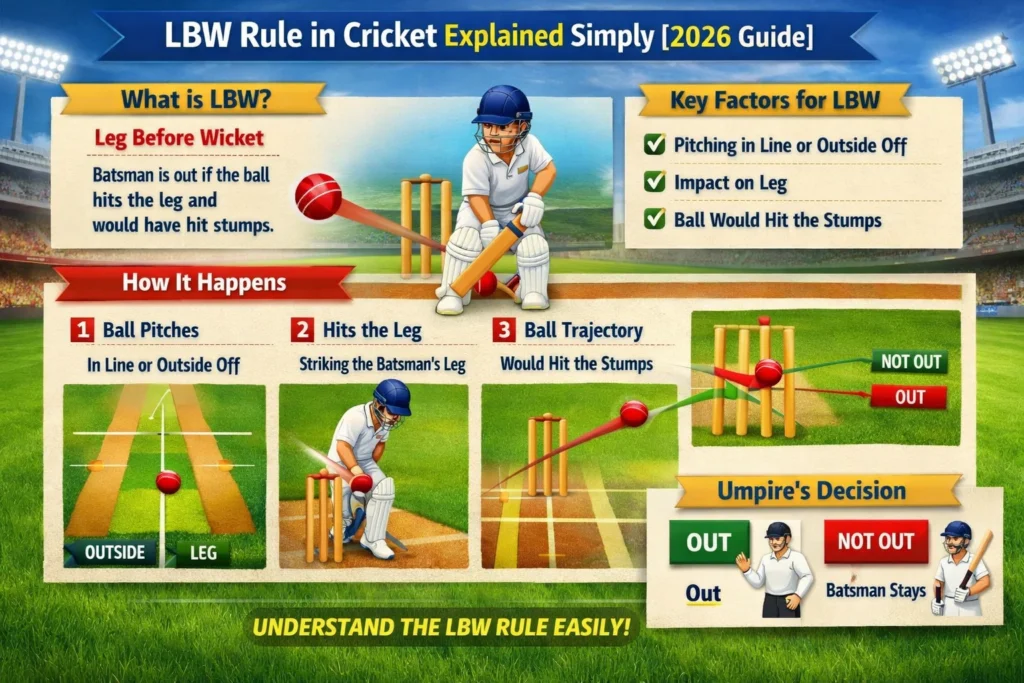

LBW (Leg Before Wicket) is a way for a batter to get out when the ball hits their leg or body in line with the stumps, and would have gone on to hit the stumps if the leg hadn’t blocked it. It’s one of the most debated dismissals in cricket.
If you’ve ever watched a cricket match and heard commentators argue for a full minute about whether a batter is “out LBW,” you’re not alone. LBW is widely considered the hardest dismissal to understand and even harder to umpire. This guide breaks it down in plain language, covers how DRS has changed LBW decisions, and answers the questions fans search for most.
What Does LBW Actually Mean?
LBW stands for Leg Before Wicket. It’s a method of dismissal where the bowler gets credit for getting a batter out if the ball strikes the batter’s body (usually the pad) before hitting the bat, and umpires judge that the ball would have gone on to hit the stumps.
The idea behind the rule is simple: batters shouldn’t be allowed to use their legs or body as a second “bat” to illegally protect their stumps. Without LBW, batters could simply stand in front of the stumps and block every delivery with their pads, making it almost impossible for bowlers to take wickets.
The Official Conditions for LBW
For an umpire to give a batter out LBW, all of the following conditions must be met:
- Pitching — The ball must pitch either in line with the stumps, or outside off stump. If it pitches outside leg stump, the batter cannot be given out LBW, no matter what happens next.
- Impact — The ball must hit the batter’s body (usually the pad) in line with the stumps unless the batter was not attempting to play a shot, in which case impact outside off stump can also count.
- Would it hit the stumps? The umpire (or ball-tracking technology) must judge that the ball, after impact, would have gone on to hit the stumps.
- Bat involvement — If the bat touches the ball before it hits the pad, the batter cannot be out LBW (though they could be out caught instead).
If even one of these conditions isn’t met, the batter is not out LBW this is exactly why LBW decisions generate so much debate on the field.
Why LBW Is So Controversial
Unlike a caught-behind or a bowled dismissal, which are visually obvious, LBW requires the umpire to make a judgment call about something that technically hasn’t happened yet whether the ball would have hit the stumps. This involves factoring in:
- The bowler’s trajectory and swing/spin
- The exact point of impact on the pad
- The distance between the batter and the stumps
- The height of the ball at impact
Because of this complexity, LBW was, for over a century, one of the most contested and inconsistent decisions in cricket until ball-tracking technology arrived.
How DRS Changed LBW Decisions
The introduction of the Decision Review System (DRS), powered by ball-tracking technology like Hawk-Eye, transformed how LBW is judged. When a team reviews an LBW decision, the system predicts the ball’s path using its speed, trajectory, and spin, then shows whether it would have hit the stumps.
DRS uses a principle called the “umpire’s call” if the ball-tracking shows the delivery was only marginally hitting the stumps, the on-field umpire’s original decision stands, since the margin is too close to overturn with certainty. This is one of the most misunderstood parts of modern LBW reviews, and a common source of frustration for fans watching close calls.
For a deeper explanation of how DRS works across all types of decisions, not just LBW, see our full guide: Umpires and Decision Making Explained.
LBW in Different Formats
The rule itself doesn’t change between Test, ODI and T20 cricket, LBW works exactly the same way in all formats. What does change is how often it’s used strategically:
- Test cricket — Bowlers often set up LBW dismissals over several overs, working on a batter’s front pad with in-swing or off-spin.
- T20 cricket — LBW dismissals often happen due to batters playing aggressive, non-traditional shots that expose their stumps.
- ODI cricket — A balance of both approaches, especially during the middle overs when bowlers try to build pressure.
To understand how these formats differ more broadly, check our guides on Test Cricket, ODI Cricket, and T20 Cricket.
Common LBW Myths — Debunked
Myth: “If the ball hits the pad, it’s always out.” False. The ball must meet all four conditions above pitching, impact line, projected path, and no bat contact.
Myth: “Umpire’s call means the batter is not out.” Not quite. Umpire’s call simply means the on-field decision stands because the tracking data isn’t conclusive enough to overturn it it could still go either way in reality.
Myth: “You can never be out LBW to a ball pitching outside leg stump.” This is actually true the rule is explicit on this point, regardless of what happens after.
Quick Reference: LBW Conditions Checklist
| Condition | Requirement |
|---|---|
| Pitching | In line with stumps or outside off (not outside leg) |
| Impact | In line with stumps (or outside off if no shot played) |
| Trajectory | Ball must be going on to hit the stumps |
| Bat contact | No contact with bat before hitting the pad |
Frequently Asked Questions
1. What does LBW stand for in cricket? LBW stands for Leg Before Wicket a dismissal where the ball hits the batter’s body in line with the stumps and would have gone on to hit them.
2. Can a batter be out LBW if they play a shot? Yes, but the impact must be in line with the stumps. If they’re playing a shot and get hit outside the line of off stump, they cannot be given out LBW.
3. What is “umpire’s call” in LBW reviews? It’s a DRS principle where, if ball-tracking shows the delivery was only marginally hitting the stumps, the on-field umpire’s original decision is upheld rather than overturned.
4. Can you be out LBW without offering a shot? Yes if a batter doesn’t attempt to play the ball, they can be given out LBW even if the impact is outside the line of off stump.
5. Does the LBW rule differ between Test, ODI, and T20 cricket? No, the rule is identical across all formats only the strategic use of LBW-focused bowling tends to vary.
Conclusion
LBW might be cricket’s most argued-over rule, but it comes down to four clear conditions: where the ball pitches, where it hits the batter, whether it would go on to hit the stumps, and whether the bat got involved first. With DRS now backing up on-field decisions, LBW calls are more accurate than ever though “umpire’s call” situations will likely keep fans debating for years to come.
For more on how technology and umpires work together to make these calls, read our guide on Umpires and Decision Making, or explore our Complete Cricket Rules Guide 2026 for the full picture.