
Cricket bowlers use a wide variety of deliveries including yorkers, bouncers, googlies, and doosras each designed to deceive the batter through pace, swing, seam movement, or spin variation. Understanding these deliveries makes it far easier to appreciate the tactical battle between bat and ball.
Watching a bowler run in and deliver the ball might look simple from a distance, but professional cricket involves dozens of subtle delivery variations, each designed to trick the batter in a different way. This guide breaks down every major type of delivery in both pace and spin bowling, explaining exactly how each one works and why bowlers use them.
Two Broad Categories: Pace and Spin
Before diving into specific deliveries, it helps to understand the two fundamental bowling disciplines:
- Pace (fast) bowling relies on raw speed, seam movement, and swing through the air to beat the batter.
- Spin bowling relies on rotating the ball to make it deviate off the pitch after bouncing, deceiving the batter through unpredictable turn.
Most bowlers specialize heavily in one discipline, though some develop a wide arsenal of variations within their chosen style.
Pace Bowling Deliveries
1. Yorker
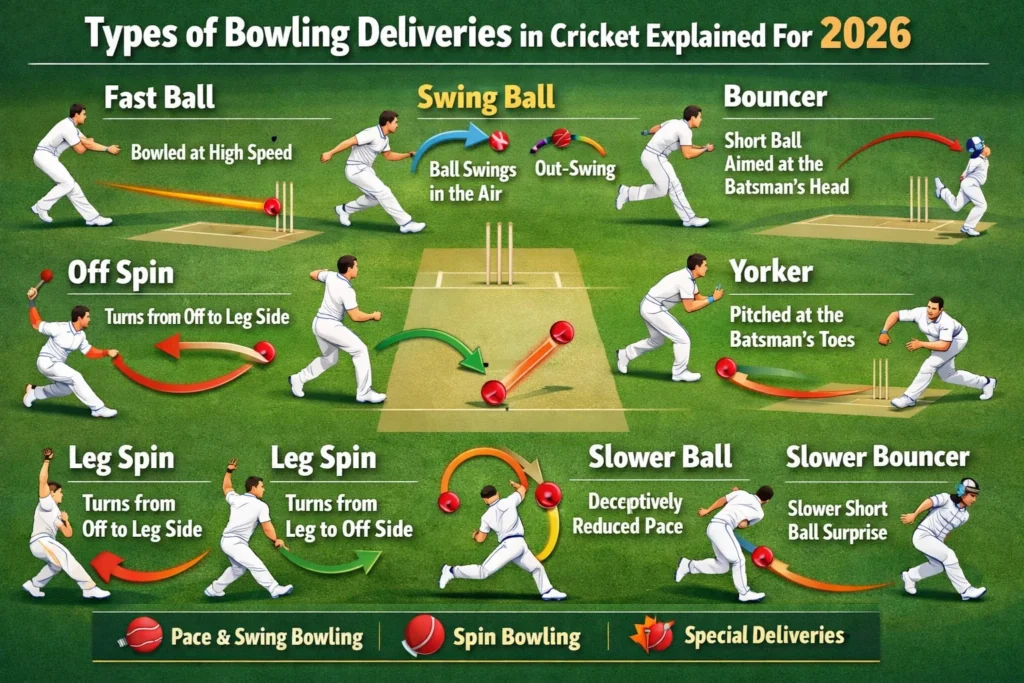
A yorker is a delivery aimed to land right at the batter’s feet, near the base of the stumps, making it extremely difficult to get the bat underneath the ball. It’s one of the most effective deliveries in limited-overs cricket, especially during the death overs, since a well-executed yorker is nearly unplayable.
2. Bouncer
A bouncer is a short-pitched delivery bowled to rise sharply toward the batter’s chest or head height, testing their reflexes and courage. It’s often used to disrupt a batter’s rhythm or set up a follow-up delivery, though bowlers are restricted to a limited number of bouncers per over depending on the format.
3. Out-swinger
An out-swinger moves away from a right-handed batter through the air, typically induced by the bowler’s wrist position and the shine on one side of the ball. It’s especially effective for inducing outside edges caught behind the wicket.
4. In-swinger
An in-swinger moves back into a right-handed batter through the air, often used to target the stumps or induce an LBW dismissal. For more on how these deliveries connect to dismissals, see our guide on LBW Rule Explained Simply.
5. Off-cutter and Leg-cutter
These deliveries use finger position (rather than pure swing) to make the ball deviate slightly off the pitch after bouncing an off-cutter moves in one direction, a leg-cutter the other. They’re often used to slow the pace down while still generating unpredictable movement.
6. Slower Ball
A slower ball is bowled with the same bowling action as a normal delivery but released with reduced pace, deceiving the batter into playing their shot too early. This is one of the most common variations in modern white-ball cricket.
7. Reverse Swing
Reverse swing occurs when an old, roughened cricket ball moves through the air in the opposite direction to what conventional swing would suggest, typically appearing later in an innings once the ball has deteriorated. It’s considered one of the most skillful and hard-to-master pace bowling techniques.
Spin Bowling Deliveries
1. Off-break
An off-break, bowled by a right-arm off-spinner, spins from the off side toward the leg side for a right-handed batter after pitching. It’s the most fundamental delivery in off-spin bowling.
2. Leg-break
A leg-break, bowled by a right-arm leg-spinner, spins from the leg side toward the off side for a right-handed batter the opposite direction to an off-break, and generally considered harder to control consistently.
3. Googly
A googly is a leg-spinner’s signature variation it looks identical to a leg-break out of the hand but spins in the opposite direction (like an off-break) once it pitches, deceiving the batter who expects the ball to turn the other way.
4. Doosra
The doosra (“the other one” in Hindi/Urdu) is an off-spinner’s mirror equivalent to the googly it appears to be a standard off-break but spins the opposite way after pitching. It’s historically been one of the most debated deliveries in cricket due to questions about bowling actions used to generate it.
5. Arm Ball
An arm ball is a spin delivery that doesn’t turn at all after pitching, instead continuing straight on with the bowler’s arm direction designed to deceive a batter who is expecting turn, often resulting in an LBW or bowled dismissal.
6. Flipper
A flipper is a leg-spin variation bowled with a lower trajectory and extra backspin, causing it to skid through faster and lower than the batter expects, rather than bouncing normally.
7. Carrom Ball
A carrom ball is bowled by flicking the ball out between the thumb and middle finger (similar to flicking a carrom disc), allowing the bowler to spin it either way with a subtle change in wrist position, making it very difficult for batters to read out of the hand.
Quick Reference: Delivery Comparison Table
| Delivery | Bowling Style | Purpose |
|---|---|---|
| Yorker | Pace | Target the base of the stumps, hard to dig out |
| Bouncer | Pace | Rise toward the batter, test reflexes |
| Slower Ball | Pace | Deceive timing with reduced pace |
| Reverse Swing | Pace | Late, unexpected swing with an old ball |
| Googly | Spin (leg) | Disguised leg-break that turns the other way |
| Doosra | Spin (off) | Disguised off-break that turns the other way |
| Flipper | Spin (leg) | Skids through low and fast, disrupts timing |
| Carrom Ball | Spin | Flicked delivery, hard to read direction |
Why Bowlers Mix Up Deliveries
Batters are constantly reading a bowler’s hand, wrist position, and seam angle to predict where the ball will go. By mixing standard deliveries with variations like slower balls, googlies, or doosras, bowlers introduce genuine uncertainty, forcing batters to react rather than premeditate their shots. This mental battle not just physical skill is one of the most compelling parts of top-level cricket strategy.
For more on how these deliveries interact with match rules, see our guides on Bowling Rules in Cricket and No Ball and Wide Rules in Cricket.
Interesting Facts About Bowling Deliveries
- The doosra was popularized in the late 1990s and early 2000s, and its unusual wrist action sparked years of debate and biomechanical testing regarding legal bowling actions.
- Yorkers are considered so difficult to play that many professional fast bowlers practice them for years specifically to execute them under pressure in death overs.
- The googly was reportedly developed in the early 20th century and gets its name from the unusual, almost comedic look of a batter being deceived by it.
- Reverse swing became widely known globally in the 1980s and 1990s, largely credited to Pakistani fast bowlers who mastered using an aging ball to generate late movement.
- Some modern bowlers now bowl five or six visibly different variations within a single over, a level of variety that was far less common in earlier eras of the sport.
- The carrom ball, while relatively modern in international cricket, is named after the tabletop game due to the finger-flicking action used to generate spin.
Frequently Asked Questions
1. What is the difference between a googly and a doosra? A googly is a leg-spinner’s variation that turns like an off-break, while a doosra is an off-spinner’s variation that turns like a leg-break they’re mirror equivalents from opposite bowling styles.
2. Why do bowlers use slower balls? Slower balls are used to deceive a batter’s timing, since the delivery looks identical out of the hand but arrives later than expected.
3. What makes reverse swing different from normal swing? Reverse swing typically occurs with an older, rougher ball and causes movement in the opposite direction to what conventional swing bowling would produce, usually appearing later in an innings.
4. Is the yorker only used in limited-overs cricket? No, yorkers are used across all formats, but they’re especially valuable in T20 and ODI cricket during the death overs when batters are looking to score quickly.
5. What is a flipper in cricket? A flipper is a leg-spin delivery bowled with extra backspin, causing it to skid through low and fast rather than bouncing as expected, often catching batters off guard.
Conclusion
From the raw pace and precision of a well-aimed yorker to the subtle deception of a doosra or googly, cricket’s variety of deliveries is what keeps the contest between bat and ball endlessly fascinating. Understanding these variations doesn’t just make watching cricket more enjoyable it reveals the deep tactical thinking behind every ball bowled in a match.
For more on how bowling connects to the wider rules of the game, explore our Bowling Rules in Cricket guide or our Complete Cricket Rules Guide 2026.