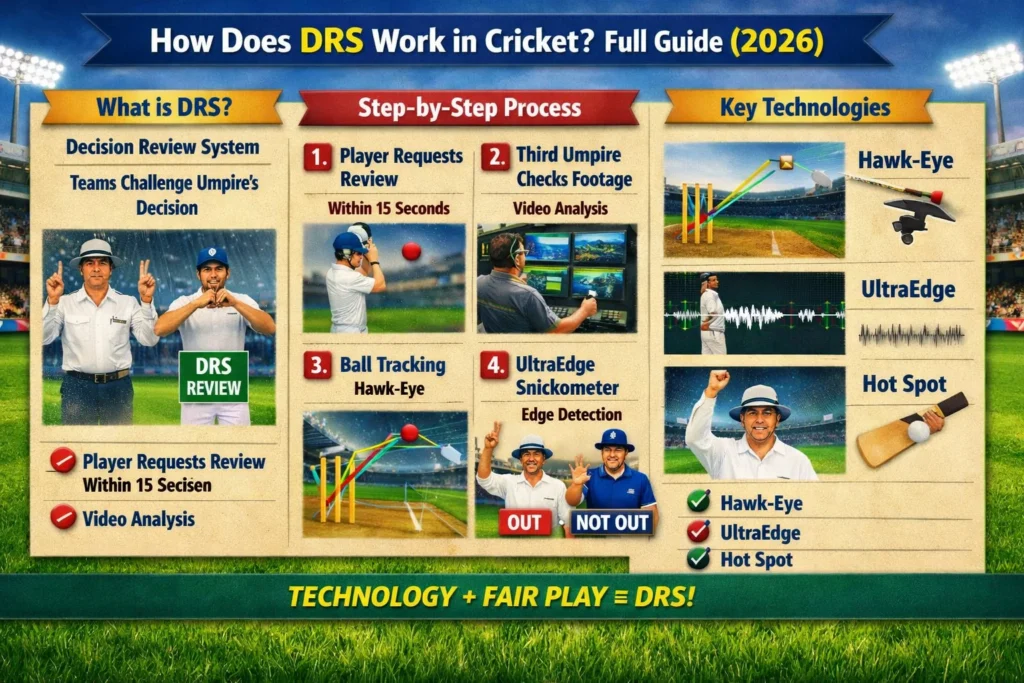

DRS (Decision Review System) lets players challenge an umpire’s decision using technology like ball-tracking, UltraEdge sound sensors, and slow-motion replays. A third umpire reviews the evidence and either confirms or overturns the on-field call, with each team given a limited number of unsuccessful reviews per innings.
Few innovations have changed the way cricket is watched and played as much as DRS. What used to be a purely human judgment call often followed by hours of debate is now backed by data, cameras, and sound-detection technology. This guide explains exactly how DRS works, what tools it uses, and why it still sparks controversy even with all this technology involved.
What Is DRS in Cricket?
DRS stands for Decision Review System. It’s a technology-assisted process that allows players either the fielding captain or the batter to challenge an on-field umpire’s decision on dismissals like LBW, caught behind, and stumpings. A third umpire, working with television replays and specialized tracking technology, reviews the decision and either upholds or overturns the original call.
DRS was introduced to reduce the number of clear umpiring errors in international cricket, while still preserving the umpire’s authority as the primary decision-maker on the field.
The Technology Behind DRS
DRS isn’t a single tool it’s a combination of several different technologies working together:
1. Ball-Tracking Technology (Hawk-Eye)
This system uses multiple cameras positioned around the ground to track the ball’s path in real time. For LBW reviews, it predicts where the ball would have traveled after hitting the batter’s pad, showing whether it would have hit the stumps.
2. UltraEdge (Snickometer)
UltraEdge uses highly sensitive microphones placed in the stumps to detect faint sounds like a thin edge off the bat combined with slow-motion video to determine whether the ball made contact with the bat before being caught or hitting the pad.
3. Hot Spot (used in some competitions)
An infrared imaging system that shows a bright mark wherever the ball makes contact with the bat or pad, due to the friction heat generated. Hot Spot isn’t used in every tournament due to cost, but where available, it’s a strong supporting tool alongside UltraEdge.
4. Replay Angles
Multiple camera angles and slow-motion replays help the third umpire assess close run-outs, stumpings, and catches near the boundary.
How a DRS Review Actually Works: Step by Step
- On-field decision — The on-field umpire makes an initial call (out or not out).
- Review request — The captain (for a fielding decision) or the batter (for their own dismissal) signals for a review by making a “T” shape with their arms, within a set time limit usually 15 seconds.
- Third umpire investigation — The third umpire examines all available technology: ball-tracking, UltraEdge audio, replays, and Hot Spot if available.
- Verification of each condition — For an LBW review specifically, the third umpire checks pitching, impact, and projected path, exactly as outlined in our full guide on the LBW Rule Explained Simply.
- Final decision relayed — The third umpire communicates the finding to the on-field umpire, who then confirms the final decision.
Understanding “Umpire’s Call”
One of the most misunderstood parts of DRS is the “umpire’s call” principle. It applies specifically to LBW reviews where the ball-tracking shows the delivery was only marginally hitting the stumps (for example, clipping the very edge of leg stump). In these marginal cases, the on-field umpire’s original decision stands regardless of whether it was “out” or “not out” because the margin is considered too close to overturn with full certainty.
This means two identical-looking deliveries can have different results depending on what the on-field umpire originally decided, which is a frequent point of confusion and frustration for fans.
DRS Review Limits
Teams don’t get unlimited reviews this keeps the system from being abused to slow down play or challenge every decision. The typical rules are:
- Test cricket: Each team gets a set number of unsuccessful reviews per innings (commonly two), which are replenished after a fixed number of overs in some formats.
- ODI and T20 cricket: Each team typically gets a set number of unsuccessful reviews per innings (commonly one or two, depending on the competition), without replenishment.
- A successful review does not count against a team’s total only unsuccessful reviews use up the limit.
What Can and Cannot Be Reviewed
Can Be Reviewed:
- LBW decisions
- Caught behind / caught decisions
- Stumpings
- Run-outs (in most formats, reviewed automatically by the third umpire without using a team’s review)
- Boundary calls (four vs six, or ball in/out of play)
Cannot Be Reviewed:
- No-ball calls for overstepping in most competitions have historically been checked automatically rather than through player review, though rules have evolved over the years for more detail, see our guide on No Ball and Wide Rules in Cricket.
- Umpire’s discretion calls, like dangerous bowling warnings or player conduct decisions, are not subject to DRS review.
DRS Across Different Formats
The core DRS process is identical across Test, ODI, and T20 cricket the differences lie mainly in the number of reviews allowed and whether they’re replenished during an innings. Shorter formats generally allow fewer reviews per innings, given the smaller number of overs available overall.
To understand how these formats differ more broadly, see our guides on Test Cricket, ODI Cricket, and T20 Cricket.
Why DRS Still Sparks Debate
Even with advanced technology, DRS decisions aren’t universally accepted as “perfect,” for a few key reasons:
- Ball-tracking involves prediction, not direct observation it estimates where the ball would have gone, which inherently involves a small margin of error.
- UltraEdge can misread sound, especially with bat taps, pad contact, or bat-on-ground noise near the moment of impact.
- “Umpire’s call” outcomes can feel inconsistent to fans, since visually similar deliveries can be given differently based on the original on-field decision.
Despite these debates, DRS has significantly reduced clear, obvious umpiring errors compared to the pre-technology era of international cricket.
Interesting Facts About DRS
- DRS was first trialled in international cricket in 2008, during a Test series between India and Sri Lanka, though India was initially skeptical and did not fully adopt it in bilateral series for several more years.
- The ICC made DRS mandatory in all international matches where the host broadcaster could support the required technology, though usage still varies slightly by tournament and host board.
- UltraEdge microphones are sensitive enough to detect bat-on-pad contact, not just bat-on-ball, which is why commentators sometimes describe a “spike” that isn’t actually an edge.
- The “umpire’s call” concept was specifically introduced to respect the on-field umpire’s authority, rather than making DRS a fully independent decision-making system.
- Some leagues have experimented with unlimited reviews in trial formats, but as of 2026, limited reviews per innings remain the standard across major international and franchise cricket.
- Hot Spot was temporarily phased out of some tournaments in the past due to high operating costs, showing that DRS technology availability can vary depending on broadcast budgets, not just governing body rules.
Frequently Asked Questions
1. What does DRS stand for in cricket? DRS stands for Decision Review System, a technology-assisted process for reviewing umpiring decisions using ball-tracking, UltraEdge, and replay footage.
2. How many DRS reviews does a team get? This varies by format and competition, but teams commonly get one or two unsuccessful reviews per innings, with Test cricket sometimes replenishing reviews after a set number of overs.
3. What is “umpire’s call” in DRS? It’s a rule where, if ball-tracking shows an LBW delivery was only marginally hitting the stumps, the on-field umpire’s original decision is upheld rather than overturned.
4. Can bowlers request a DRS review? No, only the fielding captain (on behalf of the team) or the batter being given out can request a review individual bowlers cannot call for one directly.
5. Does a successful review count against a team’s limit? No, only unsuccessful reviews count against a team’s total number of allowed reviews per innings.
Conclusion
DRS has transformed cricket from a game reliant purely on split-second human judgment to one supported by ball-tracking, sound sensors, and multiple camera angles while still preserving the umpire’s central role through the “umpire’s call” principle. It isn’t perfect, and marginal decisions will likely always spark debate, but it has meaningfully reduced clear umpiring errors at the highest level of the sport.
For more on how umpires and technology work together across all types of decisions, read our guide on Umpires and Decision Making Explained.