
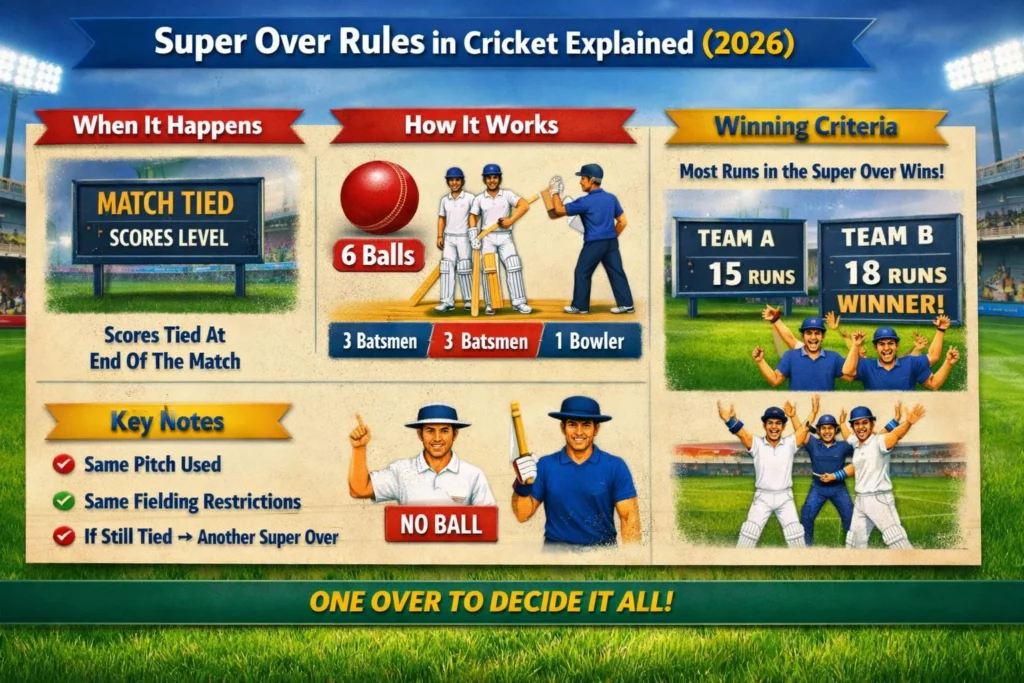

A Super Over is a one-over tiebreaker used in limited-overs cricket when a match ends in a tie. Each team bats one over with three wickets available, and whichever team scores more runs wins the match outright.
Few moments in cricket create more tension than a Super Over. It’s a sudden-death format designed to give fans and players a decisive result when a match ends level. This guide breaks down exactly how Super Overs work, the rules that govern them, and why they’ve sparked genuine controversy at the highest level of the game.
What Is a Super Over in Cricket?
A Super Over is a one-over eliminator played after a limited-overs match (ODI or T20) ends in a tie. Instead of sharing the result or replaying the entire match, both teams get one over each to bat, and the side that scores more runs in that single over is declared the winner.
It was introduced specifically to give tournaments and knockout matches a clear result without needing to restart an entire fixture, which would be impractical given broadcast schedules, player fatigue, and tournament timelines.
Basic Rules of a Super Over
- One over per team — Each team bowls and bats exactly six legal deliveries.
- Three wickets allowed — Unlike a normal innings, a team is only allowed to select three batters for their Super Over. If two wickets fall, the team is all out and their innings ends immediately, even before the over is complete.
- One bowler per over — A single bowler delivers the entire over; no bowling changes are allowed mid-over (except in case of injury).
- Team batting second in the match bats first in the Super Over. This ensures the side that batted first in the original match knows the target before their Super Over innings.
- The team that scored more runs in the Super Over wins. If scores are still tied after the Super Over, in some competitions the match continues with additional Super Overs until a winner emerges.
Who Bats and Bowls First in a Super Over?
This is one of the most misunderstood parts of the rule. The team that batted second in the main match always bats first in the Super Over. This gives the team that batted first in the original match a target to chase, mirroring the structure of the original match itself.
For a broader understanding of how batting order and match structure work, see our guide on Batting Rules in Cricket.
What Happens If the Super Over Is Also Tied?
Rules here vary slightly by competition and format:
- In many T20 leagues and bilateral series, additional Super Overs are played back-to-back until a winner is decided.
- In ICC World Cup knockout matches, a tied Super Over historically led to the boundary count rule being used as a tiebreaker (more on this controversial rule below) though the ICC has since revised this policy after major criticism.
- In some formats, a boundary count or number of sixes hit in the Super Over itself can be used as a secondary tiebreaker if a repeat Super Over isn’t feasible.
The Boundary Count Controversy
The most infamous Super Over moment in cricket history came at the 2019 ICC Cricket World Cup Final between England and New Zealand. The match ended in a tie, the following Super Over also ended in a tie, and England was declared the winner based on hitting more boundaries during the match overall a rule very few fans were aware existed before that day.
The decision sparked massive criticism worldwide, with many arguing that a World Cup final shouldn’t be decided by a technical tiebreaker rather than continued play. In response, the ICC changed the rule so that tied Super Overs in future finals would simply be repeated until a team wins outright, removing the boundary-count method from that specific scenario.
For more on how umpires and officials apply match-deciding rules like this, read our guide on Umpires and Decision Making Explained.
Super Over Rules in Different Formats
T20 Cricket
Super Overs are extremely common in T20 cricket due to the format’s tendency to produce close, high-scoring finishes. Most major T20 leagues use the “repeat until decided” approach for tied Super Overs.
ODI Cricket
Super Overs are used in ODI cricket as well, most notably in World Cup matches, but are far rarer simply because ties are statistically less common over 50 overs than in the shorter T20 format.
Test Cricket
Test cricket does not use Super Overs at all. A tied or drawn Test match is recorded as exactly that a tie or a draw since the format’s structure and purpose are fundamentally different from limited-overs cricket.
To understand these structural differences better, see our guides on T20 Cricket, ODI Cricket, and Test Cricket.
Fielding Restrictions During a Super Over
Super Overs generally follow the same fielding restrction rules as the powerplay overs of the format being played meaning a maximum of two fielders are typically allowed outside the inner circle, encouraging attacking cricket in this high-pressure over. For the full breakdown of these limits, see our guide on Fielding Restrictions in Cricket.
Super Over vs Regular Over: Key Differences
| Feature | Regular Over | Super Over |
|---|---|---|
| Wickets allowed | 10 (full team) | 3 only |
| Purpose | Part of full innings | Tiebreaker after a tied match |
| Bowler changes | Allowed between overs | Not allowed mid-Super Over |
| Result impact | Contributes to total score | Decides match winner outright |
| Used in Test cricket? | Yes (regular overs) | No |
Interesting Facts About the Super Over
- The Super Over was first introduced in T20 cricket in 2008, before being adopted into ODI cricket rules a few years later.
- The 2019 World Cup Final remains the only completed men’s ODI World Cup final decided by a boundary-count rule after a tied Super Over a decision the ICC later moved away from for future finals.
- A team can theoretically win a Super Over without losing a single wicket, since only three batters are needed and the innings ends once two are dismissed.
- Some franchise T20 leagues have experimented with rules allowing a designated “Super Over specialist” bowler to be pre-selected by teams, though this isn’t standard across all competitions.
- Multiple back-to-back Super Overs have occurred in professional T20 cricket, with some matches requiring two or more Super Overs before a winner was finally decided.
- Despite being just six balls long, a Super Over often draws similar TV audience spikes to an entire match finish, due to the sudden-death tension involved.
Frequently Asked Questions
1. How many wickets are allowed in a Super Over? Only three wickets are allowed. If two batters are dismissed, the team’s Super Over innings ends immediately.
2. Who bats first in a Super Over? The team that batted second in the original match always bats first in the Super Over.
3. What happens if a Super Over also ends in a tie? In most competitions, additional Super Overs are played until a winner emerges, though some past finals used a boundary-count rule as a tiebreaker.
4. Does Test cricket have Super Overs? No. Test matches that end level are recorded as a tie or a draw, and no Super Over is played.
5. Can the same bowler bowl the entire Super Over? Yes, one bowler delivers all six balls of a Super Over, except in the rare case of injury requiring a substitution.
Conclusion
The Super Over turns a tied match into one of cricket’s most nerve wracking spectacles just three wickets and six balls to decide a winner outright. While the format has occasionally sparked controversy, like the boundary-count decision at the 2019 World Cup Final, it remains the standard, exciting way limited-overs cricket resolves a deadlock.
For more on how these high-pressure rules fit into the wider game, explore our Complete Cricket Rules Guide 2026 or our guide on T20 Cricket.