
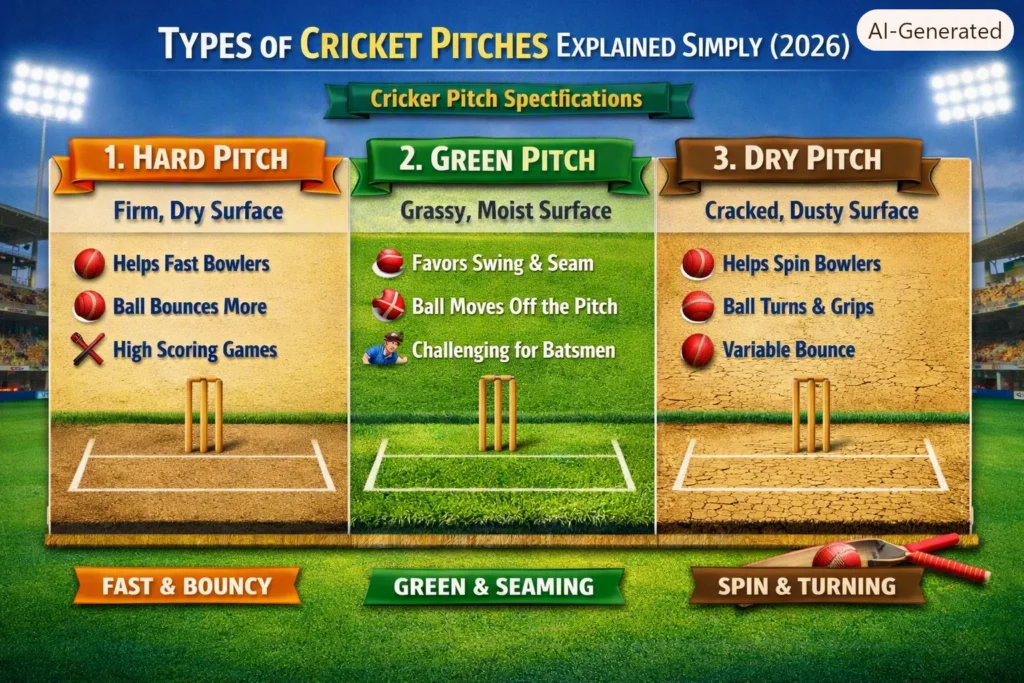

Cricket pitches are broadly classified as green (grassy), dry, dusty, or flat/batting-friendly, based on the amount of grass, moisture, and cracking on the surface. Each type favors a different style of bowling seam, spin, or pure pace and dramatically shapes how a match unfolds.
While every cricket pitch shares the exact same official dimensions, no two pitches actually play the same. Ground staff prepare surfaces differently depending on climate, soil composition, and strategic intent, creating conditions that can favor fast bowlers, spinners, or batters entirely differently. This guide breaks down the major pitch types in cricket and explains exactly how each one changes the way the game is played.
Why Do Pitches Play Differently If the Dimensions Are the Same?
As explained in our guide on Cricket Pitch Dimensions Explained, every pitch is fixed at 22 yards long and 10 feet wide. What changes between pitches isn’t size it’s the surface preparation: how much grass is left on top, how much moisture is in the soil, how compact or cracked the surface becomes, and how it’s expected to behave over five days (in Test cricket) or a single innings (in limited-overs cricket).
Green Pitch (Grassy Pitch)
A green pitch retains a significant covering of grass on the surface, usually left there deliberately by the ground staff. This grass adds extra moisture retention and creates more seam movement, since the ball can grip and deviate off the blades of grass after pitching.
How Green Pitches Affect the Game:
- Favor fast bowlers, especially those skilled at seam and swing bowling.
- Tend to offer more assistance early in a match, particularly under overcast conditions.
- Batting is generally considered more difficult in the first innings, with conditions often easing as the grass wears down over the course of a match.
Dry Pitch
A dry pitch has minimal grass covering and reduced moisture, causing the surface to wear down and break up more quickly, especially as a match progresses. Cracks can develop on the surface, particularly in hot climates, leading to unpredictable bounce later in the game.
How Dry Pitches Affect the Game:
- Favor spin bowlers, especially as the match progresses and the surface deteriorates further.
- Often start relatively good for batting before turning increasingly difficult by the third or fourth day of a Test match.
- Common in subcontinental conditions, particularly in parts of Asia known for producing significant spin-friendly pitches.
Dusty Pitch
A dusty pitch is an extreme version of a dry pitch, where the surface has broken down so significantly that visible dust rises from the pitch when the ball bounces or a bowler follows through. These pitches are heavily associated with extreme, often unpredictable spin.
How Dusty Pitches Affect the Game:
- Can produce exaggerated, sometimes unplayable turn for spinners.
- Considered among the most difficult conditions for batters anywhere in world cricket.
- Occasionally controversial, since extremely dusty conditions can make results feel overly influenced by the pitch rather than pure skill, a topic often debated by former players and pitch curators alike.
Flat Pitch (Batting-Friendly Pitch)
A flat pitch offers minimal help to either fast bowlers or spinners, providing a consistent, predictable bounce throughout the match. These surfaces are specifically prepared to encourage high-scoring cricket, particularly common in white-ball formats.
How Flat Pitches Affect the Game:
- Favor batters, often resulting in very high team totals.
- Bowlers typically rely on variations, clever field placements, and pure skill rather than significant natural pitch assistance.
- Common in T20 leagues, where high-scoring, entertainment-driven cricket is often prioritized by tournament organizers.
Quick Reference: Pitch Type Comparison
| Pitch Type | Grass/Moisture | Favors | Common Setting |
|---|---|---|---|
| Green | High grass cover | Fast bowlers (seam/swing) | Overcast, temperate climates |
| Dry | Low moisture, cracks develop | Spin bowlers (later stages) | Subcontinental conditions |
| Dusty | Extremely worn, breaks up | Extreme spin | Late-match, hot/dry climates |
| Flat | Minimal grass, even surface | Batters | White-ball, high-scoring formats |
How Pitch Type Affects Match Strategy
Team selection is often directly influenced by expected pitch conditions. A team touring a country known for producing dry, spin-friendly pitches will typically select more specialist spinners, while a green, seam-friendly surface might lead to a team fielding an extra fast bowler instead. Captains also often decide whether to bat or bowl first after winning the toss based heavily on the expected pitch behavior for more on this decision, see our guide on Toss Rule in Cricket Explained.
Do Pitch Types Differ Between Formats?
Pitch preparation strategy often does vary by format, even on the same ground:
- Test cricket — Pitches are often prepared to deteriorate gradually over five days, offering something to both bowlers and batters at different stages.
- ODI and T20 cricket — Pitches are frequently prepared flatter and drier from the outset, since matches are completed in a single day and organizers often prioritize high-scoring, entertaining cricket.
For more on how format differences shape overall match strategy, see our guides on Test Cricket, ODI Cricket and T20 Cricket.
Interesting Facts About Cricket Pitches
- Some of the most famous dusty, spin-friendly pitches in cricket history have been prepared specifically to neutralize touring fast-bowling attacks, a tactic that has sparked debate for decades among players and commentators.
- Green, seam-friendly pitches are often most dangerous for batters early in the morning session, since overnight moisture combined with overcast skies can significantly increase movement off the surface.
- Pitch curators (the ground staff responsible for preparing the surface) are considered highly specialized professionals, often with years of experience reading soil composition, weather forecasts, and grass-cutting timing.
- A pitch that looks identical on day one of a Test match can behave completely differently by day five, as cracks widen and the surface wears down from continuous play.
- Some grounds are specifically nicknamed by players and fans based on their pitch tendencies nicknames tied to being especially spin-friendly, seam-friendly, or batter-friendly, passed down through years of touring experience.
- Rain and covering conditions before a match can significantly affect how “green” a pitch plays, since retained moisture beneath the surface can increase seam movement even if the visible grass looks similar to a drier pitch.
Frequently Asked Questions
1. What is a green pitch in cricket? A green pitch retains significant grass cover, offering extra assistance to fast bowlers through seam and swing movement, especially early in a match.
2. Why do dry pitches favor spin bowlers? Dry pitches lose moisture and develop cracks over time, causing the ball to grip and turn more sharply for spinners as the surface wears down.
3. What makes a pitch “dusty”? A dusty pitch is an extreme form of a dry pitch, where the surface has broken down so much that visible dust rises off the ground during play, often producing exaggerated spin.
4. Are flat pitches bad for bowlers? Flat pitches don’t offer much natural assistance to either seam or spin bowlers, meaning bowlers must rely more heavily on skill, variation, and field placement rather than pitch conditions.
5. Do pitch types change between Test and T20 cricket? The underlying pitch preparation strategy often differs Test pitches are frequently designed to change over five days, while limited-overs pitches are often kept flatter and more consistent throughout a single match.
Conclusion
While every cricket pitch shares the same fixed dimensions, the way it’s prepared green, dry, dusty or flat completely changes the balance between bat and ball. Understanding these pitch types helps explain why the same two teams can produce a low-scoring bowling battle on one tour and a high-scoring batting spectacle on another, all within the same sport and the same 22-yard strip of turf.
For more on the fixed measurements behind every pitch, explore our guide on Cricket Pitch Dimensions Explained or our Complete Cricket Rules Guide 2026.