
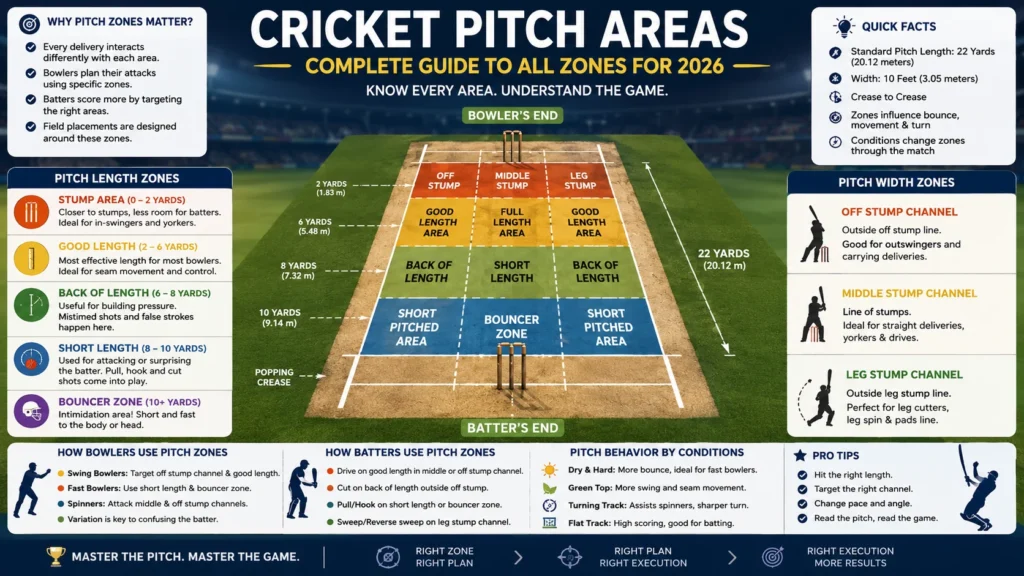

A cricket pitch is a rectangular strip measuring 22 yards (20.12m) in length and 10 feet (3.05m) in width. It includes several distinct areas defined by crease markings: the bowling crease at each end, the popping crease, and the return creases. The protected area a rectangle extending 5 feet in front of each popping crease is a critical zone where bowlers must avoid running during their follow-through. Understanding these cricket pitch areas is essential for players, umpires, and anyone who wants to truly understand the game.
Cricket is a game of precision, strategy, and fine margins and nowhere is this more evident than on the pitch itself. The cricket pitch is not just a strip of grass; it is a carefully defined playing surface divided into specific areas, each with its own purpose, rules, and strategic significance. Whether you are a budding cricketer, a curious fan, or someone looking to understand the game at a deeper level, knowing the cricket pitch areas is fundamental to appreciating how the sport works.
Every delivery bowled, every run taken, and every wicket falls within the boundaries of these carefully marked zones. From the popping crease that determines LBW decisions to the protected area that bowlers must respect, these cricket pitch areas shape the flow of the game. This guide breaks down every zone on the pitch, explaining their dimensions, rules, and importance in clear, simple terms.
What Is a Cricket Pitch?
The cricket pitch is the central rectangular strip of the cricket field where the main action takes place. It is the battleground between bowler and batsman the surface where deliveries are bowled, shots are played, and wickets are taken.
Unlike the vast oval outfield that surrounds it, the pitch is a carefully prepared strip of ground, typically rolled and maintained to specific standards. It is where the game’s most critical moments unfold, and its condition can dramatically influence match outcomes.
Official Dimensions of the Cricket Pitch
According to the Marylebone Cricket Club (MCC) Laws of Cricket and ICC regulations, the pitch has precise measurements:
| Measurement | Imperial | Metric |
| Length | 22 yards | 20.12 metres |
| Width | 10 feet | 3.05 metres |
The pitch is bounded at either end by the bowling creases and on either side by imaginary lines running parallel to the line joining the centres of the two middle stumps, each 5 feet (1.52 metres) from it.
For junior cricket, these dimensions are adjusted:
| Age Group | Pitch Length |
| Under 15 | 22 yards (20.12m) |
| Under 13 | 21 yards (19.20m) |
| Under 11 | 20 yards (18.29m) |
| Under 9 | 18 yards (16.46m) |
The Crease Areas Explained
The creases are the most visible markings on a cricket pitch. They define the key areas where batsmen stand, bowlers deliver, and umpires make crucial decisions. There are three types of creases at each end of the pitch.
The Bowling Crease
The bowling crease is the line at each end of the pitch, running parallel to the stumps. It is the line behind which the bowler must deliver the ball. If the bowler’s front foot lands beyond this line, it results in a no-ball.
- Position: At each end of the pitch, with the stumps positioned on it
- Width: Extends 5 feet (1.52 metres) on either side of the middle stump
The Popping (Batting) Crease
The popping crease also called the batting crease is the line in front of the stumps that batsmen must ground their bat or body behind to avoid being run out or stumped. It also determines the protected area boundaries.
- Position: 4 feet (1.22 metres) in front of the bowling crease
- Length: Extends across the full width of the pitch
The Return Creases
Return creases are the lines on either side of the pitch that run perpendicular to the bowling crease. They ensure the bowler delivers the ball from within a defined area and help umpires judge no-balls.
- Position: On both sides of the pitch, running back from the bowling crease
- Purpose: Define the bowling “lane” for the bowler’s run-up
The Protected Area (Danger Zone)
One of the most important and often misunderstood cricket pitch areas is the protected area. This zone exists to prevent the pitch from being unfairly damaged by bowlers running through it during their follow-through.
The protected area is defined as a rectangle bounded at each end by imaginary lines parallel to the popping creases, 5 feet (1.52 metres) in front of each popping crease. On the sides, it is bounded by imaginary lines, one on each side of the line joining the centres of the two middle stumps, each 1 foot (30.48 centimetres) from it.
Why does this area matter?
- Bowlers are prohibited from running on the protected area without reasonable cause during their follow-through
- First offence: The bowler receives a caution from the umpire
- Repeated offence: Penalty runs are awarded to the batting side
- The rule maintains a fair contest between bat and ball by preserving pitch integrity
The Pitch Strip and Wicket Area
Beyond the crease markings, the pitch itself can be divided into informal zones that players and commentators frequently refer to:
| Zone | Description |
| Good Length Area | The region where the ball pitches to make the batsman uncertain whether to play forward or back typically 6-8 metres from the batsman’s stumps |
| Full Length Area | Closer to the batsman, encouraging drive shots |
| Short Length Area | Further back, forcing the batsman to play on the back foot |
| The “Corridor of Uncertainty” | The area just outside the off stump where batsmen are most vulnerable |
These zones aren’t officially marked but are crucial tactical concepts that every bowler and batsman understands.
How Pitch Areas Affect Gameplay
Each cricket pitch area serves a specific purpose that influences how the game is played:
| Area | Impact on Game |
| Popping Crease | Determines LBW decisions (ball pitching outside leg stump) and run-out judgments |
| Bowling Crease | Governs no-ball calls; affects bowler’s length and line |
| Protected Area | Restricts bowler follow-through; maintains pitch quality for both teams |
| Return Creases | Defines the bowler’s legal delivery zone |
| Pitch Surface | Affects ball bounce, spin, and pace different areas of the pitch deteriorate at different rates during a match |
Cricket Pitch Areas: Key Rules
| Rule | Detail |
| Pitch changes | The pitch cannot be changed during a match unless umpires deem it dangerous, and only with both captains’ consent |
| Non-turf pitches | Artificial surfaces must be minimum 58ft (17.68m) in length and 6ft (1.83m) in width |
| Fielder damage | Fielders causing avoidable damage to the pitch receive a warning; repeated offences result in 5 penalty runs |
| Pitch preparation | The Ground Authority is responsible for pitch selection and preparation before the match |
Cricket Pitch Areas Comparison Table
| Area | Location | Measurement | Primary Purpose |
| Full Pitch | Central strip | 22yd × 10ft | Main playing surface |
| Bowling Crease | Each end, on stumps line | 5ft either side of middle stump | Bowling delivery line |
| Popping Crease | 4ft in front of bowling crease | Full pitch width | Batsman’s ground; LBW decisions |
| Protected Area | Rectangle from popping creases | 5ft in front × 1ft each side of middle | Bowler follow-through restriction |
| Return Creases | Sides of pitch | Perpendicular to bowling crease | Bowler’s run-up boundaries |
FREQUENTLY ASKED QUESTIONS
1. What is the exact length of a cricket pitch?
The official cricket pitch length is 22 yards, which is equivalent to 20.12 metres. This measurement is taken between the two sets of stumps at either end. This standard applies to all professional and senior cricket matches worldwide.
2. What are the different creases on a cricket pitch?
There are three types of creases at each end: the bowling crease (where the stumps are placed), the popping crease (4 feet in front of the stumps), and the return creases (on either side, perpendicular to the bowling crease). Each serves a distinct purpose in the laws of cricket.
3. What is the protected area on a cricket pitch?
The protected area is a rectangle extending 5 feet in front of each popping crease and 1 foot on each side of the line joining the middle stumps. Bowlers must avoid running through this area during their follow-through to prevent pitch damage.
4. How wide is a cricket pitch?
A cricket pitch is 10 feet (3.05 metres) wide. This width is measured between the imaginary lines running parallel to the line joining the centres of the two middle stumps, each 5 feet from it.
5. What happens if a bowler runs on the protected area?
If a bowler runs on the protected area without reasonable cause, they receive a caution from the umpire for the first offence. If the same bowler repeats the offence in the same innings, the umpire awards 5 penalty runs to the batting side.
6. What is the difference between the pitch and the wicket?
The pitch is the entire rectangular strip of 22 yards by 10 feet. The wicket refers specifically to the three stumps and two bails at each end. However, in common usage, “the wicket” can also refer to the pitch surface itself.
7. Can the pitch be changed during a match?
The pitch cannot be changed during a match unless the umpires decide it is dangerous or unreasonable for play to continue. Even then, the change requires the consent of both team captains.
8. What are the dimensions for non-turf (artificial) pitches?
Non-turf pitches must have a minimum length of 58 feet (17.68 metres) and a minimum width of 6 feet (1.83 metres). These specifications ensure artificial surfaces provide a fair contest.
9. Why is the popping crease important for LBW decisions?
The popping crease determines whether a batsman is “playing forward” or “playing back.” For an LBW decision, if the ball pitches outside the line of the leg stump, the batsman cannot be given out and this judgment is made relative to the popping crease position.
10. How do pitch areas differ in junior cricket?
Junior cricket uses shorter pitches to suit younger players. Under 13s play on 21-yard pitches, Under 11s on 20 yards, and Under 9s on 18 yards. The crease markings and rules remain the same, just scaled to the shorter pitch length.
CONCLUSION
The cricket pitch is far more than a simple strip of grass it is a precisely defined playing surface where the game’s most critical battles are fought. From the 22-yard length that has remained unchanged for centuries to the carefully marked creases that govern every delivery, each cricket pitch area serves a distinct purpose in the laws and strategy of the game.
Understanding these areas transforms how you watch and play cricket. When you know where the popping crease sits, you appreciate why that LBW decision went one way or the other. When you understand the protected area, you recognise why bowlers adjust their follow-through. When you grasp the dimensions and markings, you see the game with new clarity every ball bowled, every run taken, and every wicket claimed unfolds within these defined spaces.
Whether you are a player looking to sharpen your understanding, a fan seeking deeper appreciation, or a coach teaching the next generation, knowing the cricket pitch areas is foundational to the sport. The next time you watch a match, take a moment to observe the pitch not just the action on it, but the stage itself. That 22-yard strip is where cricket’s magic happens, and every inch of it has a story to tell.